Blurb
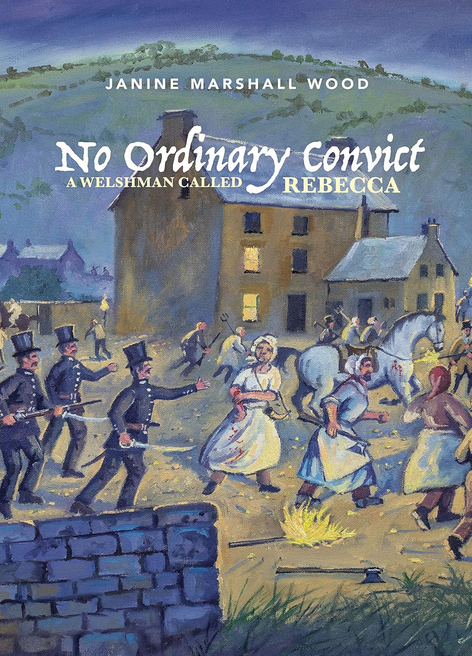
There he was – John Hughes – a handsome young man with face blackened, clad in a white nightdress and bonnet adorned with feathers. Leading hundreds of other young farmers similarly disguised, he was on a mission. After midnight under moonlight, amid a cacophony of drums, horns, gunfire and general caterwauling, they announced their presence, with John leading the way on his while horse.
The Rebecca Riots took place between 1839 and 1844 to protest primarily about excessive tolls imposed to travel across the Welsh countryside. It was a just cause in a harsh, poverty-stricken era; a serious movement imbued with a sense of the ridiculous.
John Hughes was a Rebecca. He was caught red-handed leading an attack to demolish a toll gate and tollhouse. Headline news across the Western world reported his trail, which resulted in transportation to the ends of the earth.
The life story of John Hughes is traced from Wales to England to Van Diemen’s Land, and eventually to his freedom and new life in North West Tasmania.

Review
Of the approximately 162,000 convicts transported to Australia, not all were rogues and thieves—about 3,600 were sent for political offences. These include, among others, Irishmen involved in the risings of 1798 and 1803 and the Young Irelander rebellion, as well the Yorkshire Rebels, Swing Rioters and Chartists from England, and men involved in the Rebecca riots in Wales. No Ordinary Convict: a Welshman called Rebecca by Janine Marshall Wood is the story of one Rebecca rioter, her great-great-grandfather, John Hughes(1819-1905).
No Ordinary Convict begins with a delightful anecdote about the author’s elderly Aunt Mavis and Great-Aunt Rita (both born the same day in 1909) and their trip to Llanelli, South Wales in search of the family home of Rita’s grandfather, John Hughes. Through the magic of serendipity, they not only visited Tŷ-isha farm where John Hughes’s story began but discovered, to their surprise, that he was remembered as one of the Rebecca rioters and had been transported to Van Diemen’s Land.
The Rebecca Riots were a series of protests between 1839 and 1844 in rural Wales against unjust and exorbitant tolls on roads. Those involved called themselves Rebecca’s daughters. Dressed in women’s clothing and with blackened faces, they demolished tollgates with great fanfare at night. John Hughes was a Rebecca, the leader of such a band of farmers.
The book follows John’s life beginning with his family’s situation as farmers in Wales, through his involvement in the Rebecca movement, his trial and transportation, his experiences as a convict and life after receiving his freedom. This book is far more than one man’s story though. At every point, background information is provided giving the reader a good understanding of the social and economic conditions which led to the riots, the experience of transportation, the convict system and the challenges faced by emancipists, even those who did their best to stay on the right side of the law.
No Ordinary Convict is written with empathy in engaging prose that gives the reader a sense of John Hughes himself, not just what he endured. This is helped by the inclusion of letters written by John and other family members as well as petitions and other contemporary documents. The book is beautifully presented with a wealth of beautiful colour photographs and detailed maps. I would absolutely recommend it to anyone interested in the reality of convict life as well as those interested in the history of Tasmania and the Rebecca riots.
No Ordinary Convict: a Welshman called Rebecca is not just excellent history but a great read too.
 Catherine Meyrick
Pingback: My Reading – July to September 2024 | Catherine Meyrick
Pingback: Two Years of Reading – 2024 & 2025 | Catherine Meyrick