With the passing of The Education Act 1872, the colony of Victoria established a system of education that was free, secular and compulsory.1 Children aged between six and fifteen years who lived within two miles by road of a school were required to attend school for at least four hours a day, sixty days in each half year.
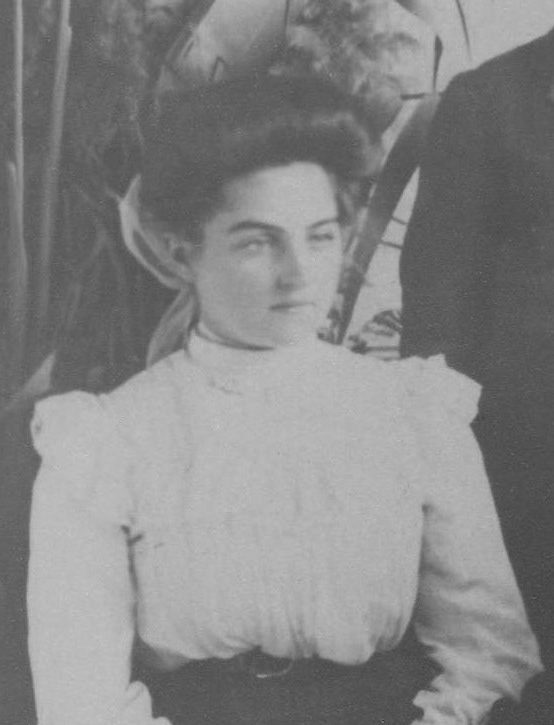
Aged 16
My grandmother, Catherine O’Connor, known as Kate, was born on 11 January 1889 on the O’Connor family farm at Valencia Creek, the third child of William O’Connor and Sarah Ann Watson. By the mid-1880s Sarah and William had moved from Sale to their farm on Valencia Creek. The block of land where their house was located was about ten miles from Briagolong and seven miles from Wa-De-Lock2 where the closest schools were located. Acquiring a basic education and the benefits of mixing with other children were clearly valued by William and Sarah as Kate’s two older sisters Mary (b.1882) and Elizabeth (b.1884) attended school at Wa-De-Lock.

2- Wa-De-Lock school (rough location) – 7 miles.
3- Briagolong school (rough location) – 10 miles.
The Moroka Road runs from above O’Connors’ farm down to the Valencia Creek-Briagolong Road and was the children’s most likely route to school. The course marked on my map is approximate.
The Gippsland Mercury reported that, on 2 May 1890, a concert and the first annual distribution of prizes was held at the Wa-de-lock State School. The schoolchildren performed musical numbers to an appreciative audience of parents. Mary O’Connor, then aged eight, received a special prize for ’unvarying neatness and attention to studies’. Elizabeth, aged six and known as ’Sis’ or ’Sissie’ (the name used in this newspaper report), was one of the prize winners in the First Class.3
Kate’s younger brothers and sisters described their experiences at school in an irregular series of letters published on ‘The Young Folks’ page of the Weekly Times newspaper between 1906 and 1914. However, the family story is that my grandmother never went to school but was taught at home by her mother. She could most certainly read, write and add up. Kate’s writing was easy to read but the only punctuation she used was full stops but sentences often did not begin with capital letters. Her letters were chatty — she wrote the way she spoke. She avidly read the newspaper every morning starting, by the 1960s, with the Death Notices. Her mother Sarah had not had an extensive education but would have attended school on some of the stations her father worked on in the Western District of Victoria in the 1860s. We do not know why Kate never went to school and it is now over fifty years too late to ask.
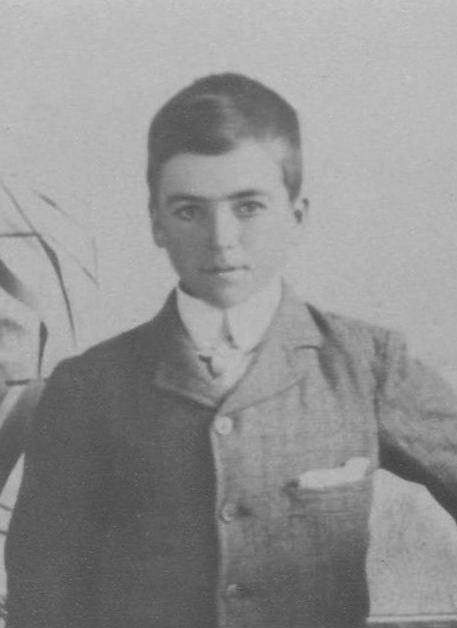
Aged 14
The first letter published in the Weekly Times was from Kate’s brother John (b.1891), who was fourteen at the time.
I have been going to school two years, and I am in the fourth class. I have two sisters going to school as well. I have a nice little pony and saddle, and ride to school. I have five sisters and one brother. Valencia Creek is only a small place. The nearest township is Briagolong, and it is ten miles from here.
Weekly Times Sat 23 Jun 1906 p.27
The two sisters would be Margaret (b.1894), known as Maggie, and Johanna (b.1898) known as Hannah.
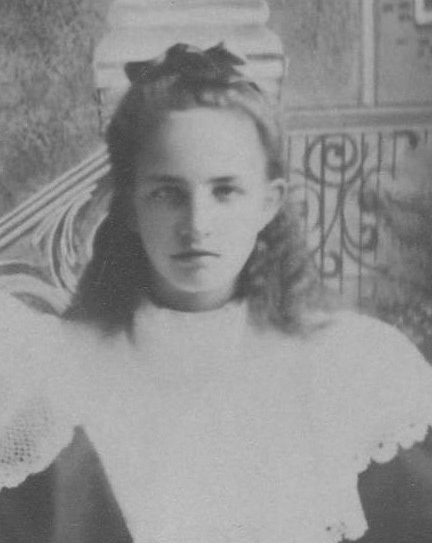
Aged 11
Maggie wrote to the Weekly Times a month later.
I have been going to school one year and five months, and I am in the third class … We have a nice flower garden at our school, and also a nice library.
Weekly Times Sat 21 Jul 1906 p.26
Maggie had started school aged ten. Her sister Hannah possibly only started school at the beginning of 1906 when she was seven and a half. I imagine William and Sarah waited until they were certain the children were confident riders and sensible enough before they let them ride the ten miles, partly through bushland, to school at Briagolong. They may already have been taught the basics at home by Sarah. The two eldest girls must have been driven to school by Sarah or by a neighbour. I can’t imagine two little girls aged six and eight riding seven miles by themselves but that might just be a failure of my modern imagination.
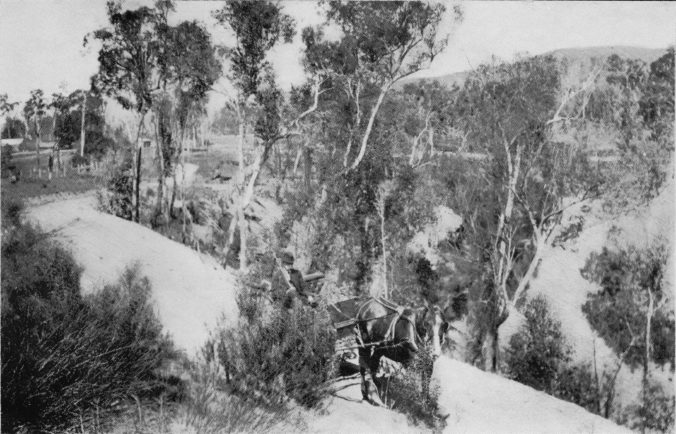
The O’Connor children would have ridden along this road when setting out for school.
Photographer: H B Hammond
Courtesy National Library of Australia
Sixteen months later, when she next wrote, Maggie had left school.
My eldest brother rides to school, and he is in the fifth class. He has been going to school three years and four months. I was going to the Briagolong school two months ago, but as I did not like over there I came home. I was going to school two years and five months, and I was in the fourth class at school when I left, and my sister was in the second class.
Weekly Times Sat 23 Nov 1907 p.37

Photographer: H B Hammond
Courtesy State Library of Victoria
Maggie’s time away from school was only temporary. In 1908 she was going to Wa-De-Lock school seven miles away. John would have left school at the end of 1907 as he was now sixteen and needed to help his father on the farm. John later took over the farm when William died in 1922.
Maggie next wrote about school two years later and, as well as her school day, she described an end of year concert, a Boxing Day picnic and New Year’s Day sports.
We had a concert on December 18 — four days before school broke up. In the morning I came to school as usual. I got there at about 9 o’clock. We went into school for a while, and then we were let out to have our lunch. At two o’clock we started our concert. We had a few “records” first; and then we had some recitations and songs. When the concert was over we were all provided with lunch, and then we were let go home after spending an enjoyable day. On Christmas Day I enjoyed myself very well. On Boxing Day I went to the picnic, and met some friends, and had a very good time. The day was nice and warm, and a lot of people gathered at the picnic to spend it. Along the picnic ground there are a nice lot of logs to sit on, and nice shady trees hanging over the logs, and you can watch the sports going on. About 12 o’clock lunch was provided. It was a very enjoyable day, it broke up about 5 o’clock, and then we had to drive a distance of 10 miles.
We got home at 7 o’clock, and I was glad to have a good sleep. On New Years Day I also spent an enjoyable day. On New Year’s Eve it looked very much like rain. When I got up I found that it was going to be a nice day. We started from home at half-past 10, and got to Briagolong at 12 o’clock. We went down to the ground and brought the horse in and took him out of the buggy and fed him. We then went up to the sports. I went over to the swing, and found some of my friends there. We had a swing for a while, and then the bell rang for the racing, and we went to where the races started. After the races we went for a walk around the ground and came back and had lunch. We then brought the horse over and put him in the buggy, and started for home. We reached home at 7 o’clock. I was glad to get home because I was tired after spending a grand day. On the following Thursday I rode down for the mail, but it was a bit hot for riding.
The school is seven miles from our place, and I have to ride every day to school, because it is too far to walk. We have a nice flower garden at our school also a nice lot of pot plants. Inside the school we have a lot of pictures, and they are framed very prettily. We also have a fine collection of insects. There, are some nice books in the library. We have 93 books all together. Sometimes it is terribly hot in the school. In the winter we have a big fire going, and it makes the school warm.
At school we sometimes play rounders, and the boys play cricket and football. The inspector came to our school about two week ago, and I passed into the sixth class. The Avon river is a quarter of a mile from our school. There is a big bridge over it, called the Avon bridge, and there are a lot of blackberries about. When we are coming home from school we can pick them. Under the bridge there are a lot of fish, and you can often see snakes amongst the stones. The wattles look pretty in the spring when they are out in bloom. There are a lot of everlastings in the school ground, and we all make wreaths with them. They look very pretty.
Weekly Times Sat 23 Jan 1909 p.37

Not mentioned in the children’s letters is a picnic and sports day held annually in February or March each year, the first held in 1893.
The ladies of Wadelock, Boisdale and Valencia Creek provided a picnic on a very large scale for the children of the district, which we learn is to be an annual one, invitations for which were freely given to the seniors likewise, as well as to numbers of the people of Maffra, all of whom availed themselves of the very pleasurable outing, the day, Monday last, being beautifully fine. The promoters could not have chosen a lovelier spot, which was conveniently shaded from the hot sun by clusters of trees and close to the river Avon, Mr Foster, of the Boisdale Estate, kindly giving the use of his grounds for the occasion, which was no little matter, as a spark from the camp fire might be the means of doing an incalculable amount of harm to the dry grass and fencing, but great care was taken by those who attended to the boilers, and every precaution was taken by Mr Foster himself and Mr E. Keogh, who before leaving the grounds had every spark extinguished. About noon a large number of people collected on the ground, we may safely say two hundred, all of whom seemed to thoroughly enjoy themselves. Sports of every description were got up such as racing, jumping, swinging, &c., &c., and very nice prizes, as well as money prizes, were given to the successful competitors, and not alone those but very child on the ground was made the recipient of a prize, so that each little one present was made happy. The refreshments were on a large scale, sweetmeats of every description as well as sandwiches, tea, fruit, etc, were spread most tastefully on tables erected on trestles, forms being placed on both sides, which made it very convenient and comfortable for both juniors and seniors. Three relays during the day were provided for the guests, which kept the attendants pretty busy; indeed all who visited the grounds were loud in the praises of the attendance and refreshments, and it must have cost those ladies who got up the affair, much time, trouble and expense.
The Maffra Spectator Thu 2 Mar 1893 p.3
By 1901 the sports were held at a ‘pretty spot on the banks of the Avon’ owned by Mr G Missen, the Maffra Brass Band also providing musical entertainment. The O’Connor children attended these occasions and the girls appear to have had some athletic ability. At this picnic Kate won the Girls Under 12 race, and Elizabeth the Girls Under 16 (just sneaking into the category). Kate also won the Ladies Race in 1910 when she was twenty-one. In 1911 Maggie won the Ladies Race and, at an event run in September 1916 ‘in aid of the fund to assist the destitute Poles’, she came second in the same race, Hannah coming first.
In May 1909, when Maggie wrote to the Weekly Times, she indicated that her school days were coming to an end.
We are having lovely weather at present, and all around looks so nice and green since the last rain. Winter is coming on with its cold and frost. How cold it is when the grass is covered with white frost, and everywhere is still with frost. I will be leaving school soon, as I am now in the sixth class. I have been going to school about four years. There are not many children going to our School now. We have our flower garden at school done up very nicely, and there are a number of different plants growing nicely. Our flower garden is looking lovely now. Our violets and chrysanthemums are coming out. We have a great many different colored chrysanthemums, such us white, red, brown, cream, dark red and other kinds.
Weekly Times Sat 8 May 1909 p.37

Aged 7
Hannah O’Connor, now twelve years old, had begun writing regularly to the Weekly Times.
[In] winter … the days are very cold sometimes, and are not very nice for children that have to walk a long distance to school. There is generally a good fire in the school rooms. Children wear warm coats, so as to keep them nice and warm, and they also play games at school, so as to keep them warm. Exercises are done by the children in the mornings with their arms. “This is the way we exercise in the cold and frosty mornings,” and several others.
Weekly Times Sat 31 Dec 1910 p.40
Maggie continued to write to the Weekly Times. In this letter, written when she was seventeen, it seems she had fond memories of school at Wa-De-Lock.
To begin with, school days, I think, are a part of the best days. Children meet and may be friends all their lives or perhaps when left school for years, they may meet again, and then can talk of the fun that has long gone past for ever. A person may be away 40 years or more from his or her school mates, and come back, and still like to meet old friends, and have a chat once more with them over old times. For instance, a person may have been about seven or eight years old when he or she planted a tree at school on Arbor Day. In years to come that person may come back, and how different that tree would look, and how that person would enjoy seeing that tree that was just about a foot high when he or she left, and how altered the district would be where the school was once standing alone on a little rise, and not another house for a distance of twenty chains. Now it is quite surrounded with cottages, and the school rooms made larger. How different everything would look, I can just imagine it myself, and how nice it would be to see how these sights have changed from the old sights about 40 years ago, perhaps more, or perhaps less, according to how long that person has been absent. I think school days are great days.
School generally goes in at a quarter-past nine, and then there is a little play between that and 12 o’clock for the little ones. At 12 o’clock the children come out for dinner and have an hour’s play. At one o’clock they go into school, again, and between that and half-past three there is a little play again. At half-past three the children are let out of school. In winter it is very awkward for children that attend school from a distance of two or three miles, on account of wet weather and of the flood water rising. Flood water only prevents the children that are on the opposite side of the river. There is a low level bridge between Valencia Creek and Wadelock, and when there is rain for a couple of days the water goes over the bridge, and when the water is first starting to rise the chains are removed off till the flood has gone down. This bridge has often prevented children from attending school. School children have a month’s holiday at Christmas-time, and there are a lot of children who look forward to holidays coming, while other children may not. At Easter-time there is a week’s holiday, also in September. The inspector generally comes around twice a year—once to see how the children are improving in their work, and the next time to examine the children. Next day, after the inspector has been to the school, according to how they pass in their work. Some children are very clever in their school work, while some others may be just the opposite. In every township there is a school. A flower garden is very nice at a school, and at any spare time the children have they can look after it and keep the weeds from preventing the plants from growing. School gardens have a lot of small beds in them, and they are all in different shapes. Harvesting is nearly all finished about here, but the crops were not extra good.
Weekly Times Sat 20 Jan 1912 p.38
That same year Hannah also wrote of Arbour Day.
We held Arbor Day last Friday at our school. It is a day of planting trees. We had a nice lot of trees to plant. We had lessons in the morning, and we sowed the plants in the afternoon. A schoolmate of mine and myself planted a tree. The other children planted other trees. I hope in years to come these trees may become of some use. There are some trees growing very well that were planted three or four years back, and they are spreading their leaves and providing a little shade. The pines are lovely shades, and these are the principal trees growing in the school yard. What a lovely cool shade these trees will give in about four or five year. The children that are going to school then, will find the use of them in the hot summer days.
Weekly Times Sat 31 Aug 1912 p.37
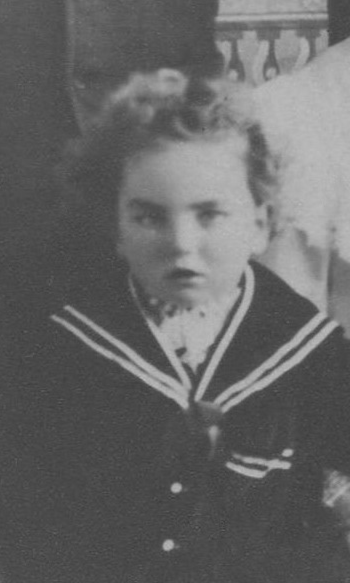
Aged 2ish
In early 1914, Hannah wrote about her pony which her ten-year-old brother Bill was now riding to school. Hannah was fifteen by this stage and possibly no longer at school.
I have a little pony, and my brother rides him to school every day. The pony eats some of the children’s lunch, if they leave it outside. When two get on him he will try and buck them off. If you are trotting along on him he will shy, and sometimes you will get a fall off him, and he will run away and you have to catch him again; but sometimes he will go to kick you if you don’t look out for him. He has never been in a buggy yet.
Weekly Times Sat 28 Feb 1914 p.7

Seated in buggy – Kate, Maggie & Sarah O’Connor
This pony (unfortunately I don’t know his name) is a character in his own right and will have the story of his antics told at a later date. In April of 1908, Sarah O’Connor had written to the Wa-De-Lock School Committee complaining that the teacher had forced her daughter to tie the pony up during school hours, which she considered to be cruel.4 If, in 1908, he was behaving as Hannah now describes, the teacher had good cause to want him restrained.
Other posts on the O’Connor family’s life at Valencia Creek can be found here.
_____________________________________________________________
I have kept the original spelling in the letters which in some instances use the American ‘or’ instead of the usual ‘our’.
Unfortunately, I have been unable to locate contemporary photographs of either the Briagolong or the the Wa-De-Lock school.
- Victoria was the first Australian colony to establish an education system that was free, secular and compulsory. Tasmania was the first colony to enact compulsory education in 1868; however, it was the last state to establish free education in 1908. ↩︎
- The spelling of Wa-De-Lock varies: Wa De Lock, Wa-De-Lock and Wadelock. In the sources I have looked at Wa-De-Lock seems to be the most common so I will use this. ↩︎
- Gippsland Mercury Sat 10 May 1890 p.3, c8 ↩︎
- ‘Wa-De-Lock State School (no.1622) & the Macdonald family’ by John Gerber. Maffra & District Historical Society Bulletin Dec 1991 V.19 ↩︎
 Catherine Meyrick