Australia’s first major engagement1 of the Great War was on the Gallipoli Peninsula alongside troops from New Zealand, Britain, France and India. They had spent up to four and a half months training in Egypt before they embarked for Gallipoli. The aim was to assist the British Navy in forcing the Dardanelles Strait and then go on to capture Constantinople.

The Australians began their landing in the early hours of Sunday 25 April 1915 at what was later called Anzac Cove under fire from the Turkish troops embedded on the heights above the beach. The allied troops did manage to gain a foothold, but despite fierce battles with heavy casualties such as Lone Pine and the Nek, the situation was a stalemate with the allied forces unable to advance, the Turkish forces unable to drive them off. On 19 to 20 December the Gallipoli Peninsula was evacuated with minimal casualties due a well-planned deception operation. The whole Gallipoli campaign cost, cost 26,111 Australian casualties, including 8,141 deaths and 70 prisoners of war taken.
On 25 April 1916, the landing and the Gallipoli campaign were commemorated for the first time, not just in Australia and New Zealand but at other places around the world.
In London, cheering crowds lined the route along which Australian and New Zealand soldiers marched to Westminster Abbey, so densely packed that at times the soldiers were unable to march in formation. The memorial service held at Westminster Abbey was attended by a range of military figures and dignitaries including the Australian Prime Minister, William ‘Billy’ Hughes, and King George V and Queen Mary. The King wore a Field-Marshal’s uniform in khaki and the Queen the black of mourning.
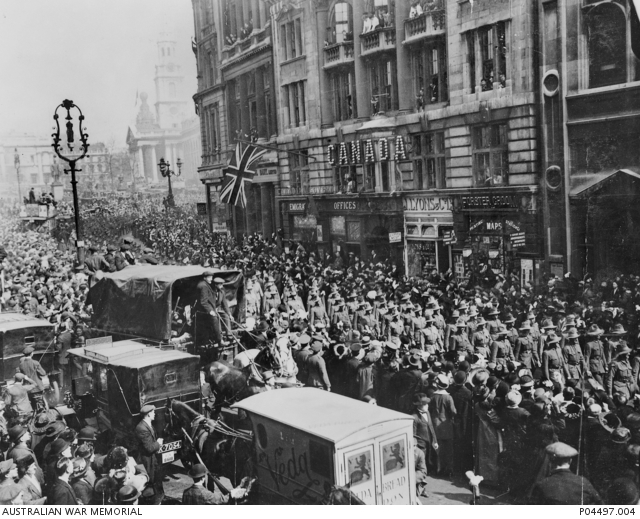
The ‘fine physique of the colonials’ was remarked upon. This was cause of some discontent among the soldiers, as was the order of the procession. It was led by the Light Horse yet the men of the 1st, 2nd and 3rd Brigades, who were the ‘heroes’ of the original landing, were at the rear of the procession. The Light Horse, although a respected force who had suffered as much as any through the campaign, had not arrived until May. As well, shorter men who had been at Gallipoli were not chosen to take part in the procession and remained in camp while some who had not set foot at Galljpoli marched.
In Egypt, an Anzac service, attended by thousands, was held a Cairo with the Bishop of Jerusalem presiding. Following the service a procession marched to the old Cairo cemetery where a thousand wreaths were placed on the graves of soldiers who had died of wounds in the military hospitals there. At the camps in Egypt a sports days was held as well.

In Australia, Anzac Day was commemorated at state schools five days ahead of the first anniversary of the landing of the troops because the students would be on their Easter holidays when the date arrived. All State Schools followed the same program with lessons held as usual in the morning followed after lunch by patriotic songs and recitations and readings from the Anzac edition of the School Paper. Children read their own essays too. They then assembled in the schoolyard and sang Kipling’s Lest We Forget. Short addresses were given by local dignitaries. The Honour Roll of fallen ex-students was read, O God our Help in Ages Past sung, and more addresses given, this time by returned Anzacs – returned because they had been wounded at Gallipoli. The flag was saluted and the Oath of Allegiance recited (this same oath was recited at the first school assembly each week up until the early 1970s). The National Anthem was sung with the following verse added—
God bless our splendid men.
Send them safe home again,
God save our men.
Keep them victorious
Patient and chivalrous,
They are so dear to us;
God save our men.
In Melbourne a week of commemoration took place beginning with a march of returned soldiers from Alexandra Avenue to the Melbourne Cricket Ground on the evening of 24 April. This was followed by a fireworks display as well as band and cinematograph entertainment at the Ground.
On Anzac Day itself, church parades were held in the recruit training camps, and church services and processions were held across the country. In Melbourne, 1,000 soldiers marched from Alexandra Avenue, across Prince’s Bridge to the Town Hall, the route packed with well-wishers. Those who had been discharged were permitted to wear their uniforms, and those whose injuries precluded them from marching or who were forced to fall out travelled in cars, accompanied by nurses. Divine Service was held at St. Paul’s Anglican Cathedral. Concerts by the Army Service Corps were given around the city from the back of a waggon drawn by eight horses. Men and women shook tins; stalls and kiosks were set up around the city selling with fruit, flowers, sweets, and souvenirs; all were raising money for the Purple Cross Fund, the YMCA’s field work and the Discharged Wounded Soldiers’ Fund. There was another march in the afternoon from the South Africa memorial opposite Victoria Barracks in St Kilda Road to the Domain where wattle trees were planted to commemorate the landing. There were also public meetings and dinners for the returned servicemen in many municipalities across the state.

On Friday, 28 April, an Anzac Button Day was held selling small badges and buttons, again to raise funds for the Discharged Wounded Soldiers’ Fund. There was another march of soldiers through the city.
Sunday, 30 April, was in many ways a more solemn day in Melbourne. Memorial services were held in the city at both St Paul’s Anglican Cathedral and at St Patrick’s Catholic Cathedral. The men returned from active service, many of whom were now discharged because of their injuries, fell in together—some in uniform, some not—and marched from the Treasury Building in Spring Street to their respective Cathedrals. The Catholic troops marched the short distance up Gisbourne Street to St Patrick’s and the other denominations down Collins and along Swanston Street to St Paul’s.

Courtesy State Library of Victoria
At St Patrick’s, the nave was reserved for the soldiers, the rest of the church was available to any of the public who wished to come. St Paul’s held a Military Memorial Service for Fallen Soldiers which was intended primarily for the soldiers themselves. This service was presided over by Archbishop Clarke. The service ended with trumpeters sounding the Last Post and the organ playing the ‘Dead March’ from Saul.
At St Patrick’s a Requiem for Fallen Soldiers was held, presided over by the Archbishop, Dr Carr, and two military chaplains. As the service drew to an end the choir chanted,
Eternal rest grant unto them, O Lord:
And let perpetual light shine upon them.
May they rest in peace.
Amen.
Four buglers sounded the Last Post and the choir sang Faith of Our Fathers. The Catholic soldiers then marched out of St Patrick’s and down to St. Paul’s to meet with the other men. Together they went on to the Domain where military and political dignitaries, including the Governor General, addressed them.
Initially Anzac Day was not a public holiday, this was instituted in 1927. While a dawn Requiem Mass was held at Albany in 1918, and a dawn wreath laying commemoration in Toowoomba in 1919, the first organized dawn service was held at the Sydney Cenotaph in 1928 when wreaths were laid and two minutes silence observed.

Possibly the first monument to fallen soldiers of the Great War, a memorial drinking fountain, was unveiled in Balmain, New South Wales, on 23 April 1916. As the war progressed and in the years that followed more memorials were established – honour boards and memorial windows in churches, halls and public buildings as well as state and local monuments.
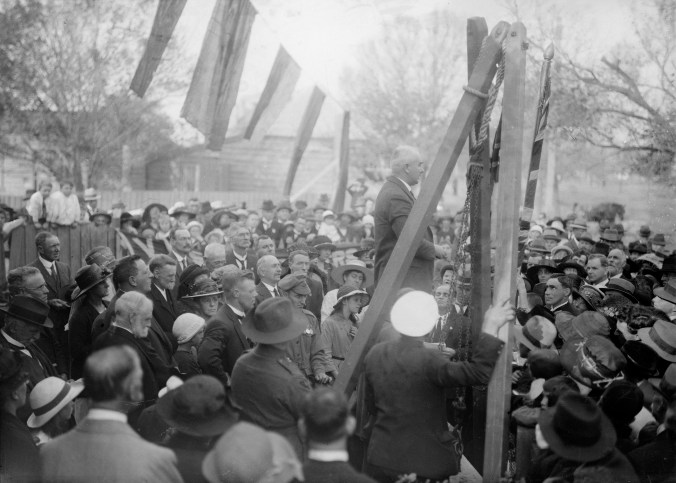
In the Melbourne suburb of Williamstown the commemoration of those local men who had died during World War 1 took the form of a Memorial Hall. On Anzac Day 1923, during a commemorative service, the foundation stone was laid by the Mayor, Cr. J. J. Liston. The building had originally been owned by the local Red Cross Society but was handed to the local ‘diggers’ in perpetuity.
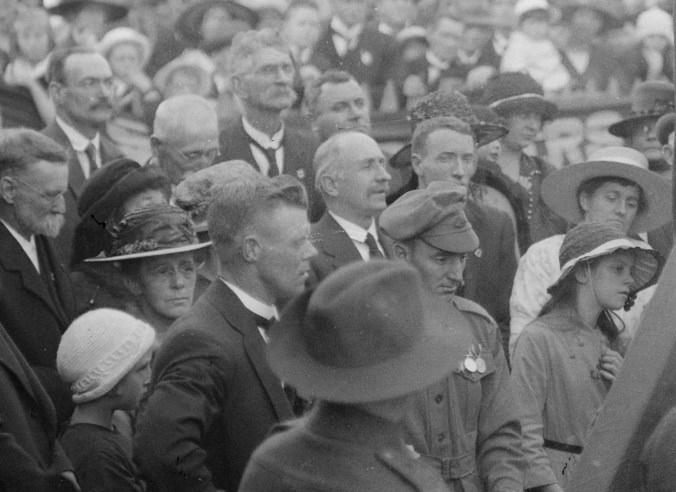
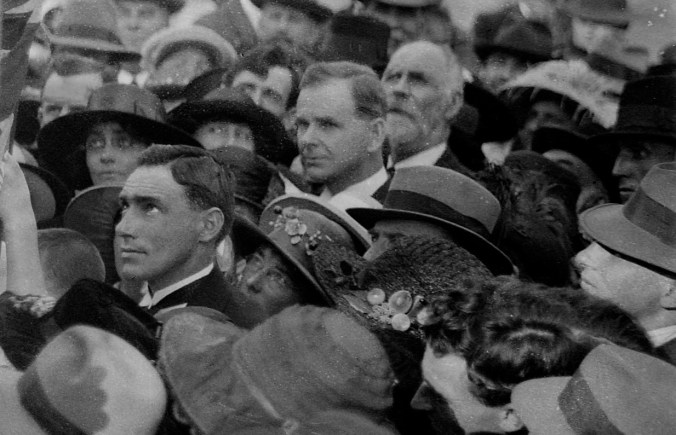
We can with imagination and empathy try to imagine the grief and loss but, even with the best will, I doubt the vast majority of us can truly come near to a complete understanding as we have no experience of the magnitude of loss that occurs in total war. This photograph taken at the service at Williamstown offers us a heart-shuddering glimpse of the grief of those left to mourn the fallen Anzacs.
Courtesy State Library of Victoria
Look into their faces and imagine.
Lest we forget.
________________________________________________________
References
Anzac Day traditions
The Age Thu 20 Apr 1916 p.8 ANZAC DAY.
The Age Thu 27 Apr 1916 p.7 ANZAC DAY.
Australian Town and Country Journal Wed 26 Apr 1916 p.15 Balmain Memorial.
The Herald Wed 26 Apr 1916 p.5 A NOBLE REQUIEM.
Williamstown Chronicle Sat 28 Apr 1923 p.2 ANZAC DAY.
- Australia’s first actions of the war were in 1914: the seizing German radio stations operating in German New Guinea and the islands of the Bismarck Archipelago, the loss of the HMA Submarine AE1 off Neulauenburg north-east of New Guinea, and the Battle of Cocos. ↩︎
 Catherine Meyrick