On 22 December 1914, just three days before Christmas, eight transports carrying soldiers from Victoria, South Australia and Tasmania sailed from Melbourne to join up with the rest of the second convoy of the Australian Imperial Force at Albany. For these men Christmas 1914 would be spent in the Great Australian Bight. The convoy, including troops from other Australian states and from New Zealand departed Albany on 31 December 1914 for Egypt where they would undertake further training.1

Waiting to board – 22 Dec 1914
Photographer: Josiah Barnes Courtesy: Australian War Memorial
Although the departure from Melbourne was meant to be a secret, around four thousand people went to Railway Pier (now Station Pier) at South Melbourne to wish their men ‘God speed and a safe return’.
Eleven special trains brought the infantry from Broadmeadows to Port Melbourne on the day of embarkation, every carriage being packed with men who sang and cheered alternately and indiscriminately. Their best and loudest vocal efforts seemed to be reserved for the passage between the Flinders street platforms, and people on their way to business learned for the last time that ‘Australia will be There’ had superseded ‘Tipperary’ as a brigade chorus.
The men embarked at once and transport after transport moved towards the Heads within a few hours of each other, until only the flagship was left at 5 o’clock; and then all the sightseers who had come down to say adieu at some other steamer’s side concentrated attention on the largest and last of the fleet. Hurried last messages were exchanged between ship and shore in a chaos of a voices.
The Argus Wed 3 Feb 1915 p.9
Australia will be There was one of the best known Australian patriotic songs of World War 1. Its original title was For Auld Lang Syne – Australia Will Be There; it contained a short refrain from the song Auld Lang Syne. It became the marching song of the Australian Imperial Force. As early as 17 December 1914, it had already been adopted as an official march by the 13th Battalion whose band had played it as the men of the battalion had marched past the saluting base at Parliament House as part of the farewell parade on that day.2
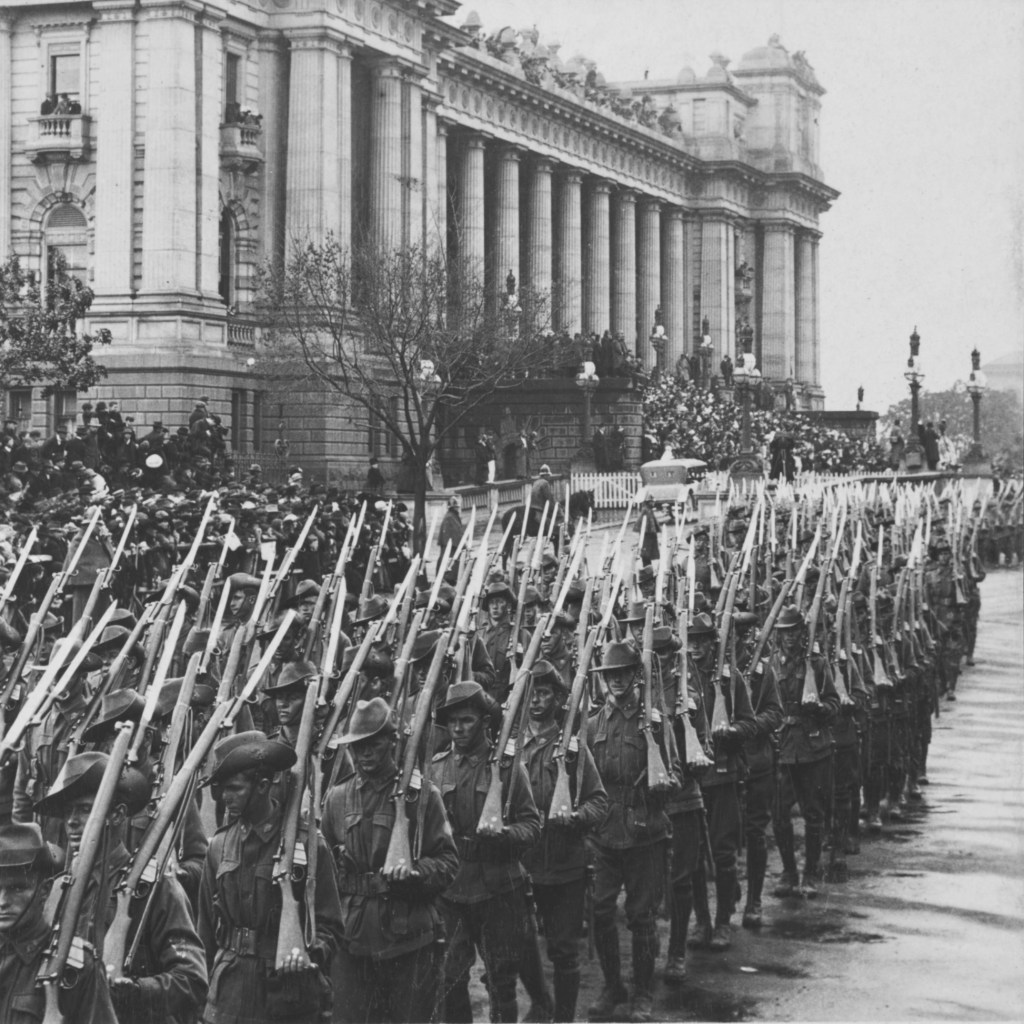
Marching past Parliament House. The saluting base was on its steps.
Photographer: George Rose Courtesy: State Library Victoria
The song was written and composed by William Walter ‘Skipper’ Francis (c.1886-c.1957). He was born in Wales and migrated to Australia around 1913 due to ill health. The Hobart Mercury reported that Francis had, in 1912, swum ‘the Bristol Channel from Penarth to Newport, a distance of 15 miles, in the record time of 4 hours 32 minutes.’ (Sat 7 Sep 1929, p.11) He was also was a champion wrestler, boxer, cyclist, swimmer and runner. He later migrated to New Zealand.
Francis was a baritone who played the steel guitar and publicly performed and recorded the song. The first mention I could find of the song in Australian newspapers was in the Perth Daily News of 24 October 1914 (p.9) which mentioned that ‘the full score and words of this song may be obtained from Messrs. Albert and Son, Ltd.’ of 180 Murray-street, Perth. After the disabling and capture of the German light cruiser SMS Emden by the HMAS Sydney in the Battle of Cocos on 9 November 1914, Francis added an extra verse recalling this event. The version below, which became the usual form, only has the first verse and theEmden verse.
There are lots and lots of arguments
Going on today,
As to whether dear old England
Should be brought into the fray;
But all right-thinking people
Know well we had to fight,
For the Kaiser’s funny business
It wants some putting right.
Rally ’round the banner of your country,
Take the field with brothers o’er the foam,
On land or sea,
Wherever you be,
Keep your eye on Germany;
But England, home and beauty
Have no cause to fear:
Should auld acquaintance be forgot?
No! No! No! No! No!
Australia will be there,
Australia will be there.
You have heard about the Emden ship
Cruising all around,
She was sinking British merchant men
Where’er they could be found;
But one fine morning early
The Sydney hove in sight,
She trained her guns upon them
And the Germans said “Goodnight.”
Rally ’round the banner of your country,
Take the field with brothers o’er the foam,
On land or sea,
Wherever you be,
Keep your eye on Germany;
But England, home and beauty
Have no cause to fear:
Should auld acquaintance be forgot?
No! No! No! No! No!
Australia will be there,
Australia will be there.
There was another later version recorded by English baritone Stanley Kirkby. He made a number of recordings of songs about topical events. It may have been written later in 1916 as it mentions ‘In France too in the trenches / They faced the foeman’s gun.’ This rendition uses the usual chorus but both verses are completely different.
The National Library of Australia has a copy of the sheet music for Australia will be There, printed in 1914. It contains the first verse and the following two verses which mention British military commanders and Australia politicians.
With Kitchener in our Army,
And French in our cavalry fine,
You bet those German bandsmen
Are in for a lively time.
Then there’s Winston Churchill
To guide out navy grand;
With these fine lot they’ll make it hot
For the poor old Fatherland.
We don’t forget South Africa,
When England was at war,
Australia’s Light Horse, my boys,
Were always to the fore.
And to-day we’re all united—
Wade and Joey Cook,
Andy Fisher and Billy Holman,
Have all now kissed the Book.
Francis is reported as saying said that once he added the verse about the capture of the Emden, the song surged in popularity. The Hobart Daily Post published the song with all four verses on of 15 February 1915; it was also published in full in several other newspapers later in 1915. I can understand why the two middle verses have faded into obscurity. At this distance, it is jarring to hear the mention of Winston Churchill, the main architect of the Gallipoli disaster where over 44,000 brave Allied soldiers were killed and over 97,000 wounded.
But when the troopships left Melbourne on 22 December 1914, all that was in the future, unimagined and unimaginable.

22 Dec 1914 at Port Melbourne
Photographer: Josiah Barnes Courtesy: Australian War Memorial
This is an excerpt of my novel, And the Women Watch and Wait, imagining that day. Kate Burke, the main character, has gone with her friend Reenie Casey, and Reenie’s mother, to Railway Pier at South Melbourne to wave the troops off.

The bell on the door jangled furiously as Reenie burst into the shop.
They’re on their way to Port Melbourne,’ she gasped. ‘Come on, Kate.’
‘Quick Kate, go and get your hat,’ Aunty said.
Kate ran into the house, pinned on her hat, shoved her gloves into her handbag and raced with Reenie to the Coburg railway station where Mrs Casey was waiting.
They were swept into the train by the crowd of people, all with the same thing in mind—to get to Port Melbourne.
Kate caught snatches of the conversation around them.
‘…special trains from Broadmeadows…’ ‘… supposed to be secret …’ ‘… they were cheering and singing …’ ‘… Waltzing Matilda and Tipperary …’ ‘… and Australia will be There …’
Some boys further along the carriage started singing Australia Will Be There and the rest of the carriage joined in.
Outside Flinders Street station Mrs Casey managed to hail a cab, but it was slow travelling; everyone else on the road seemed to be heading in the same direction. Kate’s heart pounded, fearful the troopships would leave before they got there.
Thousands were standing in the sun outside the gates to the pier which were guarded by police and sentries. The mass of women, mainly, pressed close, waiting as the soldiers slowly filed up the gangways into the towering steamships. Kate stood on tiptoes, near to tears, trying to see over the heads and hats of those in front of her. She needed to see Jack—just a glimpse of him. She told herself that if she saw him, everything would be right, he would come back to her.
Finally, the men were on board and the gates opened. Reenie caught Kate’s hand as the crowd surged forward. She led the way, pushing through the press of people until they were standing alongside the Ulysses.
Slowly, through the afternoon, to the cheering of both those on the pier and the men on the ships, the transports moved one by one toward the heads of the bay until, by three o’clock, only the Ulysses remained. Kate stared up at the men crowding the decks, some sitting precariously on the rails. She had not once caught sight of Jack.
Reenie squealed, jumping and waving to Pat who was leaning over the rail two levels up. Beside her, Mrs Casey stood rigid, her eyes wet, fighting to keep control. She blew Pat a kiss. He clearly saw his mother as he blew one back to her.
The sun beat down from a clear sky. The air was humid. Perspiration trickled from Kate’s damp hatband down her neck. She had the beginning of a headache. She was sick with the waiting, the thought that she would not see him.
Reenie pushed a thermos cup of cold sweet tea into her hands.
The headache faded as she sipped the tea. She continued her search for Jack.
She glimpsed Bert and waved to him but she doubted he saw her.
Those on the pier called to the men on board and they answered back, but in the uproar who could understand what was said or who was saying it?
She heard her name called—Kate, Kate—as clear as if the world was silent.
She looked up.
There he was. She could make out every feature despite the distance, even the beautiful blue of his eyes.
He was smiling at her, waving.
I love you.
She heard his voice as if he were beside her and called the words back.
She had seen him. He would come home to her.
Another soldier moved to the front, blocking Kate’s view. She kept calling Jack’s name and waving furiously even though she had lost sight of him. He might still be able to see her. As long as he could see her, they were together in this place.
Streamers of paper ribbon—mainly red, white and blue—fluttered between the ship and the shore. With the slowly setting sun, a lone voice began to sing Auld Lang Syne. One by one those on the pier and the men on the deck joined in until the whole world was singing its goodbye, its promises never to forget.
In a brief moment of silence, the troopship pulled away from the shore.
Ribbons snapped, a band played, and those watching from the pier sang beneath their tears as they followed the movement of the steamer.
The Last Post sounded.
The HMAT Ulysses sailed off, carrying her men to war.
- ‘In the last days of January a contingent of 10,500 Australian troops and 2,000 New Zealanders reached Egypt. They came in 19 transports. So safe were the oceans under the shield of the British Navy that the Australian submarine AE 2, towed by the Berrima for service in the Mediterranean, was their only escort. The Australian troops consisted of the 4th Australian Infantry Brigade, the 2nd Light Horse Brigade, a field bakery, field butchery, veterinary sections, and 1,800 reinforcements for existing units.’
Bean, Charles, The Official History of Australia in the War of 1914-1918. Volume I – The Story of ANZAC from the outbreak of war to the end of the first phase of the Gallipoli Campaign, May 4, 1915 (11th edition, 1941) Chapter VII – ‘The Training in the Desert’ p.136 ↩︎ - The Age Mon 28 Dec 1914 p.5 ↩︎
 Catherine Meyrick
I wrote a book about this based on HMAS Sydney’s carpenter’s diary. Had the pirate Emden won, Australia would likely have dropped out of the war & soon became a republic
Sent from Outlook for iOShttps://aka.ms/o0ukef
LikeLiked by 1 person
The book sounds very interesting, Barb. I don’t know about Australia dropping out of the war though, support was very high for the war in 1914 and 1915. Even if the Emden had managed to sink the first convoy, I think it would have only made Australia angrier and more determined to give the Germans their ‘just deserts’. As for becoming a republic, we haven’t managed that yet. There was a referendum in 2000, and although allegiance to the British Crown had fallen, it was still defeated. There’s a long history of mistrust of politicians here, and for many ordinary people the view is, if the pollies want it, it must be bad for the rest of us. You don’t want to give them any more power than they already have.
It will come in time though.
LikeLike