For a variety of reasons that I can no longer remember, I failed to post my 2024 list of books read over that year. So, I am including those books here, along with my 2025 reading.
My total for 2025 is only twenty-two books read, a third less than previous years because a large part of 2025 was spent re-reading journal articles and non-fiction, and even more time was spent writing, re-writing and editing in preparation for the publication, at the end of October last, of my latest novel which is set in Melbourne during World War 1.
As you will see from the list, around forty percent of my reading is related to World War 1 (I have asterisked those books). There is a mixture of fiction and non-fiction. There are several novels written in the 1920s and 1930s by ex-servicemen, and I found these more compelling than most of the modern novels set during World War 1. Australian writer and academic Laurie Clancy in a 1986 review of Flesh in Armour by Leonard Mann wrote that ‘it may be the case that there are certain experiences that are impossible to write about unless one has personally undergone them. The three great Australian classics of World War One – Flesh in Armour, The Middle Parts of Fortune and When the Blackbirds Sing – all convey an air of total verisimilitude when it comes to describing the conditions of battle. In comparison, even such gifted writers as David Malouf and Roger McDonald convey the impression of faking it when they come to write about war, no matter how much care they take or research they have done.’ I agree with this wholeheartedly. Consequently, only one modern World War 1 novel has made it onto my list of best reads.
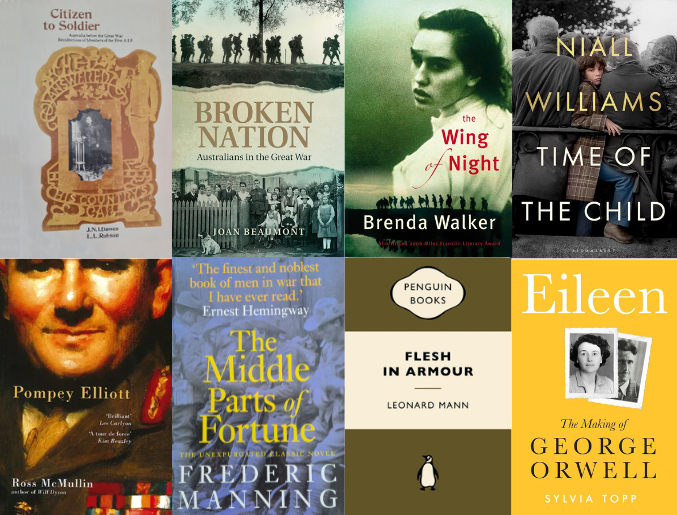
My top reads for 2024 and 2025 are below with their first lines quoted.
*Flesh in Armour by Leonard Mann
Through the chill blur of an afternoon early in August, 1917, the figures of two men in long, tawny greatcoats, lurched wearily out of the London throng and seated themselves on the stone railing in Trafalgar Square with their backs to the classical portico of the National Gallery and the Spire of St Martin’s in the Fields. Their hats distinguished them as Australians.
For me this is the best World War 1 novel I have read. It follows three Australian soldiers, a range of characters and backgrounds, through 1917 and 1918. It covers not only the experiences of Australian soldiers in the trenches but also touches on prostitution, mutiny and suicide, topics not much considered in fiction at that time.
*The Middle Parts of Fortune by Frederic Manning
The darkness was increasing rapidly, as the whole sky had clouded, and threatened thunder. There was still some desultory shelling.
Based on Manning’s experiences, an Australian in the British Army, this book captures the tedium and boredom of army life as well as the comradeship and the fear and horror of war. It also uses the language of ordinary British soldiers at the time; it was said that Australians were even better at the colourful turn of phrase.
*The Wing of Night by Brenda Walker
The horsemen sailed at five o’clock when the day was almost over and although they were travelling to do the hard work of fighting England’s enemies it felt like knock-off time on the last day of the harvest: a golden afternoon, full barns and a safe year ahead, all memory of strain and labour and injury gone from the mind.
Set during World War 1 and its aftermath, mainly in Western Australia, this is the story of two women and the one of their men who returns. The writing is light and poetic yet the story is heartrendingly realistic. I read this book in April and still think of it regularly nine months on.
Time of the Child by Niall Williams
This is what happened in Faha over the Christmas of 1962, in what became known in the parish as the time of the child.
To those who lived there, Faha was perhaps the last place on earth to expect a miracle.
Set in the same village as Williams’s This is Happiness but a few years later, this novel centres on Dr Troy and his daughter Ronnie and an infant found abandoned in the churchyard on evening of the Christmas Fair. A novel full of humanity written in Niall Williams’s beautiful, lyrical prose.
*Broken Nation: Australians in the Great War by Joan Beaumont
Clarence Joe Russell, known to his family as Joe, volunteered to serve in the Australian Infantry Force (AIF) on 4 December 1916. This was not an obvious time to enlist.
A comprehensive history of Australia’s involvement in World War 1, year by year, looking at both the campaigns overseas and developments in Australia.
*Citizen to Soldier: Australia Before the Great War : Recollections of Members of the First A.I.F. by J N I Dawes and L L Robson
Most of the 416,000 men who enlisted in the 1st A.I.F. had their attitudes shaped during the first decade of Australian Federation.
This slim book, published in 1977, presents the recollections of World War 1 soldiers of their lives before the war and the wide range of reasons for enlistment. These were collected as the result of an appeal made through newspapers in 1966. The soldiers’ own words are woven into a very readable narrative.
*Pompey Elliott by Ross McMullin
If one sets out to write biography, best to avoid saints and villains.
The biography of Australia general, Harold Edward ‘Pompey’ Elliott, charismatic, respected, loved by his men yet almost forgotten in the second part of the 20th century. The war is seen through his experiences and writings. Utterly heartbreaking in places.
Eileen: The Making of George Orwell by Sylvia Topp
‘Now that is the kind of girl I would like to marry!’ George Orwell told a friend excitedly, the night he met Eileen O’Shaughnessy.
An excellent biography – meticulously researched, nuanced analysis, and thoroughly good read. This is the first complete biography of Eileen O’Shaughnessy, George Orwell’s first wife.

The rest of my reading is set out below. As well as asterisking the World War 1 books, I have marked the very best of the other books with a dagger. The books below are certainly worth considering, all transport the reader to another time and place and the non-fiction are well-researched and informative. They are listed in no particular order except that the last novel, and the last two non-fiction annoyed me intensely for a range of reasons although plenty of other people think they are brilliant.
Fiction
†*Crucible by J.P. McKinney
“Any erfs, madam?”
“Oui, m’sieur. Assayez-vous.”
†*When Blackbirds Sing by Martin Boyd
All the way home on the ship Dominic thought of Helena. For the first week he had not so much thought of her as felt her, or felt the loss of her.
*Night in Passchendaele by Scott Bennett
‘It can’t go on much longer, not like this.’
‘’You’re right,’ says Myers. ‘It can’t go on much longer. And neither can we.’
*A Woman’s War by Jacqueline Dinan
August 1914. I am startled by of his boots pounding on the hallway boards.
*Benton’s Conviction by Geoff Page
Benton, at the very top now, collected his breath and looked north. The mist had risen, vanished, though it was still palpable in the air.
*The Ghost at the Wedding by Shirley Walker
All through the night Jessie is humming her song.
*Gather the Bones by Alison Stuart
Paul turned his head on the pillow and watched as Evelyn Morrow, clutching her purse to her chest like a shield, followed the nurse past the rows of beds.
*Snapshots from Home by Sasha Wasley
The train journey east was fifty miles of noise, heat and discomfort, but the beauty made up for it.
*The Moods of Ginger Mick by C J Dennis (Poetry)
Jist to intrajuice me cobber, an’ ’is name is Ginger Mick—
A rorty boy, a naughty boy, wiv rude impressions thick
In ’is casu’l conversation, an’ the wicked sort o’ face
That gives the sudden shudders to the lor-abidin’ race.
*Digger Smith by C J Dennis (Poetry)
“Before the war,” she sighs. “Before the war.”
Then blinks ’er eyes, an’ tries to work a smile.
*Rose of Spadgers by C J Dennis (Poetry)
I’ve crawled; I’ve eaten dirt; I’ve lied a treat;
I’ve dodged the cops an’ led a double life;
I’ve readied up wild tales to tell me wife,
W’ich afterwards I’ve ‘ad to take an’ eat
Red raw.
†Clear by Carys Davies
He wished he could swim – the swimming belt felt like a flimsy thing and it had been no comfort to be told not to worry, the men couldn’t swim either.
†The Land in Winter by Andrew Miller
He was lying on a varnished wooden board, the top of a boxed in radiator.
†New Finnish Grammar by Diego Marani
My name is Petri Friari, I live at no.16 Kaiser-Wilhelmstrasse, Hamburg and I work as a neurologist at the city’s university hospital.
†The Glassmakerby Tracy Chevalier
If you skim a flat stone skilfully across water, it will touch down many times, in long and short intervals as it lands.
With that image in mind, now replace water with time.
The Cardboard Crown by Martin Boyd
’When we have passed a certain age, the soul of the child that we were, and the souls of the dead from whom we spring, come and bestow on us in handfuls their treasures and their calamities.’
Conflict on Kangaroo Island by Stephen Crabbe
Her fingers wrapped the inside doorknob the same instant his rapped the wood outside.
The Midsummer Women by Jean M Roberts
Hannah gripped the steering wheel with taut knuckles and peered through the car window as thick tendrils of mist swirled from the ground.
Now Comes The Raven by Jean M Roberts
Distant flashes of lightning and their accompanying rumbles of thunder drew Hannah into the garden.
The Whispering Muse by Laura Purcell
The offer was too good to be true. I knew that from the start.
The Drowned by John Banville
He had lived alone for so long, so far away from the world and its endless swarms of people, that when he saw the strange thing standing at a slight list in the middle of the field below the house, for a second he didn’t know what it was.
Four Letters of Love by Niall Williams
When I was twelve years old God spoke to my father for the first time.
The Touch by Colleen McCullough
‘Your cousin Alexander has written for a wife’, said James Drummond, looking up from a sheet of paper.
Bandy by Craig R Hipkins
It was a crimson dusk. Whispy ribbons of gray had settled in the western sky.
The Cardboard Crown by Martin Boyd
’When we have passed a certain age, the soul of the child that we were, and the souls of the dead from whom we spring, come and bestow on us in handfuls their treasures and their calamities.’
The Unquiet Grave by Dervla McTiernan
Leonie Müller’s feet were cold. She was wearing a pair of wellington boots that were at least two sizes too big for her.
The Season by Helen Garner
I pull up at the kerb. I love this park they train in.
The Road to Grantchester by James Runcie
They are in the Caledonian Club, dancing the quickstep. Sidney is eighteen.
Question 7 by Richard Flanagan
In the winter of 2012, against my better judgement and for reasons that were not entirely to do with writing – much as I said they were – and which even now are not clear to me, I visited the Ohama Camp, Japan, where my father had once been interned.
Long Island by Colm Tóibín
‘That Irishman has been here again,’ Francesca said, sitting down at the kitchen table.
Exiles by Jane Harper
Think back. The signs were there. What were they?
West of Santillane by Brook Allen
No horse could plant his feet like King Georgie. I kicked him hard with my heels again, but he didn’t budge an inch.
The Buried Life by Andrea Goldsmith
His colleagues called him Doctor Death.
Adrian believed no malice was intended; it was a term of familiarity, like any nickname.
The Word is Murder by Anthony Horowitz
Just after eleven o’clock on a bright spring morning, the sort of day when the sunshine is almost white and promises a warmth it doesn’t quite deliver, Diana Cowper crossed the Fulham Road and went into a funeral parlour.
Held by Anne Michaels
We know life is finite. Why should we believe death lasts forever?
Dinner In The Fields by Attracta Fahy (Poetry)
Out of nowhere you appear in fog,
Every seven years vague outlines
Tease the vague horizon…
What Happened to Nina? by Dervla McTiernan
My name is Nina Fraser. There’s a good chance that you know who I am.
Tin Man By Sarah Winman
All Dora Judd ever told anyone about that night three weeks before Christmas was that she had won the painting in a raffle.
The Pavilion in the Clouds by Alexander McCall Smith
This began in 1938, in what was then Ceylon, in a bungalow halfway up a hill.
Yellowface by Rebecca F Kuang
The night I watch Athena Lui die, we’re celebrating her TV deal with Netflix.
Non-Fiction
†*Digger Smith and Australia’s Great War: Ordinary Name – Extraordinary Stories by Peter Stanley
Digger Smith, one of the least known of [C J]Dennis’s works, has inspired this book. As I read Dennis’s Digger Smith I wondered about the real Diggers Smith.
*The Gates of Memory: Australian People’s Experiences of Memories of Loss and the Great War by Tanja Luckins
On 11 November 1993, the 75th anniversary of the end of the Great War, an Unknown Soldier was entombed in the Hall of Memory at the Australian War Memorial in Canberra.
*The Labour of Loss: Mourning, Memory and Wartime Bereavement in Australia by Joy Damousi
‘No event has ever destroyed so much,’ wrote Sigmund Freud a year after the outbreak of the First World War, ‘that has confused so many of the clearest intelligences, or so thoroughly debased what is highest’.
*The Australian People and the Great War by Michael McKernan
Wars have shaped the history of nations
No Ordinary Convict : A Welshman Called Rebecca by Janine Marshall Wood
It was under clear moonlight, about one in the morning when Jac’s white horse was shot from beneath him.
My Life as a Jew by Michael Gawenda
Over the years, some of my friendships have withered and died, natural deaths caused by change and a narrowing of time, but I am thankful for those that have survived my growing old.
Memorial Days by Geraldine Brooks
“Is this the home of Tony Horovitz?”
Yes
“Who am I speaking to?”
This is his wife
That is exact. The rest is a blur.
Wifedom: Mrs Orwell’s Invisible Life by Anna Funder
It has been six months since the wedding. She uncaps the pen.
And now. I am currently reading Boleyn Traitor by Philippa Gregory. I’m not a Gregory fan but she is a skillful storyteller and although, as usual, there are historical inaccuracies, the novel is utterly compelling. Next, I will probably read George Orwell’s Coming Up for Air (1939), ’the first of Orwell’s novels where Eileen had been present through the whole process of creation, and her sense of fun in contemplating human nature is evident all through the book, beginning on the first page…’ (Topp, Sylvia Eileen: the Making of George Orwell p.237) Even the reviewers noted an alteration in his approach in this book.
And after that, who knows what I’ll read – the whole year is a blank page.
Wishing you all a very Happy New Year with plenty of time for reading delightful books.

 Catherine Meyrick
Thanks for the shout-outs Catherine. You had a very eclectic reading year!
Eileen was such a good biography, wasn’t it?
LikeLiked by 1 person
It was. I absolutely loved it. It was thoroughly researched and readable. By the end I felt that I had a good sense of both Eileen and George Orwell as complex interesting people, in different ways both people of their time.
LikeLiked by 1 person
Exactly!
LikeLiked by 1 person