This is a list of the lesser known but real people who are mentioned in my novel And the Women Watch and Wait.
It is a work in progress and I will be adding to it, slowly, over the next few months. So far, I have been unable to identify Private J Hopkins for whom the first tree was planted at Coburg Lake Reserve, Sister Seymour the matron of the Coburg emergency influenza hospital, or the soldier who was followed home by the cake his mother sent to him in France.
If there is someone in the novel that is not on this list, and you want to know more about them, please let me know and I will do my best to find out more about them. And, if you think I have something wrong, please let me know via the contact page of this website.

Lieut. Catron
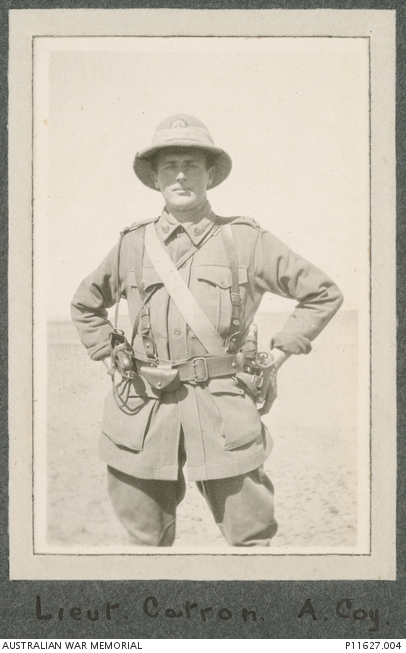
William George James Catron (1886-1917) enlisted in 1914. He was married with a child and working as a warder at Pentridge at time of enlistment; previously he had been a teacher at Skenes Creek. He embarked on the Benalla on 19 Oct 1914 as part of the 8th Battalion which took part in the landing at Gallipoli on 25 April 1915. He was promoted to the rank of 2nd Lieutenant on 26 April and Lieutenant on 4 August. He suffered from appendicitis in July 1915 and was operated on several times in Egypt, Malta and England. Following the initial operation Lieutenant Catron suffered from weakness in the abdominal wall, a tendency to hernia and continual pain in the site. He was returned to Australia in April 1916 for three months change. He was recommended for discharge for private treatment of abdominal adhesions but was deemed fit for active service in July 1916. He left Australia the following October, rejoining his battalion in France in January 1917. On 3 March 1917, Lieutenant Catron, O.C. of ‘A’ Company, and five other soldiers were killed when a German mine exploded in the Company Headquarters dugout at Lusenhof Farm south of Baupaume. He was buried in an isolated grave 4 ¾ miles S.E. of Doullene. After the war he was reinterred at Bulls Road Cemetery, Flers. His was the second memorial tree planted at Coburg Lake Reserve on 31 Aug 1919.
[Mentioned Ch.68]
Fr Devine
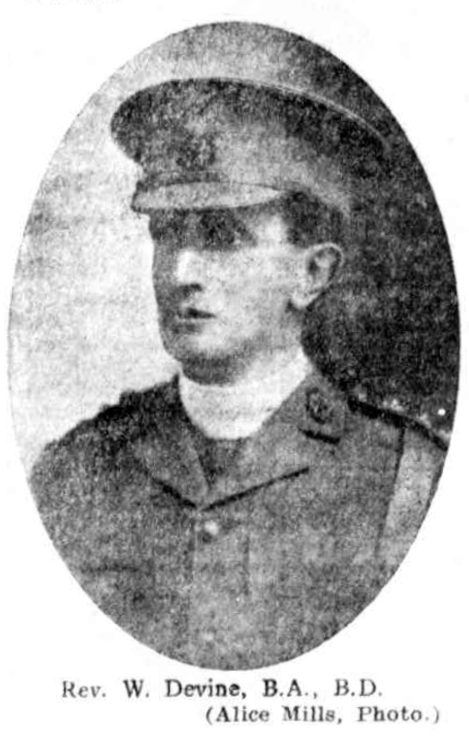
Rev. William Devine (1887-1959), was born in County Tyrone, Ireland. He studied for the priesthood at St Patrick’s College, Maynooth and was ordained in 1912. He came to Melbourne the following year. He was appointed assistant priest at Coburg in 1914.
Fr Devine enlisted in the AIF and embarked on HMAT Demosthenes on16 July 1915. He served as chaplain in both Egypt and France. From 1916 much of his time was spent with the 48th Battalion. He returned to Melbourne briefly in 1918 as a transport chaplain, but returned to the front in May 1918 and remained with the AIF until September 1919 when he returned to Melbourne. In 1917 he was awarded the French Croix de Guerre for ‘conspicuous services’, and the Military Cross in 1918 for ‘conspicuous gallantry and devotion to duty’.
A detailed biographical entry in Australian Dictionary of Biography written by Michael McKernan gives a sense of the man himself and of a full life given in service of others. Fr Devine wrote a history of the 48th Battalion, The Story of a Battalion (Melbourne, 1919). McKernan says, ‘From his book it would seem that Devine succeeded as a chaplain and enjoyed his work; it demonstrates love for his men, sympathy and concern for their welfare, ability to share their life and acceptance of their ways.’
[First mentioned Ch.16]
Dr Dyring
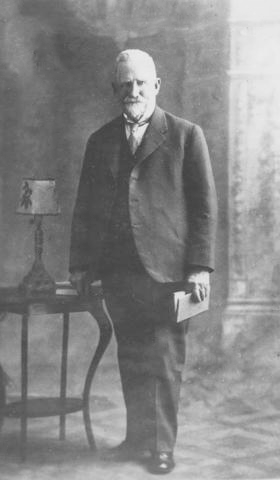
Courtesy Picture Victoria
Carl Peter Wilhelm Dyring (1860-1931) was born at Beechworth. His father was Danish and mother English. He graduated in Medicine in 1886 and had previously held the position of lecturer in chemistry at Ormond and at Trinity College. He began his medical practice at Coburg and was the Medical Officer for the Shire of Coburg from 1887. That year, he married Helen Maude Kate Willis (1860-1899) who sadly died in 1899. In 1901 Dr Dyring married Dagmar Cohn of Bendigo.
Aged 55, Dr Dyring enlisted in the AIF, leaving for Egypt on 17 July 1915 on board HMAT Orsova. He served as Captain in the Army Medical Corps with the 2nd Australian General Hospital in Egypt, and in France. He returned to Australia in January 1917 and not long after retired from practice. He then held the position of Honorary Physician at the Caulfield Military Hospital.
[Mentioned Ch.16]
Mrs Dyring
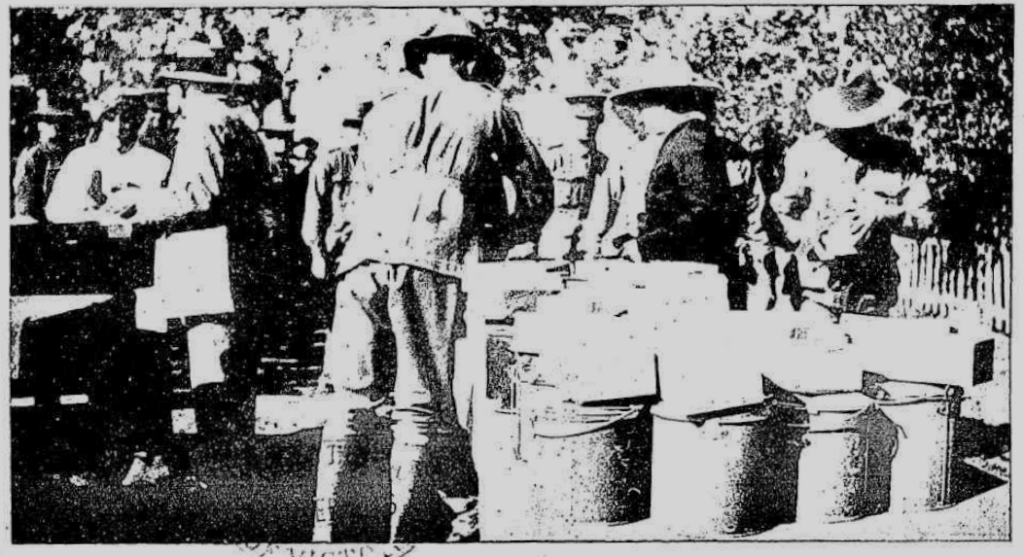
Bendigonian 24 Jan 1916 p.15
Dagmar Alexandra Esther Cohn (1874-1947) married Carl Dyring in 1901.
Local newspapers reporting on the farewell social evening that was held at the Coburg Town Hall for Dr Dyring, stated that Mrs Dyring was accompanying him and ‘hopes to have her services accepted as a nurse’. Mrs Dyring left on the Mologa on 7 Sep 1915. By this stage Dr and Mrs Dyring had three children aged between twelve and six; they stayed with Mrs Dyring’s mother at Bendigo while she was away.
Mrs Dyring did not get the opportunity to nurse but she spent her time visiting sick and wounded Australian soldiers in the hospitals in Egypt. She was employed in a British hospital ‘preparing food and helping the nurses to look after the typhoid cases’. She volunteered at the YMCA canteen in Cairo where she and other Australian and English women ‘cut sandwiches, and they handed out tea and eatables continuously for hours every afternoon, and on Saturdays and Sundays’. She was involved with the Australian Soldiers’ Comforts Committee, ‘helping unpack the cases of goods arriving from Australia and make them up into smaller parcels for distribution’ and took part in the distribution of the Christmas billies to the soldiers.
In March 1916 the 2nd General Hospital departed Egypt for France, Dr Dyring with it. Mrs Dyring then returned to Australia, arriving back in May 1916 and went to Bendigo where her children were.
[Mentioned Ch.16]
Fr Fahey
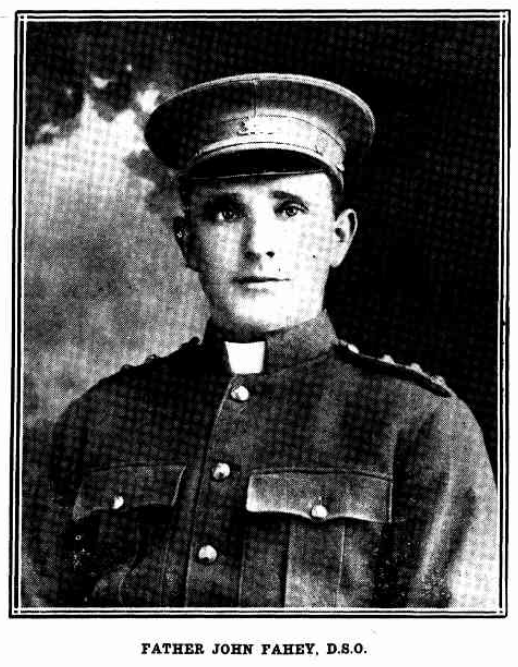
John Fahey (1883-1959) was born at Glenough, Tipperary. He was ordained a priest in 1907 and left almost immediately to serve in Australia, as many other young Irish priests did. At this time, there was only one major seminary in Australia and only 20% of the clergy were Australian born. Each year newly ordained priests were shipped out from Ireland and settled around the parishes as assistant parish priests. Fr Fahey served in Western Australia and when the war began joined the Australian Imperial Force as a chaplain with the permission of his Bishop. He was assigned to the 11th Battalion.
On 25 April 1915, chaplains were ordered not to disembark. Fr Fahey ignored this and managed to get ashore, believing his duty was to go with his men, ‘consoling the wounded, burying the dead and encouraging the living’. He was highly regarded by that soldiers, as were many of the other chaplains of all denominations who served at Gallipoli and through the whole war.
Such was his reputation that The Advocate of 3 Jul 1915 (p.15) reported that he ‘worked like a hero in the fighting line. When no officers were left, he took a rifle and shouted, “Come on, boys; at ’em!”’ Something similar was reported of Fr E McAuliffe. ‘We have just heard of … a fine bayonet charge led by Father McAuliffe, after all the other officers had been put out of action.’ (Tribune 1 Jul 1915, p.5). I suspect similar stories may have been told about the chaplains of other denominations. These stories are apocryphal; the chaplain was forbidden by the rules of war to take part in the fighting and had a different role to play. In a letter to Archbishop Clune of Perth, published in The Advocate (Aug 7 1915, p.10), Fr Fahey describes the tension. ‘Each man as he reached the shore dropped his pack, fixed his bayonet, and with a yell rushed for the hill. I felt a wild desire to pick up a dead man’s rifle and do the same, for there seemed to be nothing else to do. However, I had plenty to do in a few minutes, when I looked around.’ Michael McKernan’s Padre, Australian Chaplains in Gallipoli and France (Allen & Unwin, 1986) provides an excellent understanding of the role and personalities of the chaplains who accompanied the A.I.F.
A more detailed biography of Fr Fahey by Michael McKernan can be found in the Australian Dictionary of Biography.
[Mentioned Ch.24]
Fr Hayes
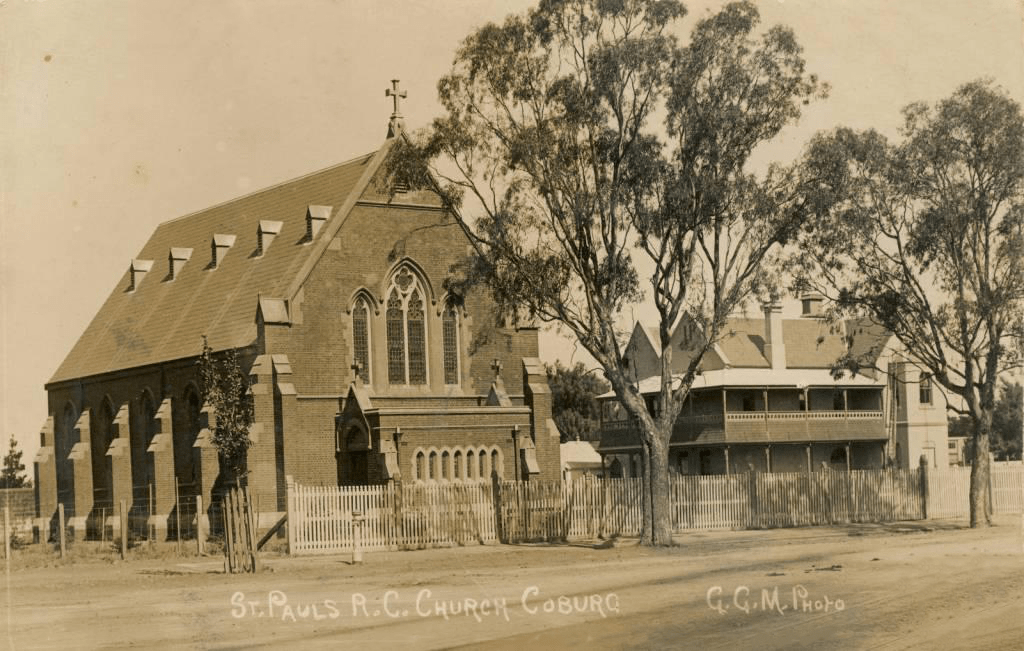
Early 20th century
Photographer – GMM Photo
Fr Mathew Hayes (c1840-1916) was the parish priest of Coburg from 1882 until his death in 1916. Born in Limerick, he was educated at All Hallows College but ordained in Melbourne in 1866 by Archbishop Goold, the first Archbishop of Melbourne. He served various parishes from Kilmore, North Gippsland, to Williamstown, and finally Coburg. At that time Coburg covered the vast area of Coburg, Brunswick, Epping, Woodstock and Yan Yean. He was also appointed Catholic chaplain of Pentridge prison and, in 1895, chaplain of the Melbourne Gaol.
Fr Hayes was involved in building and improvements in the parishes he worked in beginning with the presbytery at Sale, as well as churches at Coburg and Epping, schools at Coburg and Brunswick, and the presbytery at Coburg. When he arrived at Coburg, St Paul’s church was in such serious disrepair that it was condemned by the Board of Health in 1887 and was considered ‘liable to tumble down on any Sunday and kill half the congregation’. After the church was demolished, Mass was said on Sundays in the school room. Just as sufficient funds were collected to begin building, the bank holding the money collapsed, one of the many in the 1890s depression. So Fr Hayes began again and on 27 May 1894 Archbishop Carr laid the first stone and, later, blessed the finished church on 25 Nov 1895. Fr Hayes also had a new presbytery built at Coburg in 1903. By 1910 all the other areas had separated from Coburg and become their own parishes.
At the time of his death on 2 Jan 1916, Fr Hayes was one of the oldest priests in Victoria. His funeral service was held at St Paul’s and he was buried in the Melbourne General Cemetery, following a lengthy funeral procession. He was remembered with affection by his parishioners.
[First mentioned Ch.11]
First Coburg officer Killed in Action
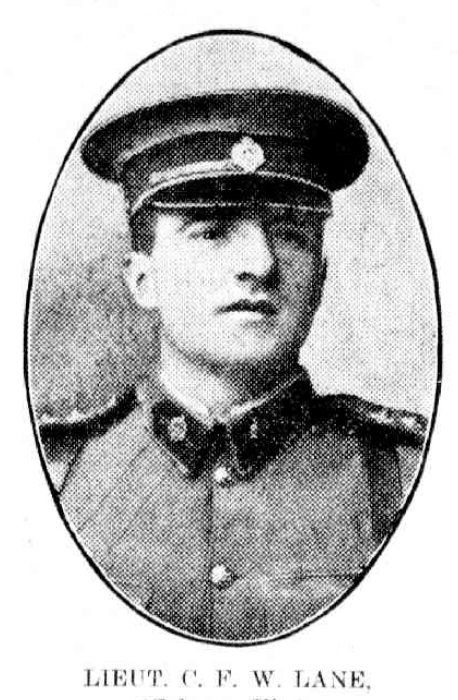
Clement Frederick Wills Lane (1891-1915) was the sixth of the eight children of Rev Henry Wills Lane and his wife Emily Williams. Rev Lane was from Gloucestershire and, after a period as a missionary in Africa, arrived in Australia in the mid-1880s; he was minister at Holy Trinity Anglican church, Coburg, from 1914.
Clement Lane was educated at Geelong Grammar and Carlton College. He was unmarried and working as a clerk at the time of his enlistment on 18 August 1914. A Second Lieutenant with the 6th Battalion (promoted Lieutenant 1 Feb 1915), he departed on HMAT Hororata from Melbourne on 19 October 1914.
Lieutenant Lane was Killed in Action on 25 April 1915. He has no known burial place but is commemorated on the Lone Pine Memorial to the Missing. On 31 August 1919, a tree was planted in his honour (no.75) as part of the memorial avenues of trees at Coburg Lake Reserve.
[Mentioned Ch.13 but not by name]
Martin O’Meara, VC
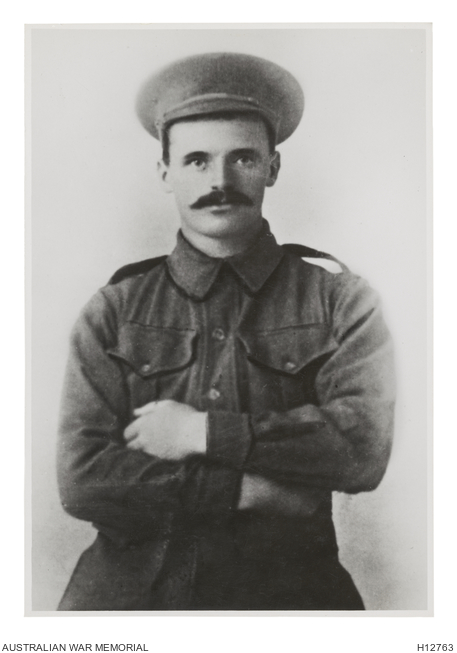
Martin O’Meara (1885-1935) was born at Lorrha, County Tipperary* and migrated to South Australia in 1912 where he worked as railway construction labourer and as a timber cutter. He enlisted in the AIF in August 1915 and sailed from Fremantle in December 1915 as part of the 16th Battalion. He was awarded the Victoria Cross for conspicuous bravery at Mouquet Farm, Pozieres between 9 and 12 August 1916. Under intense artillery and machine-gun fire, he repeatedly went out and brought in wounded officers and men from No Man’s Land. He was wounded three times: Mouquet Farm in August 1916, Bullecourt in April 1917 and Messines in August 1917.
He arrived back in Australia on 7 November 1918 as part of a group of Australian Victoria Cross recipients intended to assist with recruiting. Because of a suspected influenza outbreak, the passengers on ship they were travelling on, the Arawa, were quarantined at Woodman’s Point south of Perth.
Martin O’Meara had a complete mental breakdown at the Woodman’s Point Quarantine Station. He was admitted to Claremont Hospital for the Insane in January 1919 and transferred to the newly opened Lemnos Soldier’s Hospital in September 1926 where he remained until just before his death, at the Claremont Hospital, in December 1935. He was fifty years old. He is buried in Karrakatta Cemetery, Perth.
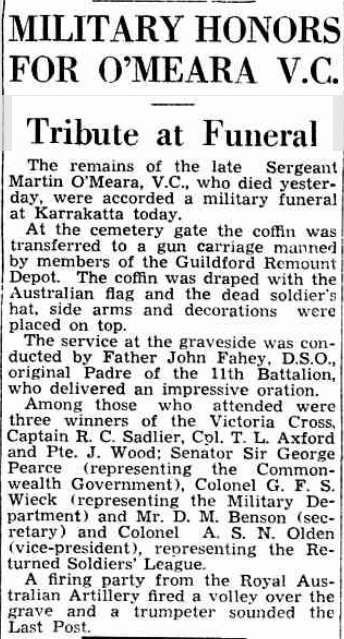
Martin O’Meara’s entry in the Australian Dictionary of Biography can be read here.
*There were various places mentioned as Martin O’Meara’s place of origin. Many articles said he was from King’s County.
[Mentioned Ch.24 but not by name]
The blind soldier who returned on the hospital ship Ballarat.
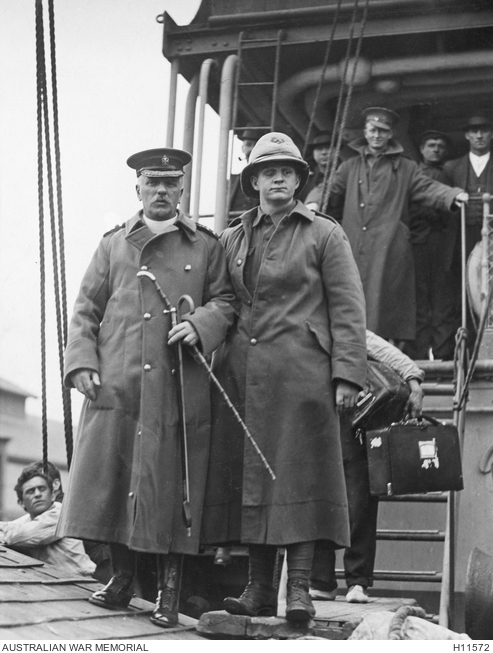
Courtesy Australian War Memorial
Frank Henry Downes (1895-1939) was an unmarried sawmiller from Bowen Hills, Queensland who enlisted on 18 Aug 1914. He had previously served in the Militia and was appointed to the Machine Gun Section of the 9th Battalion. He departed Brisbane aboard HMAT Omrah on 24 September 1914.
The 9th Battalion was among first battalions ashore at Gallipoli on 25 April 1915. He was wounded that morning as he carried a soldier back to the beach for medical attention. Private Downes was shot by a bullet which went ‘through his right temple, tore one eye from its socket and irreparably injured the optic nerve of the other.’
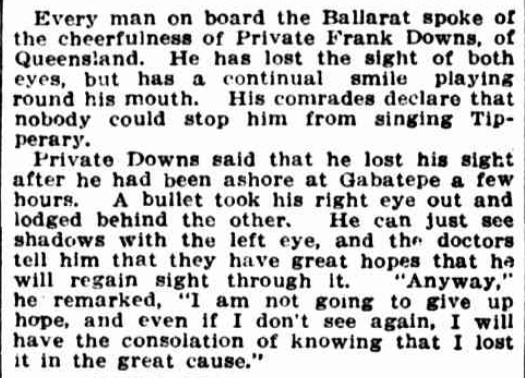
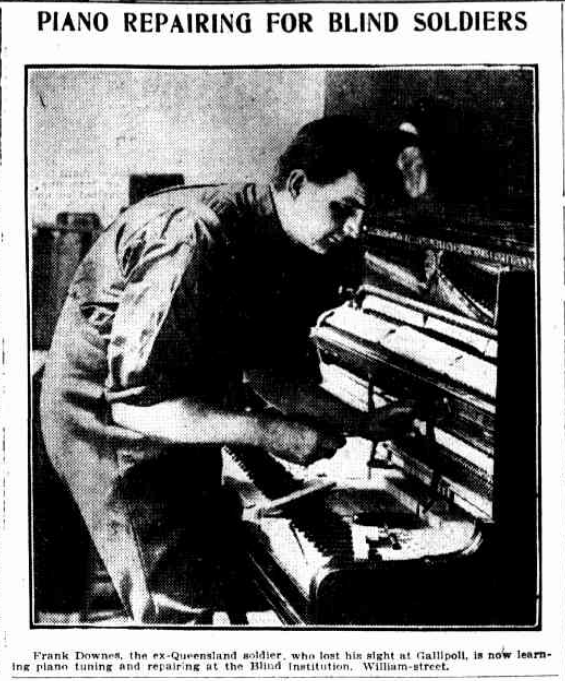
He was evacuated to the 15th General Hospital at Alexandria and returned to Australia on 19 July 1915 on the hospital ship Ballarat which brought home the first group of wounded from World War 1. He was discharged from the army the following January. After returning to Brisbane, he went to Sydney at the end of 1915 to be retrained as a piano tuner by the Sydney Industrial Blind Institution. He was President of the New South Wales Blinded Soldier’s Association and travelled throughout Australia advocating for fair treatment for blind returned soldiers.
Frank married Marjorie White at Singleton, NSW, in 1917 but she filed for divorce in 1930 after Frank had left her and entered into a relationship with Elizabeth Traquair. He intended to marry Elizabeth once the divorce was finalised but she committed suicide a month after the stillbirth of their child. He married Lucy Courtois the following year at Norfolk Island. Frank Downes died at the Callan Park in Sydney on 28 August 1939. He was only 43, like so many returned soldiers, a life that was cut short. More can be read about Frank Downes here.
[Mentioned Ch.18 but not by name]
Dr Mathew
Alexander Craigievar Mathew (1895-1975) was the fourth of the five children of John Mathew (1849-1929) and Wilhelmina Scott. Rev Mathews was the Presbyterian minister at Coburg from 1889 to 1923; he was also a military chaplain at Broadmeadows during the War.
Alexander was born in Coburg and studied Medicine at Melbourne University. He enlisted in the AIF in June 1918 but was not called up for duty. His three brothers had enlisted and served overseas. In 1919, when the emergency influenza hospital was established in Coburg High School, Alexander Mathew was a fifth year medical student and was appointed as the medical superintendent of the hospital. Many influenza hospitals employed fifth year medical students during the pandemic.
Alexander graduated in1921 and was married the following year to Violet Glynn; the service was officiated by his father. Dr Mathew practiced medicine in the early 1920s at Tongala then returned to Coburg. He moved to Kew in the 1950s. He died in 1975.
[Mentioned Ch.64]
Mrs Whaley
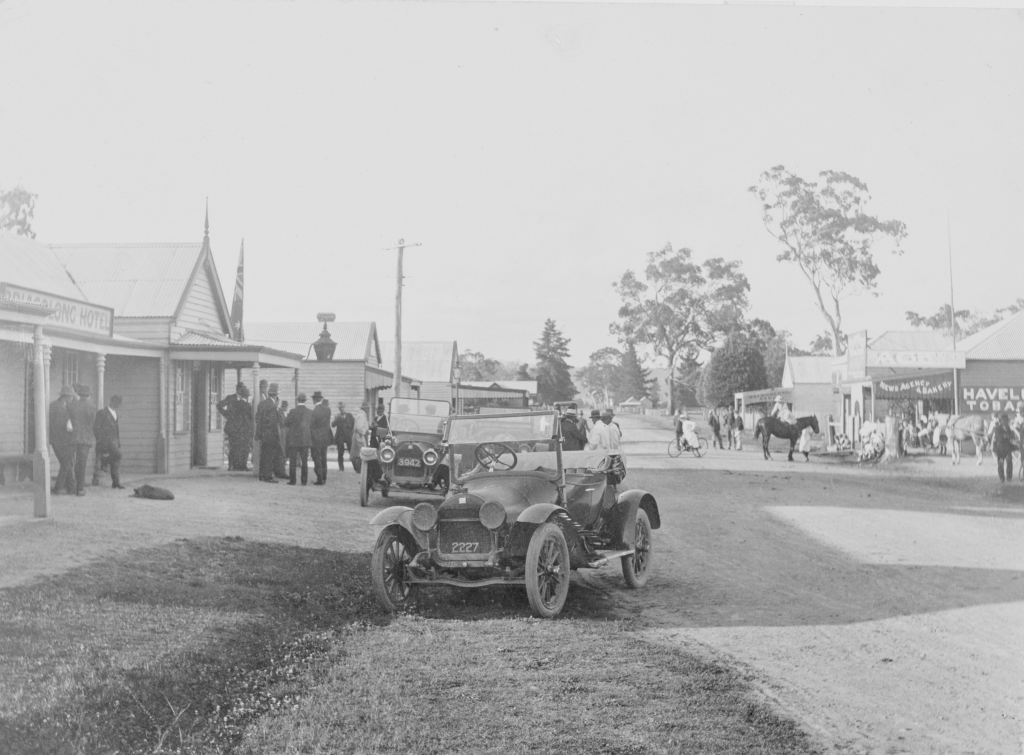
Mrs Whaley’s Coffee Palace would be to the lower right of the photo, out of view.
Photographer: H B Hammond
Courtesy State Library Victoria
Elizabeth Whaley (c1848 -1926) was a longstanding and active member of the Briagolong community. Born, possibly, in Scotland around 1848, Elizabeth Bendalow married William Alexander Whaley in Liverpool in 1865. William was a joiner and cabinetmaker. They migrated to Australia in 1871 with their two-year-old daughter Margaret Wilhelmina, and lived, initially in Griffiths Street, Richmond, where three more children were born: Isabel in 1874, John William in 1874 and Margaret Isabella in 1877. Sadly, all their children except Margaret Isabella did not survive childhood.
They moved to Briagolong some time in the 1880s and became active members of the community. They built what was to become Mrs Whaley’s Coffee Palace on Forbes Street around 1890. It also operated as a fancy goods and a general store, and as an undertakers for Mr Whaley. Mrs Whaley took in boarders as well. By the early 1900s, a visiting doctor consulted with patients in a room there several times a month. The Whaleys were active in musical events and supported local sports activities. Mr Whaley played the cornet and was a founding member of the Briagolong Band. He and his daughter Margaret Isabella, known as Nellie, helped provide music for local dances and concerts, Nellie playing the piano. She was also an organist at the Briagolong Presbyterian Church. William Whaley died in 1903, aged sixty-eight and Nellie in 1912 from pneumonia—she was only thirty-five.
During the Great War, Mrs Whaley was an active supporter of the Briagolong branch of the Red Cross. This branch was prolific considering the size of the community. Over the war years they produced 1,315 flannel undershirts, 97 pairs of pyjamas, 164 towels and 312 kit bags, and knitted 1,008 pairs of socks.
Mrs Whaley died on 17 February 1926, aged seventy-eight, in the Gippsland Hospital following a fall at home. She is buried in the Briagolong cemetery along with her husband and daughter.
The building where Mrs Whaley lived and operated her Coffee Palace is still standing.
[Mentioned Ch.30]
 Catherine Meyrick