This post continues from Hannah Miles ~ A journey to Van Diemen’s Land which traces Hannah ‘Annie’ Miles life from her birth in Clifton Campville, Staffordshire, to her journey on the Cadet as a woman under sentenced of seven years transportation.
After 115 days at sea, the Cadet arrived in Hobart on 12 April 1849. On arrival all the convicted women’s details were recorded in ledgers. Annie’s physical description records her as 5’2” in height. She had a round face with a short nose and a large mouth and chin, and her complexion was brown. Her hair and eyebrows were black as were her eyes. She had WA, an anchor and a man tattooed on her left arm. Her occupation was given as a dairymaid. She was a Protestant and could read. Her behaviour on board the Cadet was described as very good. Her Convict Indent lists her father James and no mother, her three half-brothers, and her sister Elizabeth1. There is no mention of her three half-sisters. I can’t help but wonder if it was a troubled relationship with her step-mother and, perhaps, favoured treatment (and the evils that follow on from that) of her half-sisters that propelled her from home.
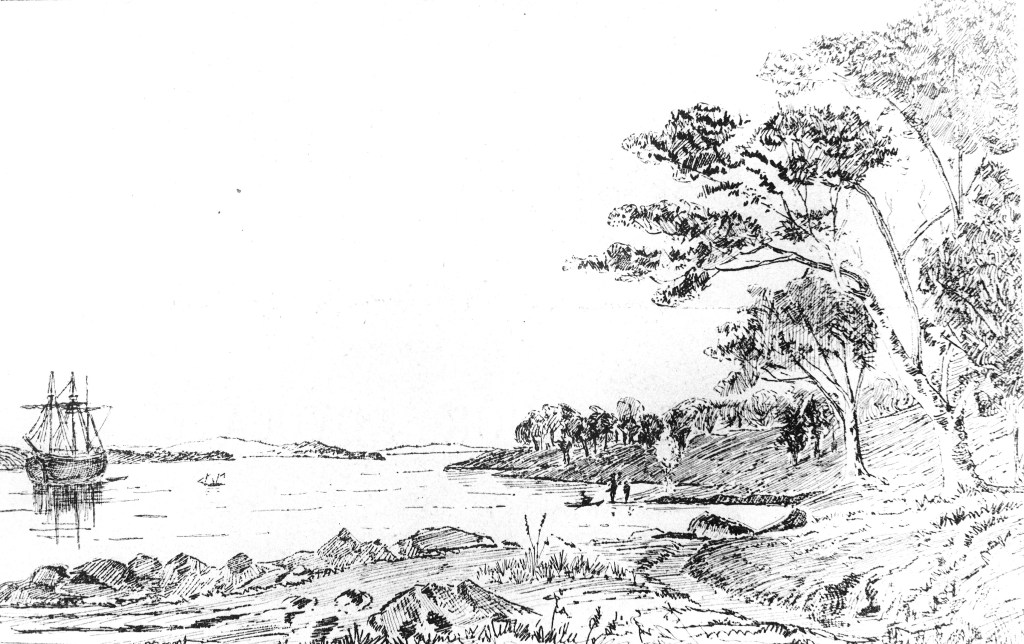
Courtesy Libraries Tasmania.
PH30/1/1980
Annie may have spent her first four months in Van Diemen’s Land months on board the Anson hulk moored at Risdon near Hobart. The Anson was a former warship that had arrived in Hobart in 1844 with male convicts. It was refitted as a prison to be used as a Probation Station for female convicts because of overcrowding at the Cascades Female Factory. The female convicts usually served a six month probation there and then, as probation pass-holders, were hired out to private citizens. The daily routine was described in a report by Dr Edmund Bowden, superintendent of the Anson, in 1845.
The following is the daily routine observed on board:-At an early hour the ship’s bell is rung to summon all parties to their several posts ; the hammocks in which the prisoners sleep are brought on deck, the bedding aired and stowed away in the nettings, the wards are cleaned, and the school opened: at eight, the wards and messes are summoned in rotation by sound of bell to the galley to receive their bread for the day, and their morning meal; the breakfast being finished, the bell is rung for prayers; the chaplain officiates for the protestants, and the Roman catholic catechist for the catholics; at nine, the bell is again rung for silence, and for the general duties of the day; at noon, the prisoners dine, after which, the duties are recommenced until the evening meal and prayers.
From Dr. Bowden’s report of 1845 to the Governor Sir Eardley Wilmot, pages 41 and 42.2
The Anson was closed in 1849/50 and in the last years of transportation to Van Diemen’s Land, women were sent into private service straight from the convict ships. It is always possible that, instead of a period on the Anson, this could have been Annie’s experience. It’s probable that Annie and Jane Whitton3 never saw each other after their probation period. Jane was sent north to the area around Launceston and Annie, as a 3rd Class Pass-Holder, was hired by W. Moriarty of Hobart on 3 August 1849. This is possibly William Moriarty, Port Officer for Hobart who died on 26 March 1850. Annie was then hired on 6 May 1850 by John Case of William Street for seven months at £12. John Case was a carpenter. On 24 September 1850 this was extended for another seven months at the same pay, though Annie did not stay with him for the full period. On 1 January 1851, she was hired out to William Cole of Liverpool Street for 8 months at £8. William Cole was most likely a watchmaker and silversmith. This seems not to have worked for one or both of them as, six days later, she was hired to Henry Curll of Macquarie Street for 11 months at £12. Henry Curll was the Deputy-Assistant-Commissary-General for Van Diemen’s Land. By September 1851, when Annie applied for a Ticket of Leave, she was living at Macquarie Plains in the New Norfolk area, and employed by the Anglican minister Rev Wickham Mayer Hesketh. Her application was refused but it was indicated that she should reapply in six weeks. On 18 November 1851 she was granted her Ticket of Leave and could work on her own account and choose her own employer. She is recorded as employed, probably as a house servant, by Edward Terry, owner of the Askrigg estate at Macquarie Plains, on 25 November 1851.4 Given the standing of several of Annie’s employers, her behaviour and work must have been exemplary.

Using embroidery, beads and ribbon roses, it was made in hope that Annie had some pretty sparkly things in her life. At that time, I had no knowledge of her experiences in 1855.
Annie applied for permission to marry Thomas Woodhouse, a former convict with a Conditional Pardon. This was granted on 7 July 1852. Thomas Woodhouse, originally from Albury Hertfordshire, was convicted of highway robbery at the Essex Summer Assizes on 30 July 1827 and sentenced to transportation for Life for ‘stealing from the person’ both wearing apparel and money on two occasions. He had previously been acquitted of a charge of sheep stealing. It is possible he was out of work at the time of his thefts as he said, when describing his situation, that he had last worked for Mr Bryant on Jamaica Level at Bermondsey. He was a kitchen gardener and was good with the spade. From August 1827 until his departure on the convict transport Marmion, he was kept on the hulk Leviathan. The Gaoler reported that he ‘Behaved well’. The Marmion arrived in Hobart on 8 March 1828. Thomas was described as being a stout man of 5′ 9 3/4″. He had a long oval pock-pitted face with a mole on his right cheek. His complexion was brown, like Annie’s. His hair, whiskers and eyebrows were also brown but his eyes were blue. He had the name ‘Elizabeth’ tattooed inside his right arm.
Through the 1830s Thomas was assigned to William S Sharland at New Norfolk, and continued to work for him after he received his Ticket of Leave in September 1836. Throughout the 1830s he is recorded as receiving punishments such as admonishments, time in the stocks or in the cells on bread and water to three months on a chain gang for offences including drunkenness, disobedience and insolence, being out after hours, absence without leave and ‘absence from his master and remaining a whole week in a public house.’ Thomas received a Conditional Pardon on 5 November 1840. At the time of his marriage to Annie, he described himself as a farm servant and was living at Macquarie Plains.
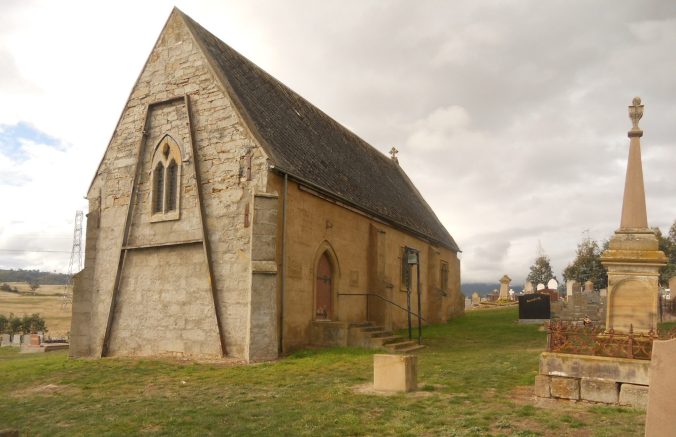
Annie and Thomas were married at the church of St Mary the Virgin, Macquarie Plains, on 8 March 1852. The service was officiated by the Rev Hesketh. The witnesses were Henry Speakman, a blacksmith and former convict, perhaps a friend of Thomas’s, and Charles Maddox, a respected tenant farmer of Edward Terry’s who may have been a churchwarden as he was a witness at many of the marriages at St Mary’s.
Annie received a Conditional Pardon on 30 Nov 1853. Her convict record is spotless, not even a single minor offence during the four and a half years as a convict in Van Diemen’s Land. Had she found a more orderly life where she received the respect and kindness that was possibly missing in her earlier years? Or was it that she had lost the will to fight and bowed her head to the inevitable? At this distance, we cannot know.
In late 1854 Annie became pregnant. It appears that as the birth approached Annie became serious unwell and suffered hallucinations. It is easy to imagine the visceral fears could have plagued her, especially fear for her own survival and for the future of her child. Perhaps on the advice of others, Thomas took Annie to Campbell Town where she was placed in the care of the respected Dr William Valentine. He delivered Annie and Thomas’s only child, Hannah Keating Woodhouse on 18 July 1855.
Under the ‘elegant’ title of ‘Another Lunatic’, the Colonial Times reported in its 23 August 1855 edition (p.3)
The sitting justices, at the police court, heard an application yesterday in a case of a pauper lunatic, Ann Woodhouse, a female about forty years of age, who was led into the court by her husband, a much older person5. He stated that himself and wife had been in service at the Macquarie; they had been married five years ago. About five weeks since his wife became deranged, and she had to be removed to Campbell Town, where she was attended by Dr Vallentine, whose charges, and the expense of coach hire, &c. had reduced him to beggary, and he had no means of supporting his unfortunate wife. Dr Hewson, of Battery Point, gave the requisite medical evidence, and their worships (Messrs Burgess and Bateman,) made an order of commitment to H.M. gaol, to await the decision of His Excellency the governor in terms of the Act.

The Hobarton Mercury of 24 August 1855 (p.2) reported as well, though some of it is contradictory as it talks of an illness five months ago, not five weeks, and says that she had been in hospital in Launceston, not Campbell Town and it gets Thomas’s given name wrong. It does provide more information about Annie’s illness.
A lunatic, Ann Woodhouse, was brought before their Worships, in order to have evidence taken in reference to her lunacy, with a view to her admission into the Lunatic Asylum.
Dr. Hewson stated that he had examined the patient on two occasions, and had ascertained she was of unsound mind, and incapable of maintaining herself. She was subject to hallucinations, and betrayed by her manner and language her mental incapacity.
John Woodhouse, her husband, stated that his wife and himself had been in service together at Macquarie Plains, and about five months ago she had a severe illness, since which she had not been right in her mind. She had been in the Launceston Hospital for five days, when she was discharged; witness brought her to Hobart Town by the recommendation of the doctor; he was unable to maintain her.
The Bench being satisfied with the evidence, the poor woman was removed, to await an order for her admission into the Asylum.
Annie was held at the Hobart Gaol until approval was given for her admission to the Lunatic Asylum6 at New Norfolk, as was the usual practice at the time – later in the century people in Annie’s situation were held at the Hobart Hospital. Approval was granted on 28 August and Annie admitted on the 30th. She was diagnosed as suffering from Amentia7. Her case notes state that she was of ‘unsound mind, unfit to be at large and incapable of maintaining herself’. She was described as being quiet and tractable, and showing no indications of mental ‘aberration’, but she was taciturn. Her bodily health was considered robust. A month and a half later she was ‘In good health, mental state unimproved, appears taciturn and moping, does not speak until addressed is stout and florid and apparently in robust bodily health.’ She was treated with a blister in mid-October and had a seton inserted into the back of neck two weeks later. Blistering involved using hot irons or chemicals to blister the skin and, it was believed, so draw out toxic humours. With a seton, a needle was used to insert a thread or tape through a fold of skin, and moved side-to-side daily to create a running sore. It was usually placed on the nape of the neck in the belief that it would drain ‘noxious’ humours and relieve the brain inflammation thought to cause insanity.
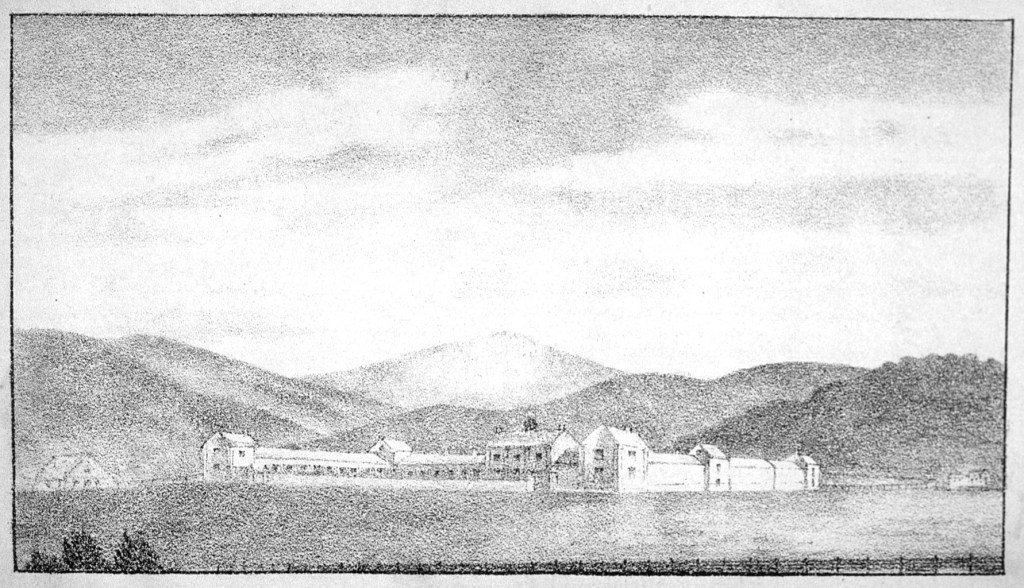
Courtesy Libraries Tasmania.
The entry of 5 December 1855 reports ‘Some slight improvement has taken place in the woman who is occasionally inclined to work in the ward but is generally moping and taciturn’. A month later, it was reported that Annie was ‘much the same but she makes herself in some degree useful by cleaning ward but has the look and manner of an imbecile.’ Or, perhaps, she had the look and manner of a deeply depressed woman wandering in a cruel and alien environment.
Finally on 4 March 1856: ‘Considerable improvement has taken place in the woman lately she has been very useful and industrious manner is far less taciturn. She is at her husband’s request discharged to his care.’
Not one mention in made in Annie’s case notes of the fact that she had recently given birth to a child and that she might have been suffering from some form of peri-natal depression or psychosis. These conditions were recognised at the time, though not well understood. Often treatments involved separation of the mother from her child. The blistering and the seton would have done nothing to aid Annie’s recovery and possibly hindered it. In the end, her improvement probable came from the passage of time and her own will to live.
Annie went back to Macquarie Plains and worked as a servant and, hopefully, was able to experience the joy of watching her daughter grow, and to draw comfort from her husband’s company. I believe Thomas truly cared for Annie. He had used all his careful savings trying to get her medical treatment and he came to the Asylum and took her home. Some would have left their wives there without a second thought. I hope Annie, Thomas and Hannah all had moments of sheer happiness and laughter together and that life was gentle over the next thirteen years.
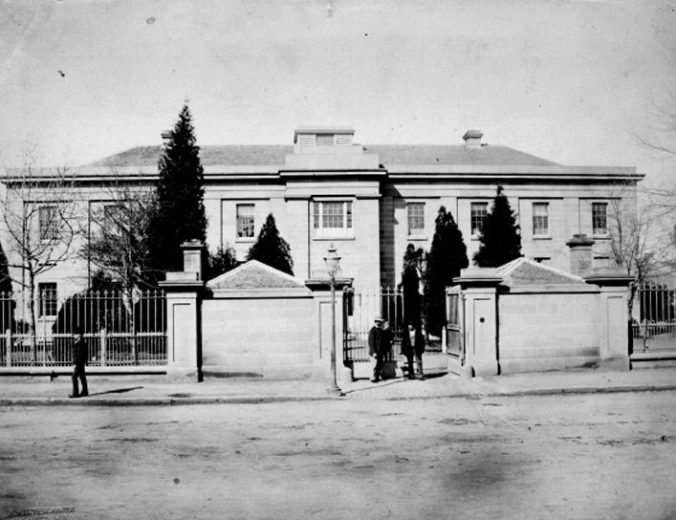
Courtesy Libraries Tasmania
PH30/1/1024
On 18 October 1869, Annie was brought down from Macquarie Plains and admitted to the General Hospital in Hobart suffering from kidney disease. She died on 21 November and was buried four days later in a pauper’s grave at Holy Trinity Church, Hobart. It is possible that both Thomas and their daughter, Hannah, accompanied Annie to Hobart. It may be soon after this that Thomas entered the Brickfields Pauper Asylum. He was sixty-five in 1869 and given the hard life he had lived he may not have been able to work enough to support himself and his daughter. He died in 1872 of gangrene of the arm and was buried in a pauper’s grave at Cornelian Bay cemetery.
Hannah Woodhouse was fourteen when her mother died. On 16 April 1870, three months before her fifteenth birthday, she married by licence William Reader, thirty-two years Hannah’s senior. William had been living in the New Norfolk area from at least 1864 and had been previously married. He had five children ranging in age from thirteen to twenty-one, though not all were living with him. He had been born in Kent and arrived at Launceston in November 1842 as a private in the 96th Regiment of Foot. In January 1845 he and a mate, William Moreton, stole a cap, stockings, and some quilling net from a house, while drunk, and threatened the owner and his wife. The two Williams were tried and sentenced to seven years transportation which resulted in them entering the convict system in Van Diemen’s Land.
Annie Miles’ daughter, Hannah Woodhouse, is truly a silent woman. All we know of her is the dates of her birth, her marriage and her death, and the births of her children and the deaths of two of them. The only family story that has been handed down is that Hannah was very pretty. We do know her words or her thoughts. We do not know why she married William Reader. Was she charmed by him? Or was it that he seemed a safer option in a world that had fallen apart for her?
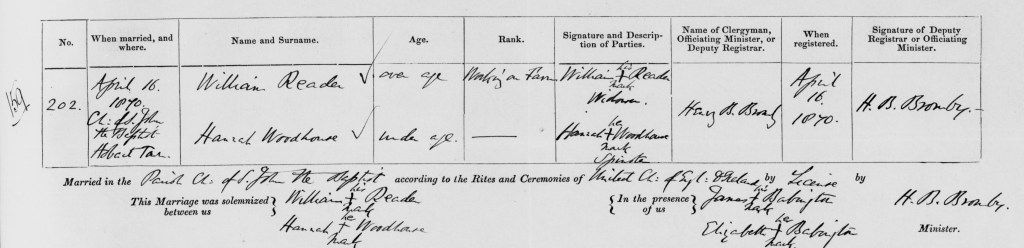
Hannah and William had nine children between 1871 and 1893. From 1877 they lived at Askrigg, Macquarie Plains, in a house with three acres rented from the estate of Edmund Terry, for most of their married lif3e. In September 1897 Hannah suffered an intestinal obstruction and was brought by train to Hobart and admitted to the hospital where she died on 22 September. She was buried in a pauper’s grave at Cornelian Bay cemetery at 9.30 am on the 24th. An Anglican minister, Rev A Wayn officiated. I have no idea who of her family stood at the graveside. I do hope some of her older children were there.
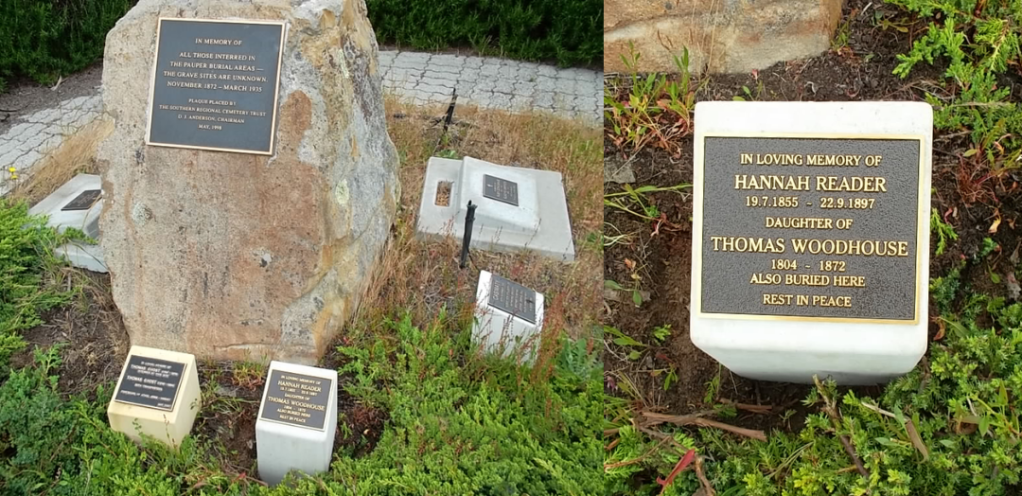
A year later Hannah’s three youngest children, Emma Bertha (13), Albert Arthur (10) and Leonard Lawrence (5) were placed in the care of the Department of Neglected Children as William was deemed unfit to care for them. He was seventy-five. He died four years later at Askrigg and is buried at St Mary the Virgin’s churchyard in an unmarked grave.
Not all life stories are happy but they still they need to be told so that we can understand the world as it was, and as it is now. Like most ordinary women down the centuries, Hannah and Annie’s greatest legacy was their children. Hannah had seven children who lived to adulthood, twenty-four grandchildren and at least seventy great-grandchildren, their descendants are from all walks of life spread all around Australia, each making contributions in their own way..
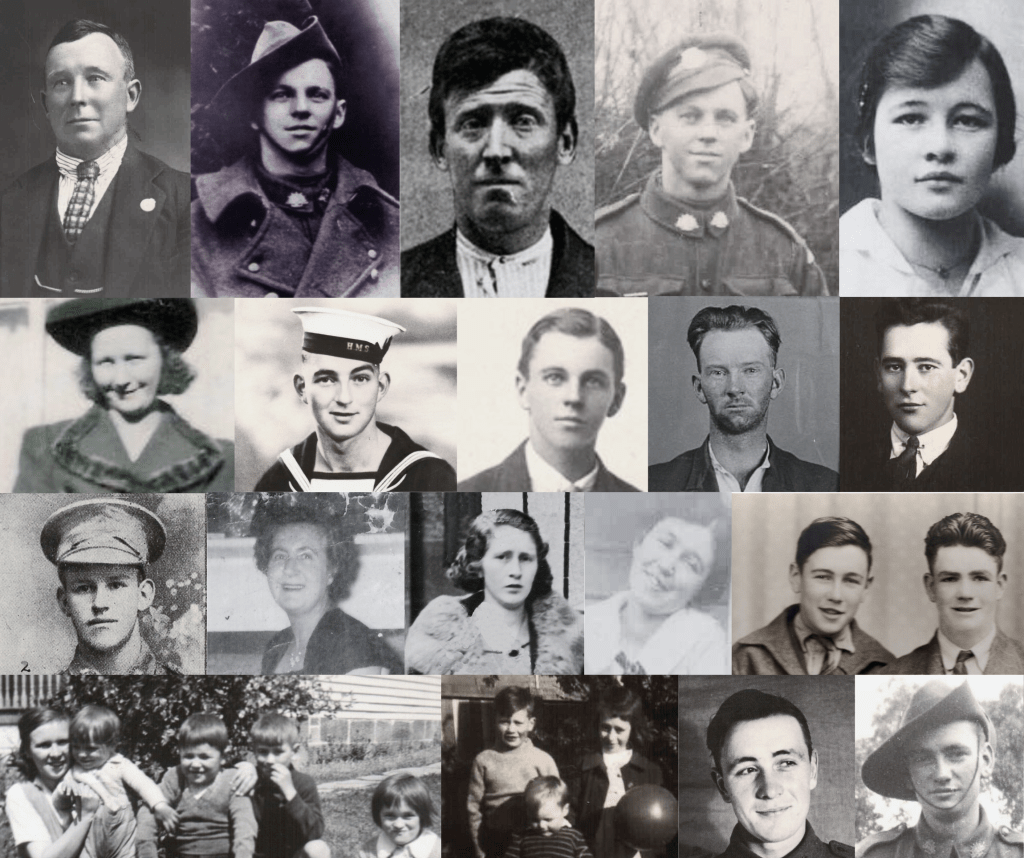
Here we have a few of Hannah Woodhouse Reader’s children, grandchildren, great-grandchildren and a couple of great-great-grandchildren.
Next month’s post will be about Hannah’s son, Albert Arthur Reader – the Anzac son of a convict who was awarded a posthumous Military medal for ‘striking courage and valuable service in rescuing wounded under heavy fire’ as a stretcher bearer at Lagnicourt in April 1917.

- I haven’t been able to locate Annie’s sister Elizabeth in the 1841 census but when she married in 1844, she is recorded as living at Harthill in Warwickshire, about thirteen miles from Clifton Campville. She married William Wardel, a 23-year-old labourer, at Mancetter, Warwickshire. They lived at Warton, Warwickshire where William was from and had eight children. Elizabeth died of a stroke in 1878 aged fifty-six. ↩︎
- From Female Convicts Research Centre Inc., accessed online14 March 2026 from https://femaleconvicts.org.au/convict-institutions/probation-stations/anson ↩︎
- Jane Whitton was from Litchfield. She was eighteen at the time of her arrest with Annie and had one previous conviction for disorderly conduct. She gave her occupation as a housemaid and had been two years on the town. She was described as 5’ ¾” with sandy hair, a fair complexion and light blue eyes. As a 3rd Class Pass-Holder she was sent to the north of the state in the area around Launceston. Her record was not clean like Annie’s—she had a number of offences listed: absences without leave, a single instance of drunkenness and on one occasion she falsely represented herself as free. For that she had to serve eight days in the cells. Jane received her Ticket of Leave on 16 August 1853 and the next year, at Green Ponds, married George Shadbolt a former convict who had recently received a Conditional Pardon. They had six children together and settled at Sassafras where George took up farming. Jane died in 1875 of an obstructed intestine and is buried at the Sassafras Uniting Church cemetery. A fine headstone stands over her grave. ↩︎
- Register of Female Ticket of Leave Holders in the District showing Place of Residence. (POL516) ↩︎
- In 1855 Annie was 35 and Thomas was 51. ↩︎
- This was the hospital’s official name from 1829 to 1859. ↩︎
- This is a hard word to find a concrete definition for. It seems to have been a catch-all word that covered everything from developmental disorders to psychosis. ↩︎
Image in the header to this post is Hobart Town from the Domain attributed to Knud Geelmuyden Bull (1811-1889), c.1854-1856. Courtesy Allport Library and Museum of Fine Arts, State Library of Tasmania.
_________________________________________________________________
©Catherine Anne Merrick.
Unauthorized use and/or duplication of this material without express and written permission from this blog’s author and/or owner is strictly prohibited. Excerpts and links may be used, provided that full and clear credit is given to Catherine Anne Merrick and https://catherinemeyrick.com/ with appropriate and specific direction and links to the original content.
_________________________________________________________________
 Catherine Meyrick
Pingback: Hannah Miles ~ A journey to Van Diemen’s Land | Catherine Meyrick