There and Back: The Story of an Australian Soldier 1915-351 is the memoir of Rowland Edward Lording (1899-1944) writing as A Tiveychoc. The pen name is a reference to the 8th Infantry Brigade commanded by Major General Edwin Tivey in which Lording served. Lording, writing as Tiveychoc, says at the beginning that the narrative ‘mirrors myself, as I was and felt, and others as I saw them at the time. It is “dinkum;” and that is why in the narrative I have changed my name, and have also referred to others simply by their Christian names or nicknames in case they, like myself, do not like too much of the limelight of truth.’ (Author’s Note to Rex)
The narrator of his story is Edward ‘Ted’ Rowland – not so far from Lording’s own name.

Like Lording, Ted was born on 20 June 1899 in Balmain, a suburb of Sydney, New South Wales. He left school at fourteen despite his parents’ objections and went to work in his father’s factory.2 He was undertaking the compulsory military training required of boys and young men between 12 and 26 and had attained the rank of signal-corporal in the Senior Cadets. Once war was declared, Ted made a number of attempts to enlist; he even learnt to ride a horse and to play the bugle in hope it would ease his way in. In June 1915, military age was expanded to 18 to 45 years, and height was dropped to 5 foot 2 inches.3 With his parents’ consent, 16-year-old Ted successfully enlisted in the 30th Battalion in July 1915 giving his age as 18 and one month.4 His parents had agreed because they feared he would take himself off to another state and enlist under an assumed name, as other young men had also threatened.5 Their consent was given on the understanding that he would join the signalling corps in the mistaken belief that his training would take twelve months and by then the war might be over.
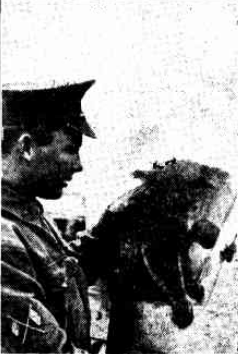
Sunday Times (Sydney) 29 Oct 1916 p.3
We follow Ted through his enlistment and his training at Liverpool Military Camp, his settling in to military routine, the range of personalities he mixes with, the move of his battalion to the Sydney Showgrounds with its easier access to the city, and his leave home. Three months after his enlistment, on 9 November 1915, Ted sailed on HMAT Beltana for Egypt.
From the point of departure until 19 July 1916, Ted tells his story in diary form. He describes the conditions and routine, the training and the activities on board, as well commenting on the dubious quality of the food. It is all done in plain Australian English with an undercurrent of humour.
Friday, Dec. 3rd.—… We continue towards the war at the hair-raising speed of ten knots, and all’s well.

The battalion disembarked at Alexandria on Sunday 12 December and travelled by train to the Aerodrome Camp near Heliopolis where the accommodation was bell tents and the messes were in large matting huts. There were periods of leave where Ted and his mates went to look at the Pyramids and the Sphinx, and visited Heliopolis ‘a modern town of broad streets, extensive squares, and attractive architecture.’ They went into Cairo and took advantage of the many cafés and restaurants and visited the bazaars and various quarters of the city including the European quarter and the Gardens, as well as taking an unedifying trip into the Wazzir, the notorious red-light district.

The battalion then moved to Ferry Post on the Suez Canal near Ismaila where Ted and the other signallers were on outpost duty at the visual signalling station. News of the withdrawal from Gallipoli came as a shock and he commented on the men of Gallipoli ‘in their faded, ragged uniforms they look a worn out lot and they did not take the least interest in our cheers. It seems they are past cheering or caring.’ (Ch.VIII Monday, Jan. 24th 1916)
In February the battalion was sent to Tel-el-Kebir, about thirty miles west of Ismailia. Following the reorganization of the AIF into two separate corps, they returned to Ferry Post in March. The 8th Brigade travelled by train to Ismailia. It was as a result of this that the 8th Brigade became known as Tivey’s Chocolates/Chocs, chocolate soldiers who looked good but could not take the heat. The 14th and 15th Brigades marched across the desert. The march was a shambles – the soldiers were suffering the after-effects of recent typhoid inoculations; they were ill-dressed for the march and out of condition; and the supply of water was inadequate. Some collapsed with exhaustion and others became ill with the heat. A New Zealand Division in the area came to their assistance but a number of the 14th Brigade died as a consequence of the march. The commander of the 14th, Brigadier General G. G. H. Irving was relieved of his command as a result and sent back to Australia.

Friday, March 31st.—At Ferry Post. Have seen a lot of the 14th Brigade after their awful march. They look even worse than did the troops upon their return from Gallipoli, and we have heard much of their trying experience. They have not a good word for those responsible for the march, but they are full of praise for the New Zealanders who went out voluntarily from Moascar and helped them in. The 15th Brigade arrived to-day and, although they have had a better march, they all look knocked up. They rub it into us about being ‘Tivey’s Chocolates,’ but I fail to see how the inhuman treatment they have received will make them any better in action than we ‘Chocolates’. (Ch.IX)
Now a Lance-Corporal, Ted was sent to the Zeitoun Signalling school at Cairo for a three-week course. By June they were preparing to leave for France and were lectured on the discipline that would be required in France.
Friday, June 2nd.—… It seems that we Aussies have a bad name for not saluting. But, if we are to salute each and every one of the officers we meet in France, a chap will get the equivalent of housemaid’s knee in his elbow. Our easy way of leaning up against a wall or a post when we are resting enables us to conserve our energy for when it is wanted. Can’t see how being all the time as stiff as a poker is going to win the war. We came here to fight for freedom, not to be slaves to our superiors—we haven’t got any. (Ch.X)
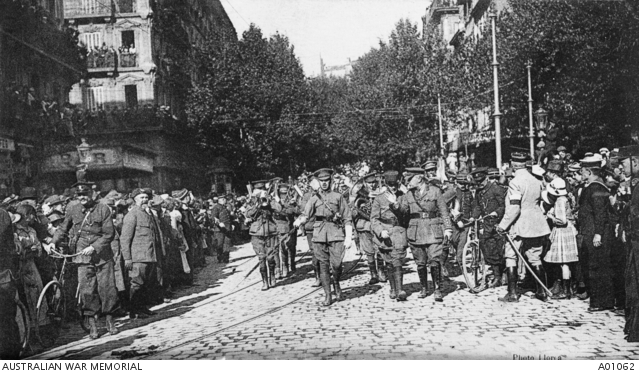
They departed Egypt on 16 June 1916 and arrived in Marseilles on 22 June, disembarking the following evening to the sound of the regimental band. They marched to the railway station to the cheers of the local population. Like so many others describing their arrival in France, Ted described the beauty of southern France and the locals along the way waving and throwing kisses.
They were billeted at a farm at Hazebrouck, close enough to the line to hear the distant rumble of guns. Ted describes the route marches and gas mask training and visits to the estaminets at Morbecque, particularly one run by ‘Madame’ and her daughters Yvonne and Marie who all called Ted, enfant carporal. It is easy with the humour and the high-spirited way the narrative is written, to forget just how young Ted is but there a moments when Tiveychoc gently reminds us: Ted chewing on a cigarette on his way to go into camp because smoking it properly brings on a fit of coughing, or dropping his first ever cigar over the side of the Beltana as it pulls away from the pier because it makes him queasy. And then there is that visit to the Wazzir, described obliquely in parts, no doubt due to Ted’s ‘shame at the degrading sights I have voluntarily witnessed’ – a reminder to the reader that Ted is not much more than a boy, inexperienced, with a decent upbringing.
They move on by stages to Estaires then to Jesus Farm, three miles from the front.
Looking out over the battle-scarred landscape, we see the bursting shells, the pock-marked ground, the screen camouflaged roads, battered and shell-holed buildings, splintered trees, and old trenches and entanglements. Yet some peasants are working in their fields, and it seems incredible that we are within easy range of Fritz’s shells. (Ch.XII)
On 10 July 1916, Ted left for the front line at Bois-Grenier, a day ahead of his battalion as he had to familiarise himself with the lines of communication before the battalion took over the next night. He was to be in charge of a section of signallers and described his experiences over the next few days. Ted, following a signalling officer, for the first time crawled out into No Man’s Land to lay a telephone line, flares bursting overhead.

British Official Photographer. 5 June 1916.
The narrative is moving inexorably towards the centre point of the book, the Battle of Fromelles.6
On the 16th, they receive orders for a ‘hop-over’ the next day; it is postponed ‘but the artillery of both sides is boxing-on a treat.’ The hop-over is now planned for 6 p.m. on the 19th and Ted receives his instructions: he is to take four signallers out, following behind the first charge, and establish a telephone station at the German trenches.
Ted is barely seventeen yet he understands the situation he is in.
The glamour of war has gone; we see it as it is, a struggle for life amidst death. I remember the cause for which we are fighting. I’ll do my bit, not with the idea of any dazzling glory, but with a realization of the tragedy of it. (Ch.XIII)
On the 19th, twelve months to the day since he went into camp at Liverpool, they are issued with forty-eight hours’ dry rations and a phial of iodine, are given ‘a good hot feed’ and are waiting to move off.
Here Ted’s diary ends—a story just begun. Snapping an elastic band over the pages, he stows and buttons the note-book into a tunic pocket.
It feels almost as if the account is told in real time from this point as they move along to their positions surrounded by the roar of gunfire, sharp explosions of shells, the noise of the barrage, the sight of the walking wounded being helped back to the aid post. But it is not yet zero hour.
When it arrives, Ted leads his section out across No Man’s Land in ‘short crouching runs and flinging themselves down before anything that will afford the slightest cover.’
A lull and off, they rush again. Zipzip! Bang! Another twisted heap of khaki hits the ground.
It is Ted. He does not move. His cobbers crawl over to his side.
This is a memoir, not fiction, readers know what is coming but still the moment is a profound shock.
The night sky is alight with bursting shells as another signaller drags Ted back to the trench. He is hit again. His arm is shattered, blood is bubbling from his side, he has lost all feeling from the waist down. The reader then travels with Ted as he is carried by stretcher bearers to an aid post in a dugout full of wounded. He is then taken to a field ambulance and then on to clearing station. He slips in and out of consciousness
‘He is put on a table. The doctor thinks he should be dead, but Ted talks and asks questions.’
He waits to be transferred to the field ambulance.
He drifts and thinks, and in his semi-conscious moments his mother’s face appears. He feels her kiss and is then wafted into the unconsciousness of blessed sleep. (Ch.XV)
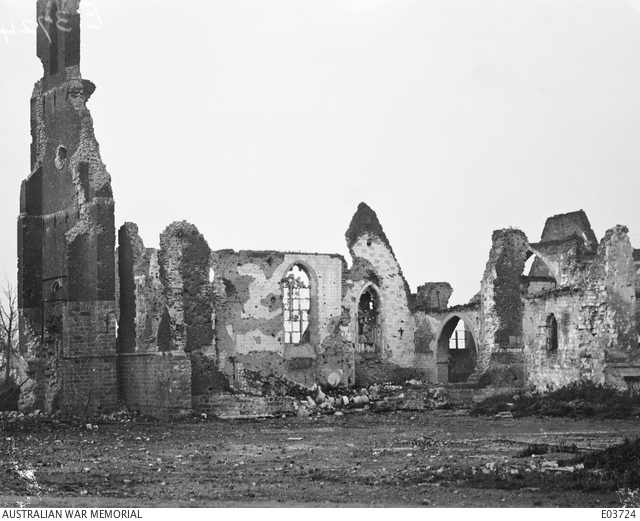
Unknown Australian Official Photographer
Ted was transferred by train to No. 13 General Hospital in the Casino at Boulogne and was immediately operated on. He had gunshot wounds in his chest – a small hole just below the neck and a large cavity four inches in diameter on the left side. His lung had been shattered and what was left had collapsed. His heart had moved and could be seen through the hole. The right arm was smashed through the elbow. There were four small shrapnel wounds in his back, one partially paralysing his spine.
Then, to make matters worse he contracted tetanus, a horrific agonising death sentence, yet Ted survived. He had almost daily operations, including the removal of part of a rib done without anaesthetic because his chest was too bad to administer it. His condition fluctuated, he hovered between life and death, but just over six weeks later, on 2 September 1916, Ted was transferred to England to Fort Pitt Military Hospital at Chatham, Kent.
At Fort Pitt, Ted underwent a lengthy operation conducted by the King’s surgeon, Sir Frederick Treves, removing portions of six ribs; the remaining part of a lung was treated and inflated. Again it was touch and go, with medical and nursing staff fearing he would ‘go under’. The pain he suffered is mentioned but it is not dwelt upon.
Mere words cannot tell what Ted endured, nor, for that matter, can they adequately express the suffering of those who nursed and watched and waited over him day and night. (Ch.XVII)

And no matter what happened, it is told with a touch of humour. A few days after his operation, Ted, looking at all the tubes running in and out of him, commented: ‘You’d think a man was a blanky Murrumbidgee irrigation farm.’ He also kept the removed portions of his ribs in a jar on his bedside locker, joking of the pain he suffered when the nursing sister dusted them.
The doctor dresses Ted’s chest wounds, mopping out the cavity with gauze pads on large forceps. This does not hurt, in fact it tickles his back ribs on the inside and makes him laugh.
Ted even asked for a mirror to be held near the hole in his side so he could see, ‘and when he saw his heart he remarked that it looked like a piece of meat. Maybe he expected it to be of gold.’ (Ch. XVII)
It is astounding that with such extensive injuries, in those days without antibiotics, that Ted survived. Beyond Ted’s grit and determination, it is also a testament to the dedication, skill and resourcefulness of the medical and nursing staff.
His suffering is always accompanied by thought for those who cared for him.
Many other friends—doctors, sisters, V.A. nurses, wardsmaids, orderlies, and convalescent patients—gave untiring service, sympathetic treatment, and cheer. Their kindly words of encouragement, their jocular remarks, their little acts of kindness smoothed the roughness of the way and helped to clean and heal the wounds of the mind for which there are no lotions other than love and understanding. (Ch.XVI)
Six months on, exactly, from the day he was wounded, Ted was lifted out of bed and stood on his own two feet and ‘with right arm hanging in a splint, left arm in a sling, body bent, and two stiff legs—he walked.’
He was transferred to the No.1 Australian Auxilliary Hospital at Harefield, Middlesex, preliminary to returning to Australia. On 22 February 1917, Ted embarked on hospital ship Karoola for the journey home.
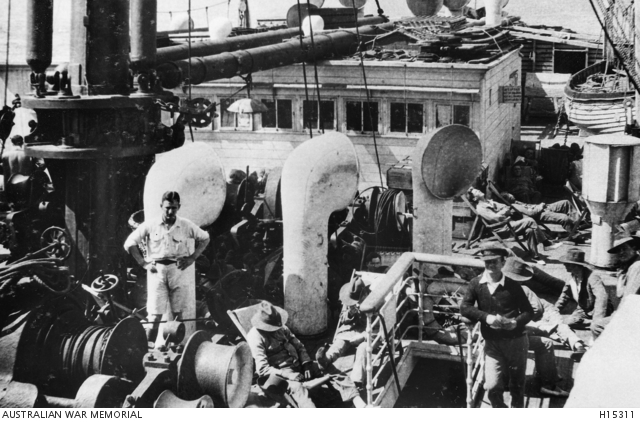
When the ship reached Sydney on 12 April 1917, Ted faced an unimagined future.
And, for one who was of no further active use, well there was nothing left but to make the best of a bad lot, have a good time, try and find a place in civilian life, keep smiling and—forget. (Ch.XIX)
Ted wanted to quietly return home but the newspapers were full of his arrival.
“Boy Hero Comes Home,” “Young Soldier Hero,” “Boy Soldier’s Silver Ribs”7 (but nothing about his tin ——) were some of the headings to the wild fictions published by the Press. (Ch.XX)
Ted’s parents’ house was decorated with bunting and the whole neighbourhood had gathered to welcome him home with speeches. Finally, ‘Dad and Ted adjourned to the woodshed for a yarn, and it was not until the early hours of the following morning that mother and son had an opportunity for quiet talk.’
A few days after his return, Ted joined the other soldiers from hospital ship Karoola at Randwick Military Hospital where he underwent numerous operations. He was discharged from the Army on 12 October 1917, but his medical treatment continued. By this stage, Ted had become addicted to morphine, both what was medically prescribed and what he could obtain elsewhere. Without it, he suffered unbearable pain. He noted, ‘The military hospital was a good market for the war-profiteer whose nefarious business was the selling of drugs.’ (Ch.XXI)
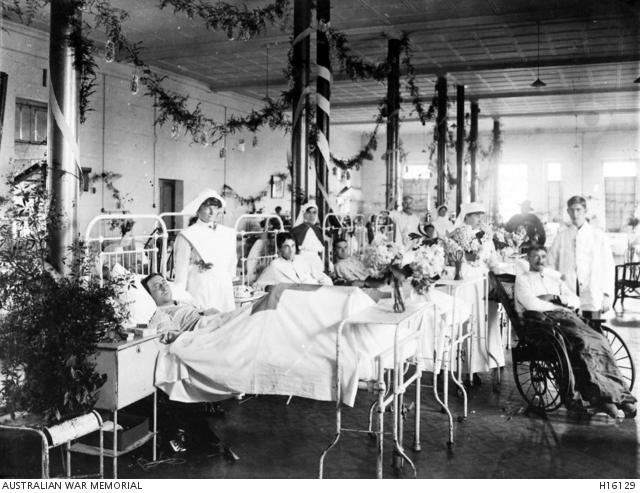
With other chronic patients Ted was transferred to the Royal Prince Alfred Hospital in January 1918. Initially the hospital staff were not aware of his addiction because morphia was part of the medical treatment. Like most patients, he undertook handcrafts, in Ted’s case leather-work. Sales of his leather-work, along with his pension, funded his addiction. His condition deteriorated to the point where he was ‘void of anything else in life other than to sleep and dream, crave and rave, and sleep again.’ The superintendent of the hospital set up a strict regime and, with the support of other staff, over many months Ted was able to successfully fight his addiction.
And so Ted, yet a boy of but twenty summers went home. Despite the years of suffering and the hell through which he had passed, the flame of youth that had so many times almost burnt out was still there—a little dull, and flickering somewhat—but there nevertheless. Within a few weeks it had kindled the fire of ambition, and in the bright glow that radiated from the flames he pictured the future—successful occupation, a home of his own…There was much to live and strive for, life was sweet. He planned and set to work accordingly. (Ch.XXII)
The final chapter of There and Back covers the years 1919 to 1935. Ted had begun a correspondence course in book-keeping and business training in 1918, and was admitted to an accountancy institute in 1934. He was involved in organising returned soldiers’ clubs and associations and was responsible for placing hundreds of returned men in employment.8 He set up his own studio for his art leather-work in Sydney. Within a few months of his discharge, he said he had lost his craving for drugs.
His right arm was stiff and still had an open wound and so was amputated above the elbow, without morphia, in 1920 and he was fitted with a prosthetic arm. Later that year, he took on the job of clerk with a manufacturing company and rose to become the employment manager. Believing he was now settled in to civilian life, Ted married in 1922.9 In 1925, Ted needed yet another operation. He hoped that morphia could be avoided but his condition after the operation was such that it was administered ‘and again he went through the hell of 1919.’ With the help of friends and the former superintendent of the Prince Alfred Hospital, ‘the evil thing was again conquered.’
Ted had several business ventures, a couple in partnership with a mate including manufacturing and retailing gramophones, casual employment in his mate’s estate agency business, work with his own ‘model breeding’ poultry farm.
Courtesy National Archives of Australia
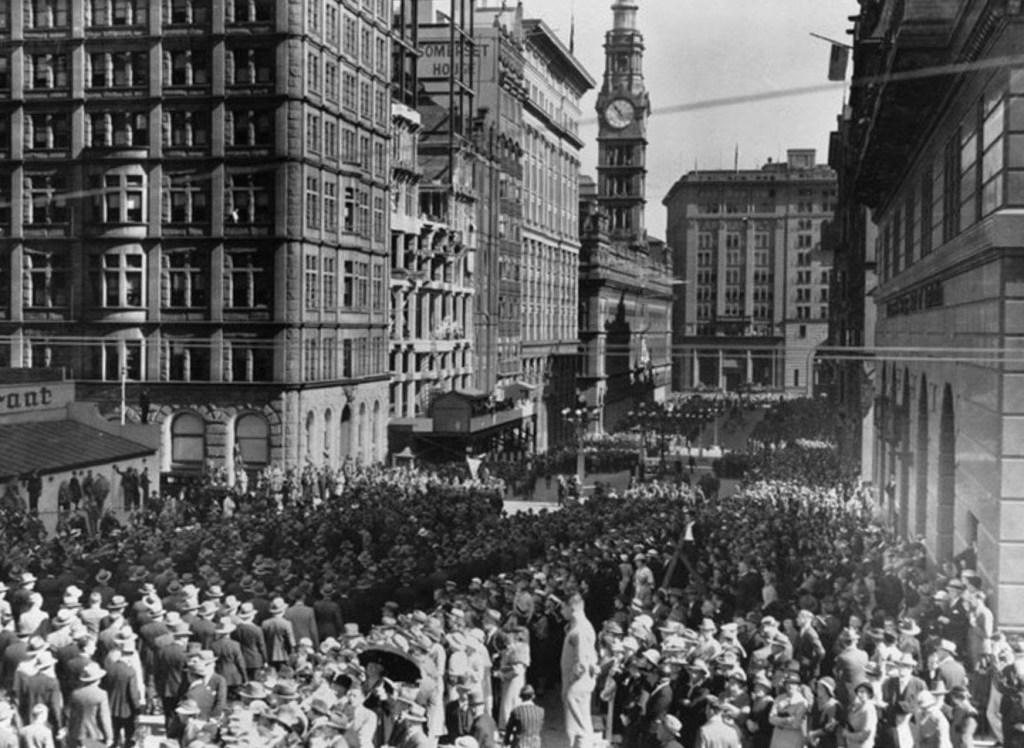
The book ends on Anzac Day 1935 with the Dawn Service and the Anzac Day march, and the gathering afterwards.
Tribute has been paid. Fallen comrades have been honoured. And, as in the past—when Diggers had erected a rough wooden cross to mark the last resting place of some beloved cobber, and made their way to the estaminet and carried on—so these sixty thousand Diggers went to their respective rendezvous. It was as their absent comrades would wish.
Of Ted, There and Back concludes
While there are returned soldiers’ organizations to be served, and while his one lung is able to provide the energy of life, his left arm is not idle for want of something useful to do. (Ch. XXIII)

The first half of the book is interesting and provides detailed glimpses of the life of a bright young recruit full of both enthusiasm and occasional thoughtlessness. We see, too, the range of characters from all sorts of backgrounds who enlisted, their interactions, their attempts to stretch the rules when they can; we see them behave in ways we would prefer they did not. We also see genuine mateship in adversity, men putting themselves in danger to aid a mate. It is the second part of the book, after Fromelles, that makes this memoir extraordinary. It is astounding that with the severity of his chest wound, and the tetanus, Ted survived at all. This part of the book shows so clearly that returning to Australia was not the end of the war. Ted faced ongoing pain and suffering, more operations, and his battle with drug addiction. He faced it all with stoicism, endurance and wry humour – that last, a quality that was very much part of the character of men and women of this generation. It is an honestly written book – it shows Ted warts and all, but it does not tell the whole story. It tells almost nothing of Ted’s later family life and how his wife and children coped with his life of physical and psychological pain, and the periods of addiction. It is understandable that he would want to shelter his family from prurient interest and, I imagine, he had no wish to share every detail of his personal struggles. Stoicism was what the culture of the time demanded, and Ted presented a stoic and good-natured face to the world. And while his survival was astounding, his reaction to the new circumscribed world he faced was equally so.
There and Back is Rowland Edward Lording’s story and that continued beyond 1935. Although he was assessed as totally and permanently injured and despite his continuing struggles with pain, and his further hospital admissions, Rowland Lording continued his interest in the welfare of other soldiers. It is worth wondering what he would have achieved in life, both for himself and for those around him, if he had not been injured or if he had been forced to wait until he was 18 to enlist.

Western Mail 9 Jan 1936 p.6
On 20 September 1944, Rowland was admitted to the Prince of Wales Hospital suffering from ‘severe nerve storms’; his wife was described as ‘almost worn out attending him.’ While at the Prince of Wales he was restless, talkative and confused. He suffered delusions and attacked another patient and threw himself out a window. He was transferred to the Reception House, Darlinghurst, on 22 September. The Reception House served as a place for the temporary detention and assessment of persons believed to be mentally ill but not yet certified as such. Rowland was described as ‘hallucinating, noisy and difficult to control.’ As he had not improved, on 26 September he was certified and transferred to the Callan Park Mental Hospital. On arrival he was found to be suffering from broncho-pneumonia.10
Rowland Edward Lording died on 1 October 1944. He was only 45.11 His cause of death was broncho-pneumonia but equally it could be said that he died of wounds.

I have based my discussion of There and Back on the understanding that anyone who reads it will already know of Rowland Lording’s experiences. And while it might seem that I have told his whole story, I have merely skimmed the surface. I thoroughly recommend this book to anyone interested in the experiences of the ordinary men who made up the Australian Imperial Force, anyone who wants to see beyond the statistics and numbers to the faces of those men.
- Copies of There and Back are now difficult to obtain but there are a few are held by state, university and military libraries. The book has been digitised by the Gutenberg Project and can be read at Archive.org but lacks page numbers. This is the copy I read and consequently I have only been able to give chapter numbers in reference to quotations. ↩︎
- Edward Lording operated a bicycle enamelling and electroplating factory where Rowland worked as a book keeper. ↩︎
- At the start of the war ‘military age’ was defined as being 19 to 39 years. Standards were high, men were required to be 5 foot 6 inches in height with a fully expanded chest measurement of 34 inches and perfect vison. Standards were lowered as the war progressed and the supply of eager volunteers declined. In June 1915 military age was redefined as 18 to 45 years, height was dropped to 5 foot 2 inches and chest expansion to 33 inches. The height limit was further lowered in 1917 to 5 foot. ↩︎
- Lording’s height on enlistment was 5 foot 4 inches and he was described as sturdily built. The Sun (NSW) 29 Apr 1917 p.13 ↩︎
- James Martin (1901-1915) was one such young man. He was the youngest Australian to die on active service and similarly threatened his mother that he would ‘run away, join under another name and not to write to her if he succeeded in being deployed.’ He enlisted in 1915 aged 14 and 3 months. He arrived at Gallipoli on 7 September 1915 but later in October contracted typhoid. He died on aboard the hospital ship Glenart Castle on 25 October 1915 and was buried at sea. ↩︎
- At Fromelles, Australia suffered the worst twenty-four hours in its history with 5,533 casualties in one night with over 2,000 killed in action or dying of wounds. ↩︎
- Many claimed that as his ‘ribs could not be replaced, a silver plate was put in instead. On it is engraved a memorial of the battle in which Rowley was wounded, and its date.’ Evening News (Sydney, NSW) 12 Apr 1917 p.3. Tiveychoc states in the book that ‘At one time there was some talk of putting a silver plate in his side, so he asked that it be engraved with the date and name of the battle, but the idea was later abandoned.’ (Ch. XVI) The engraved plate story has been repeated in modern articles on Rowland Lording. ↩︎
- Rowland Lording was honorary manager of the employment bureau of the Limbless Soldiers’ Association and also the founder of the 30th Battalion Association. ↩︎
- On 14 June 1922, Rowland Lording married Rosalind Mary Crowther, a young woman he had met in England. They had two sons and a daughter but separated in 1940 and were divorced in 1941. Lording married Orea Moustaka in 1943. ↩︎
- Repatriation File PP6451 M34291 Courtesy National Archives of Australia ↩︎
- The number of returned service men and women who died prematurely of war related causes is not known. The 1933 Census shows a decrease of 38,000 veterans in the 14 years from 1919. Casualties of war by Craig Tibbitts ‘Rebuilding Lives’ ↩︎

