Although the Armistice was signed just after 5 o’clock in the morning of 11 November 1918 and the guns fell silent at 11 o’clock, the war did not officially end until the signing of the Treaty of Versailles on 28 June 1919. To mark this longed for moment, King George V requested that a special Service of Thanksgiving be held throughout the United Kingdom and the Empire at 3pm on the first Sunday of the Peace, 6 July 1919. As well, an official day of celebration was to be held two weeks later on Saturday, 19 July.
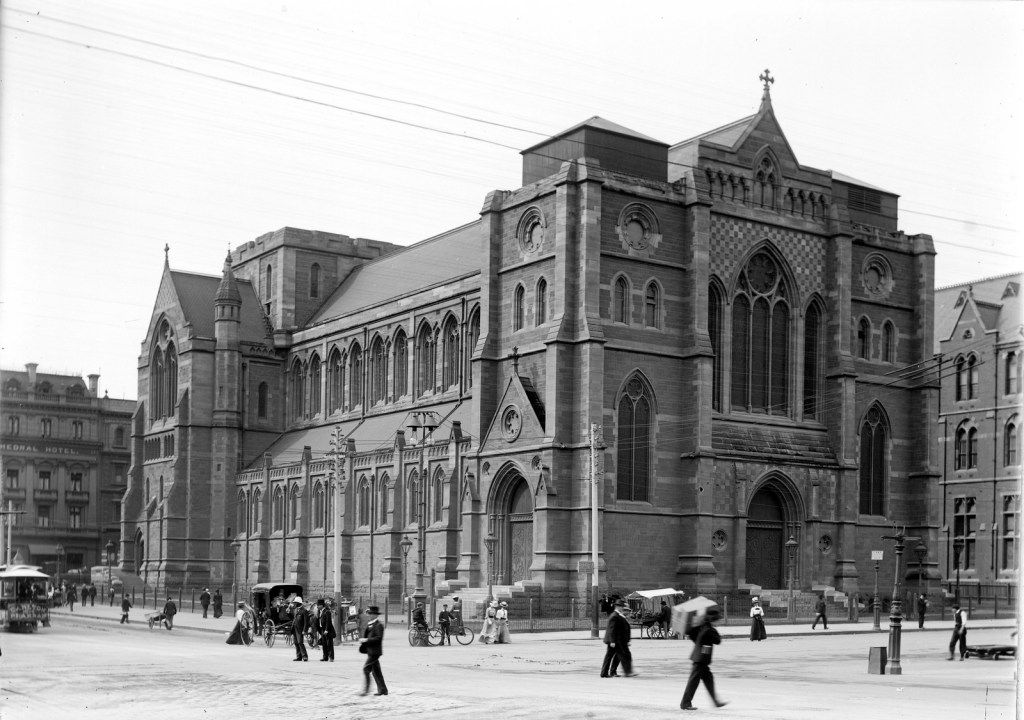
Courtesy State Library Victoria
In Australia church services were held by all denominations on 6 July, attended by large congregations giving thanks for ‘the blessing of peace after the prolonged years of war.’ Civic services were held in Town Halls, Mechanics Institutes, Drill Halls and other halls in every township and city across Australia. This was a united Protestant service compiled by the national leaders of the Anglican, Presbyterian, Methodist and Congregational churches and approved by the Commonwealth and State Victory Celebration Committees. The services began with singing of the Old Hundreth and prayers were offered for the King and the country and in thanks for the Peace. Other prayers and hymns followed. At exactly 3.30 p.m., the Proclamation of Peace was read and the national anthem sung. An address was also given during these services either by local ministers, invited military chaplains or by local dignitaries. Although those of the Catholic and the Jewish faiths did not take part, they held their own special services. In Melbourne, Solemn High Mass was said at St Patrick’s Cathedral and a prayer of thanksgiving was said; this prayer, Pro Gratiarum Actione (For the giving of thanks) had been recited in the Catholic churches of the diocese since the signing of the peace treaty. A special vespers service was also held at the Cathedral and at St Francis Church in Lonsdale Street. On both the Saturday and the Sunday, synagogues held special services approved by the Chief Rabbi of the British Empire. In Melbourne additional prayers were added to the Sabbath services at the Bourke St Synagogue. As well there were services in country and suburban synagogues and Catholic churches.
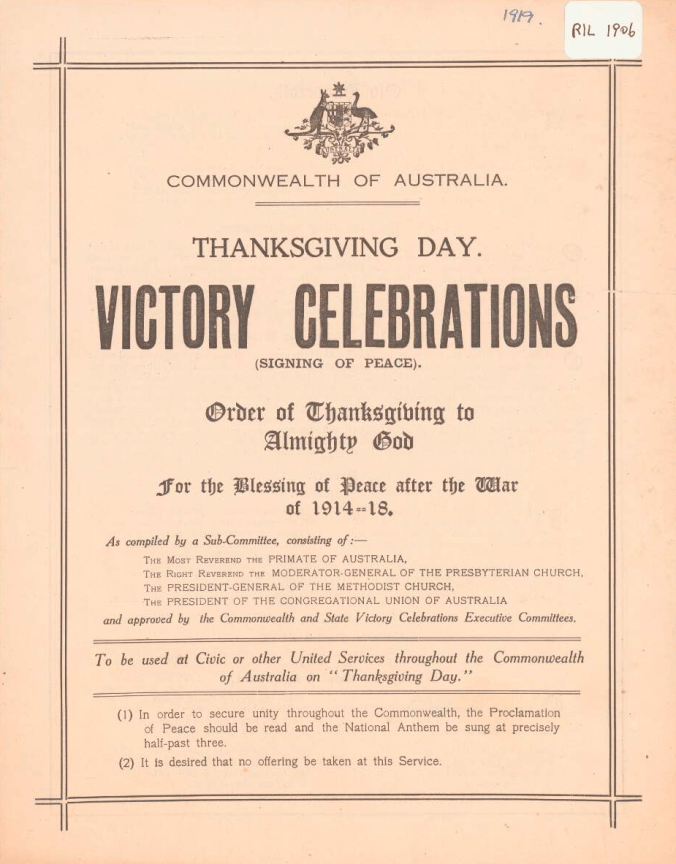
Courtesy National Library of Australia
The Brunswick & Coburg Leader of 11 July 1919 reported on the service held at the Coburg Town Hall. All civic services would have been similar to this.
A thanksgiving service of the united churches was also held in the Coburg Town Hall, which was crowded to the doors. The Mayor presided, and the other councillors were also on the platform as well as the clergy of the various Protestant churches. Prior to the reading of the Peace Proclamation by the Mayor, Bandmaster Davison, of the Coburg Municipal Band, acted as trumpeter and blew blasts to all the four quarters.
The combined choirs effectively aided by the Coburg Band, rendered the musical portion of the service in which the large audience joined.
The Mayor delivered an appreciative address on the war, its incidents and its effects upon the world.
The Rev. John Mathew [Methodist Minister] also gave a moving and eloquent discourse…
The official day of celebration was held a fortnight later. In the week leading up to it, Peace Medals were handed out to school children across Australia at special services held in each school. The medals were issued by the Defence Department to commemorate the signing of the Treaty of Versailles. The were made of silvered brass and suspended on a red, white and blue ribbon.
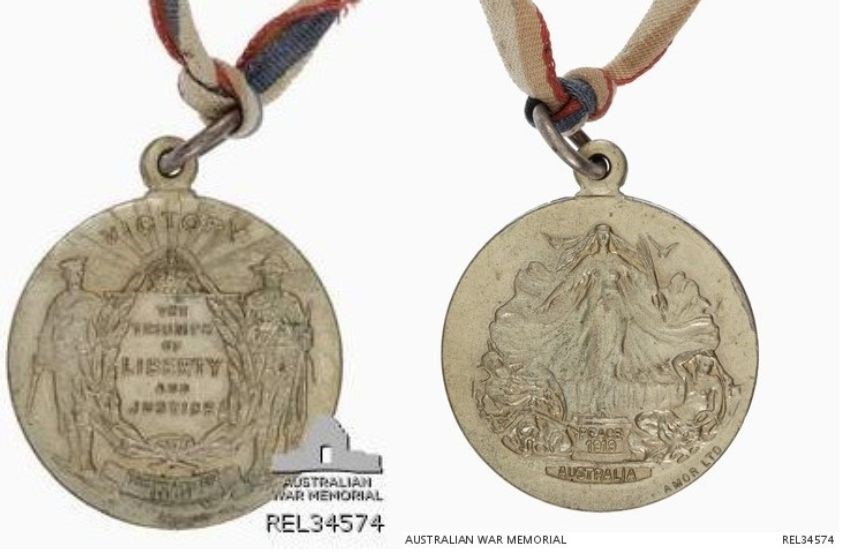
Courtesy Australian War Memorial
Initially, despite the grief for those who would never return, the Armistice had been greeted with relief and jubilation, yet Peace had been a struggle so far. The ‘Spanish’ influenza had arrived in December 1918 and surged in two waves through the first half of 1919. A seamen’s strike, over three months from May 1919, brought shipping to a standstill, affecting the supply of coal to industry and a reduction in public transport. Not all the troops were yet home1 but a public holiday was proclaimed for 19 July and, with the influenza waning, the public was keen to celebrate.
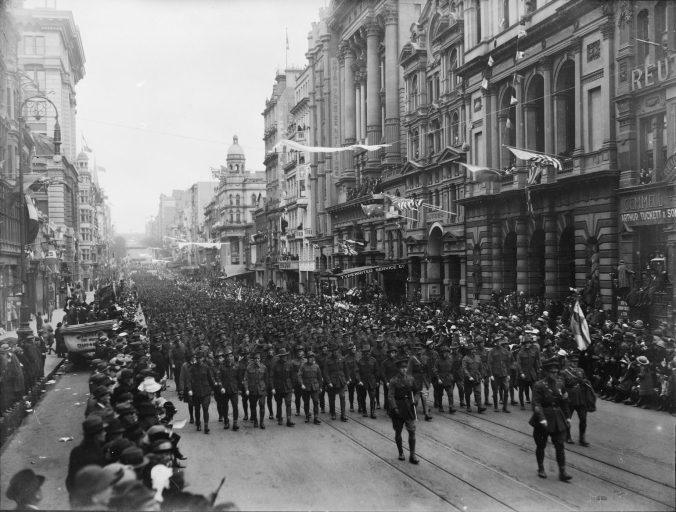
In Melbourne, despite a cold, biting wind and the threat of rain, thousands flocked to the city to watch the parade of returned soldiers. The city was brightly decorated. The Australian flag and the Union Jack, and those of the Allied nations, flew from the upper windows of buildings or were displayed at the front of shops. Bunting in red, white and blue was strung from verandahs. Along the route of the march, banners stretched across the street, each with the name of a battle from Gallipoli and Pozières near the beginning to Villers-Bretonneux and Palestine towards the end. Brightly coloured streamers fluttered everywhere, many unfurled by those sitting at first and second storey windows. Wreaths of gum leaves, one for Peace and one for Victory, hung at the intersection of Swanston and Bourke Streets. At Collins and Queen Streets two shields, surrounded by leaves and blossoms, welcomed the soldiers home. Five aeroplanes flew overhead and performed stunts high in the sky.
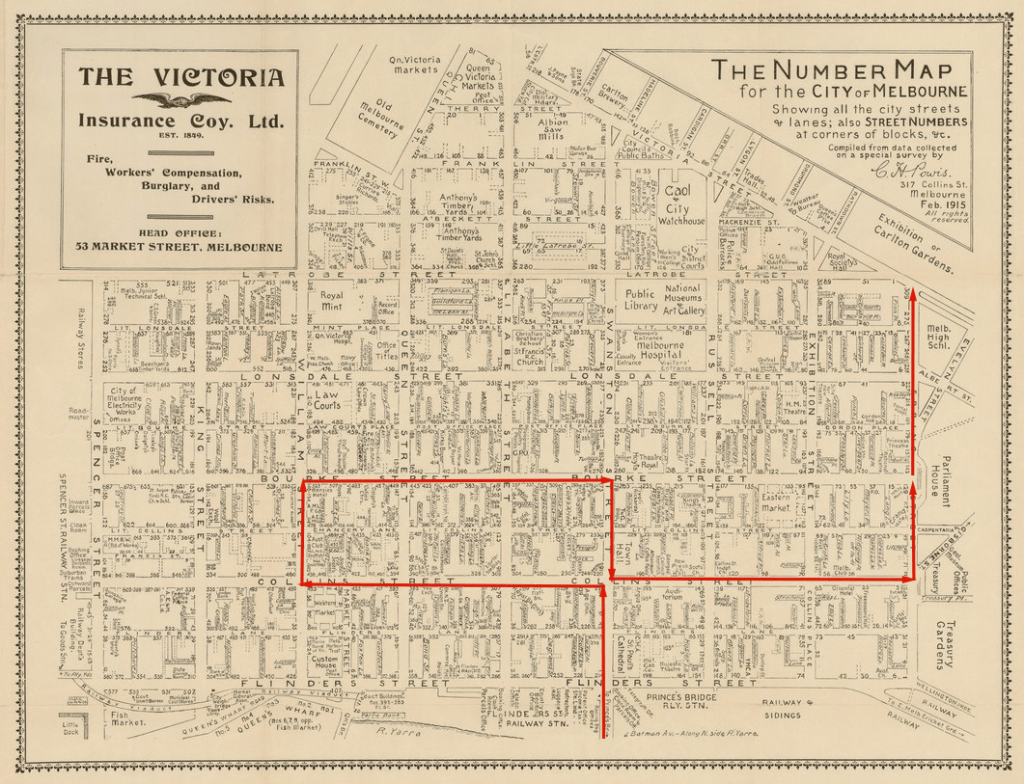
Map of City of Melbourne created by E. W. Cole 1915
Courtesy State Library Victoria
At a quarter past ten the march set off from Princes Bridge into Swanston Street to the pealing of bells from St Paul’s Cathedral and a roar of welcome. The parade was to do a circuit of the city. It was to turn westward into Collins Street and march as far as William Street, then along William to Bourke Street. It would turn from Bourke Street back into Swanston and then into the eastern section of Collins Street. Once the parade reached the top of Collins Street, it would march along Spring Street to the Federal Parliament House. Bands played, some marching, others positioned along the route.
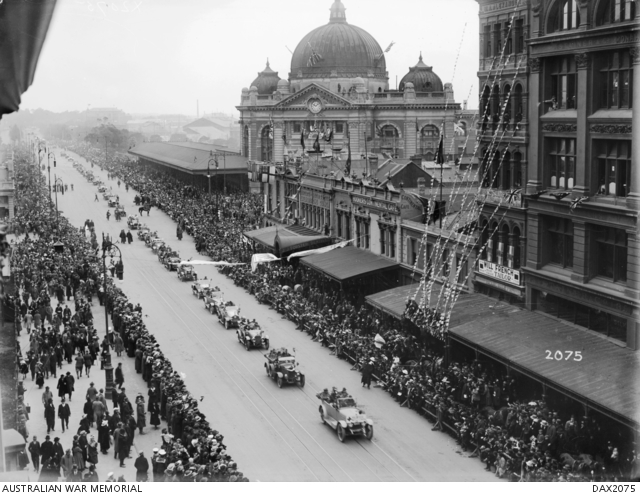
Flinders Street railway station in the background.
Darge Photographic Company
First came a stream of cars carrying wounded and invalided men from the military hospitals, followed by the nurses in their grey uniforms, scarlet capes and white veils. They took up position to watch the rest of the procession near the saluting base at the Federal Parliament House where, behind the flags, stood the Governor General in the uniform of an Australian militia officer, Federal and State Ministers, senior naval and military officers, consuls of Allied nations, heads of religious denominations and local mayors and city councillors.
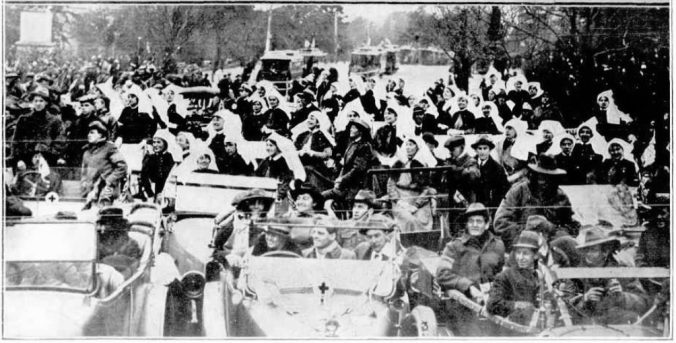
The Australasian 26 Jul 1919 p.ii/54
Thirteen platoons of sailors were cheered as they marched by. The cheering increased in volume at the sight of the Light Horse and other corps that had been fighting in Egypt and Mesopotamia. After them came the Camel, Cyclist and Flying Corps.
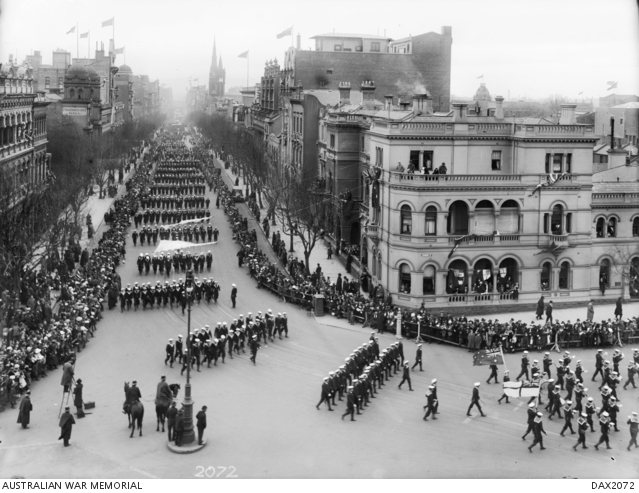
Darge Photographic Company
The battalions were divided into groups, each group led by a Brigadier General on foot. They marched with precision, in the same steady rhythm as they had in the farewell parades over the years from 1914. But rather than marching in disciplined ranks of four, rifles with fixed bayonets on their shoulders as they had in those years, they were now spread across the road in ranks of twelve, in uniform but without their rifles. Not all looked straight ahead, some glanced towards the crowd, grinning at a family member or a friend glimpsed beyond the barriers.
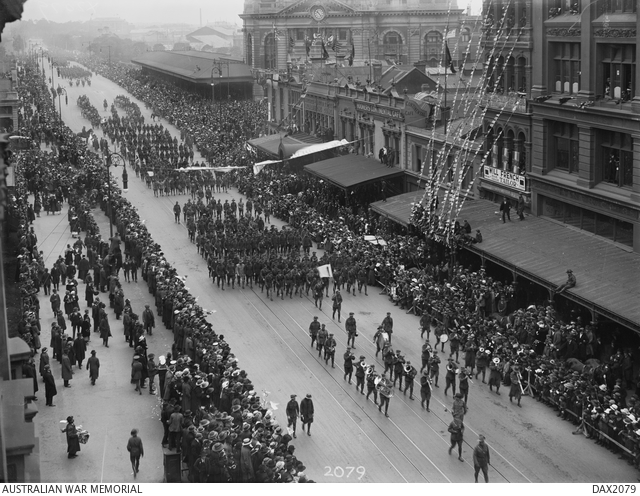
Darge Photographic Company
Photographer: Kerr Brothers.
Courtesy State Library Victoria. Harold Paynting collection.
Most of the crowd, packed ten deep in places along the route, cheered, cooee’d and waved flags. But some stood stiff with self-control, others wept. Among the crowd were women, mothers and widows, wearing the Mothers and Widows badge pinned to their coats. ‘… many were silent as the troops went by. For many still remembered Gallipoli and the battles in France.’ (The Age 21 July 1919, p.9)
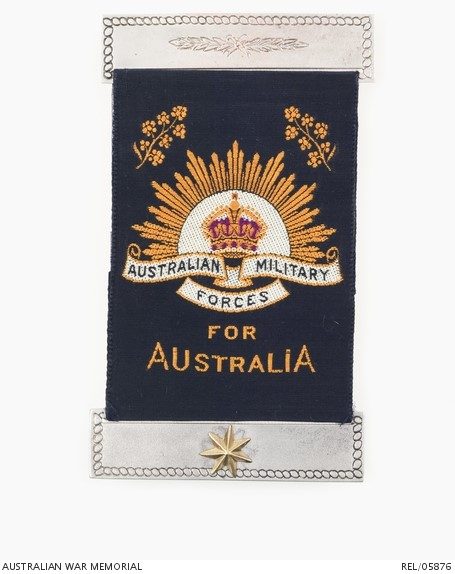
This badge was issued to Mrs Annie Caroline McPherson, mother of Private Leslie Herbert McPherson who was killed in 1917.
The celebration of peace and of victory was for some a day of remembrance of the fallen.
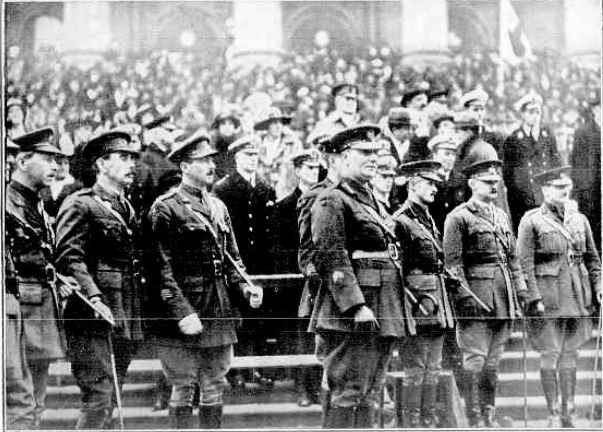
The Australasian 26 Jul 1919 p.iii/55
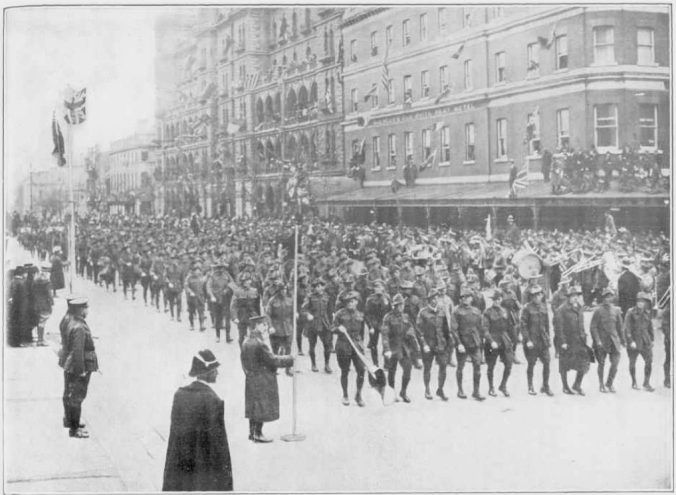
While marching, the formation leader salutes and the remaining ranks turn their heads and eyes toward the reviewing officers and officials.
The Australasian 26 Jul 1919 p.iii/55
At eleven o’clock the parade reached Parliament House and halted. The flags were lowered. A bugler sounded the Last Post. As the notes carried, the soldiers stood to attention and the crowd fell silent, men removed their hats and all heads were bowed, all thinking of those tens of thousands—soldiers, sailors and airmen, and twenty-five nurses—lying dead so far from home. Except for muffled sobs, the hush spread through the streets, continuing after the Rouse was sounded. Then, as if shaken from a solemn reverie, the parade moved on.
Photographer: Kerr Brothers.
Courtesy State Library Victoria. Harold Paynting collection.
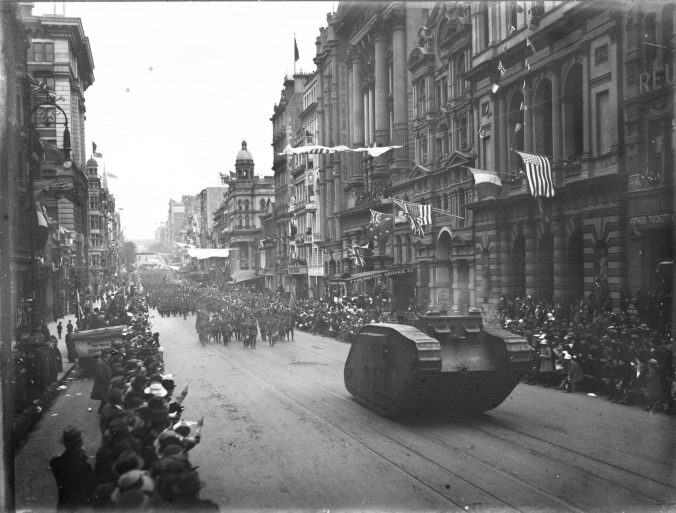
At intervals between the marching battalions the war trophies captured from the Turks and the Germans were paraded: machine guns, field guns on infantry wagons, a massive grey tank lumbering slowly along.
Photographer: Thomas McKenzie Hill
Courtesy State Library Victoria
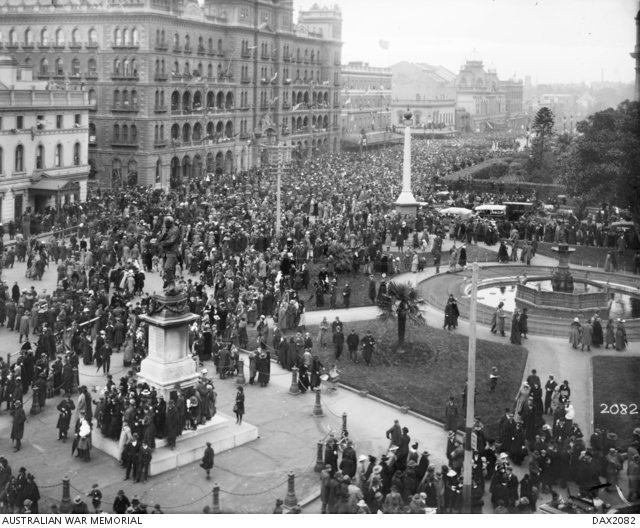
When the last battalion had passed the saluting base, they marched on to the Carlton Gardens where light refreshments and cigarettes were available for them. And, the parade over, the day was theirs. They could go to the races at Caulfield, or to the football, where they would be admitted free of charge. Or spend their day in whatever way took their fancy.
Darge Photographic Company
Apart from the parades in the cities and towns around the country, many places celebrated with events that involved children. In the Gippsland town of Maffra ‘a big programme of entertainment’ was arranged for the children of the area.
…nothing will be left undone to ensure the kiddies being impressed with the importance of the occasion. All residents of the district are specially asked to use their best endeavors towards making for complete success, and parents are invited to bring their children—and all of them—so that they will remember always this notable day in history. Each child is required to bring his or her ‘own mug’ so that the day will not be ‘dry’ for them. Everybody bring luncheon and make it a big picnic day. Hot water will be on the ground and biscuits and sweets for the kiddies.
Business folk are asked to decorate their stores and places of business and help to make the appearance in every way impressive.—The Maffra Spectator 14 July 1919 p.3
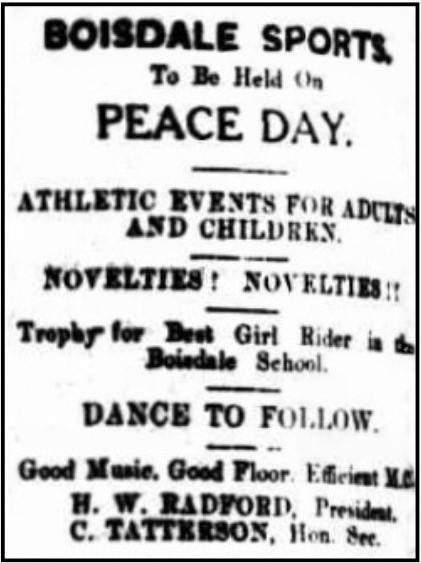
Nine miles away at Boisdale there was entertainment for every one.
In suburban Melbourne, Coburg decided that its main celebration of the peace would be a carnival for the children. Children marched in their school groups to the recreation reserve where the Moreland School Cadets band played as they entered. The celebration began at 11 o’clock with a ceremony saluting the flag followed by ‘short’ patriotic addresses. Then refreshments were served to the children. Races and other sports activities were held through the early afternoon. Carnival attractions included a merry-go-round and steam and hand driven ocean waves as well as a refreshment and other stalls.
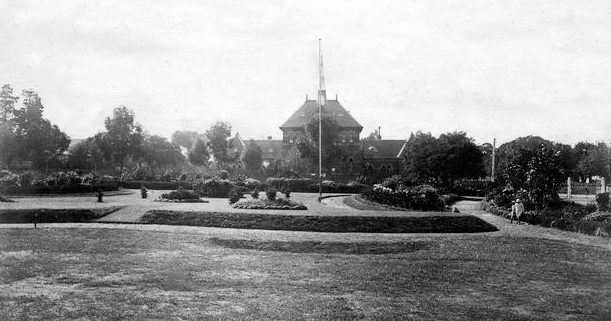
Photographer: Walker
Courtesy Picture Victoria
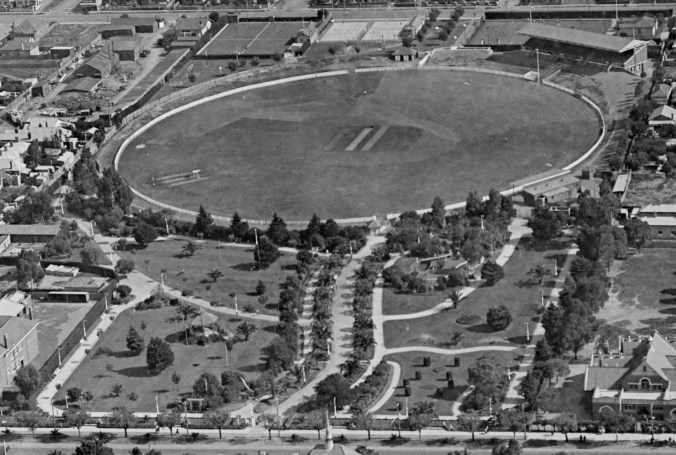
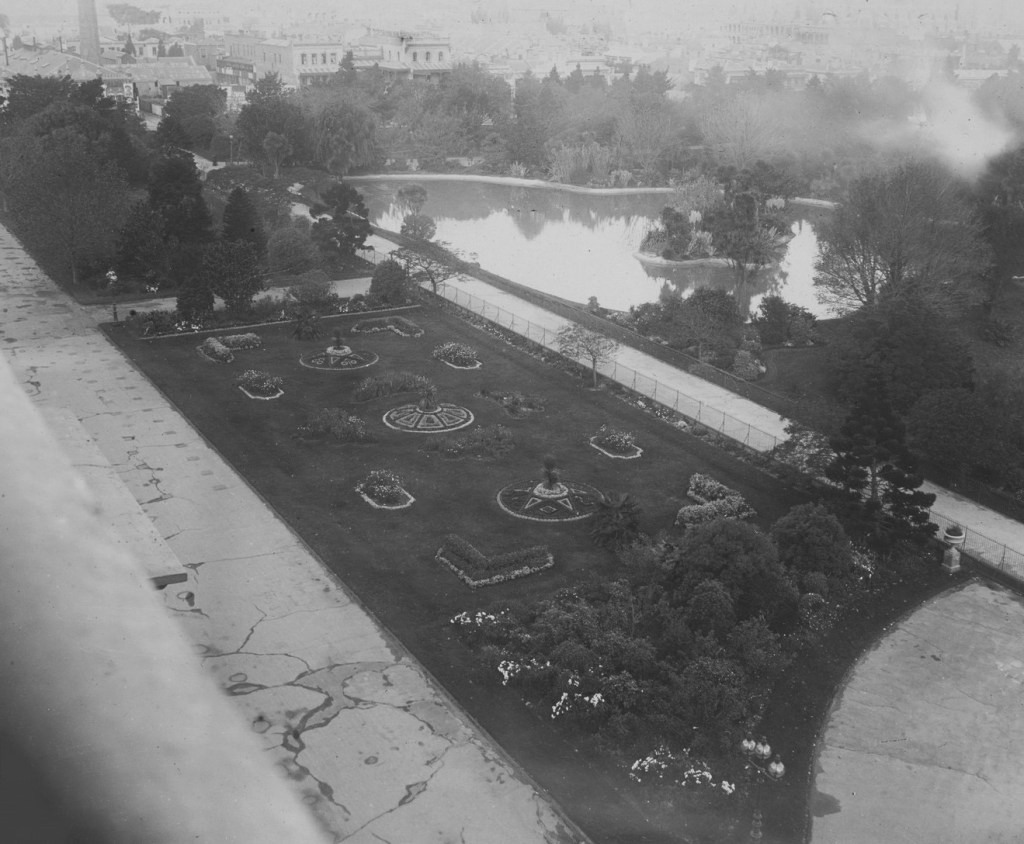
The football oval and bowls and tennis courts to the south.
(This photograph is taken from the north looking southward)
Photographer: Airspy
Courtesy State Library Victoria
A campfire concert planned for the evening was cancelled because of the weather but, as the rain had stopped, the fireworks display went ahead with roman candles and catherine wheels, the bursting lights from rockets lighting up the night sky.
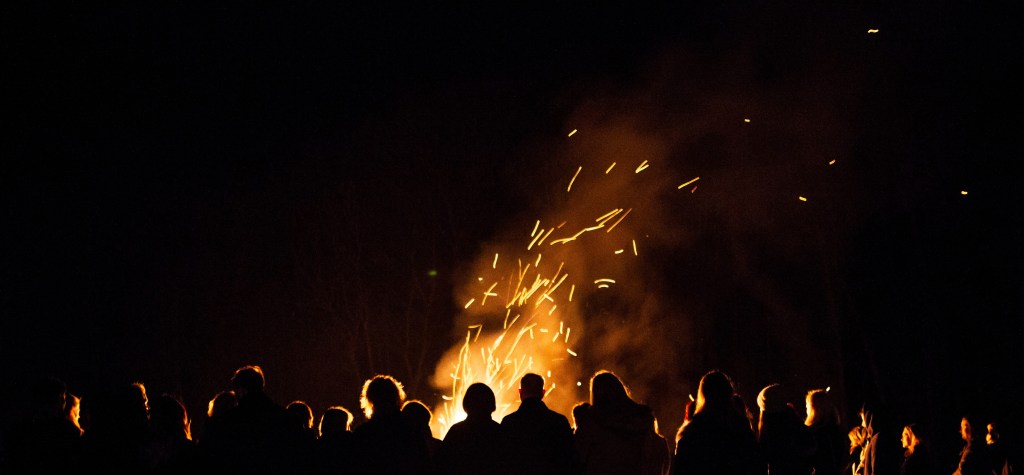
A ‘monster’ bonfire had been built of brushwood, timber, and anything else that would burn. An effigy of the Kaiser had been hoisted to the top and the wood below well doused with kerosene. At half past eight the Mayor of Coburg, Cr McAlpine, set fire to the wood. The flames rose steadily through the pile, licking upwards to the effigy, burning off the clothing. When the head tumbled downward into the bonfire, a massive cheer rang around the reserve.
While around the country the day was a fitting celebration of the peace, in Melbourne what may have started out as boisterous celebration—there was a band playing on the Town Hall balcony and revellers dancing below—as the night progressed it descended into riot which continued over four days.2
Returned servicemen played a large part, though some said there were a number of civilians masquerading as soldiers in the crowds. Many returned men were disgruntled at their treatment since their return, especially at the level of unemployment and the difficulty in finding work. The spark was the arrest of two soldiers for unruly behaviour and attempts to release them from the lock-up. Initially, it seemed to be fuelled by alcohol although all hotels and public houses had been closed for the day as was usual at the time for public celebrations. Police dealt with the rioters using batons and horse charges. The next night, Sunday, there was a march on Victoria Barracks in St Kilda Road, some thought to raid the armoury, which descended into riot again and in the melee one man was shot and killed by a sentry. On Monday men marched to the Treasury Gardens where the Premier addressed them from a balcony. A small group surged into the Premiers office and he was injured when a heavy inkwell was thrown at him. Outbreaks continued but the tide turned on Wednesday 23 July at a meeting of ex-servicemen and soldiers at the Kings Domain, called by the State Commandant Brigadier General Brand. The men were addressed by a number of military commanders including the well-respected, even loved, Brigadier General H.E. ‘Pompey’ Elliott who was given a ‘rousing reception’.3
And with the celebrations and their aftermath over, all now faced the reality of the peace.
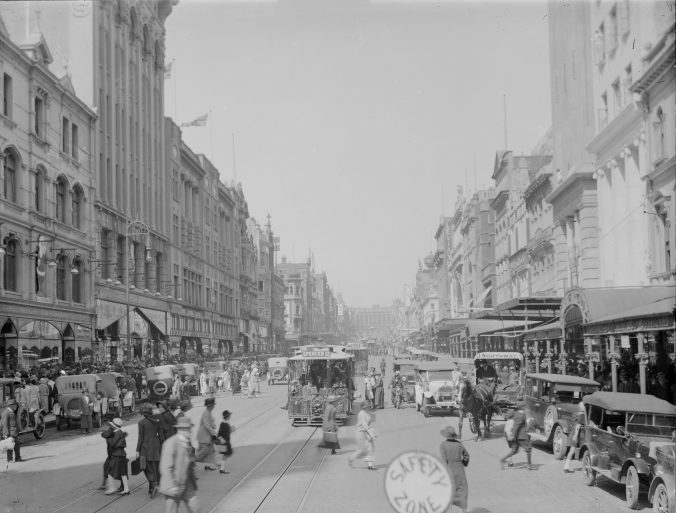
Photographer: Lyle Fowler
Courtesy State Library Victoria

- – Around 58,000 would return in the next three months. Those still in Britain would have taken part in the celebrations there. https://aif.adfa.edu.au/OrderOfBattle/statistics2.html ↩︎
- A short but detailed description of the riots and thoughts on its causes can be found in ‘Melbourne’s peace day riots, July 1919’ by Peter Hopper Sabretache: the journal of the Military Historical Society of Australia 2009, 50, 1 pp29-32
This should be available for download from any Australian State Library ↩︎ - Melbourne was not the only place to experience Peace Day riots. There were disturbances at a number of places in England. At Luton, Bedfordshire, the Town Hall was burnt down. A description of the events at Luton and their causes can be read here https://backwatersman.wordpress.com/2010/11/14/keep-the-home-fires-burning-the-peace-day-riots-of-1919/ ↩︎
 Catherine Meyrick
fascinating to see those historic photographs
▪️◾◼️⬛◼️◾▪️▫️◽◻️⬜◻️◽▫️▪️◾◼️⬛◼️◾▪️
LikeLiked by 1 person
Yes, Graham. We are so lucky to have such a window to the past.
LikeLiked by 1 person
💯👌👍🌟✨💫
LikeLike
An fascinating account, Catherine. All the more so, because I walked the streets earlier in the year.
It is interesting, that behind the public façade of unity, there seemed to be a great deal of discontent – not surprising having been dragged into a European war and suffered so much and the poignancy of what would happen in twenty years.
LikeLiked by 1 person
Thank you, Graham. I think, in the beginning, many had no idea what they would be facing. Gallipoli was a horrific awakening.
I often wonder what it must have been like for the men and women who went through that period to see their sons, and a few daughters, marching off twenty years later. But that was a war that had to be fought.
LikeLiked by 1 person