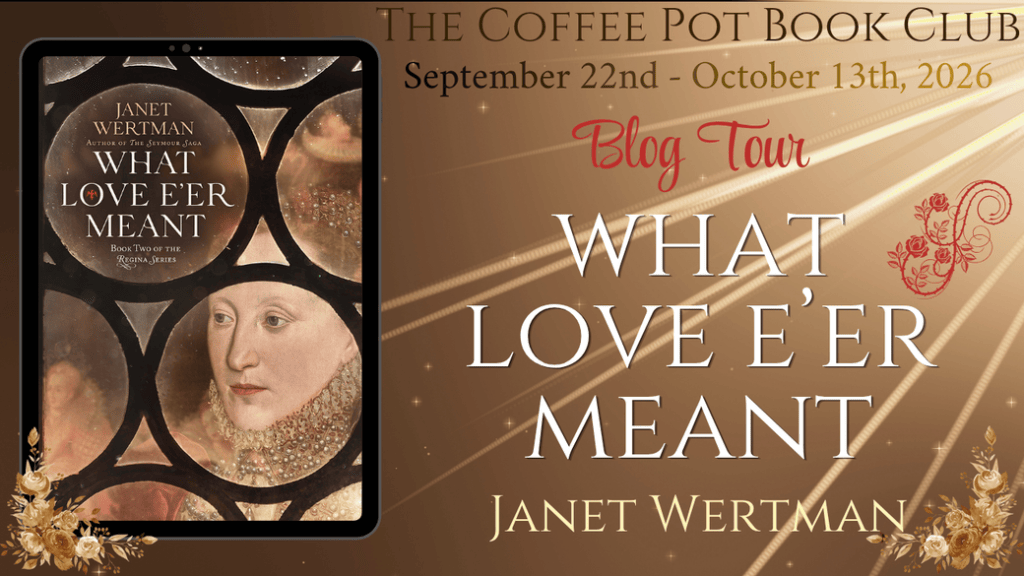
Today I’m delighted to be sharing an excerpt from Janet Wertman’s newly released novel, What Love E’er Meant, as part of a blog tour hosted by The Coffee Pot Book Club.

Blurb
A new queen must prove she deserves the throne God gave her, while the path everyone insists will secure it might cost her everything
Against all odds, Elizabeth Tudor has become Queen of England. Determined to fulfill what she sees as a divine responsibility, she sets out to heal a country ravaged by religious discord, war, and debt – and vindicate the legacy of Anne Boleyn, the mother who did not deserve her fate.
But Elizabeth’s crown is not fully secure: to the Catholic world, her cousin Mary Stuart is the rightful Queen of England and there are rumblings to put her there. Shoring up defenses requires that Elizabeth challenge France’s control of Scotland and Spain’s dominance on the seas, as well as calm internal strife. Above the din of menace, one question dominates all others: who will she marry?
William Cecil, her trusted Secretary of State, urges her to secure an alliance through a strategic match. Robert Dudley, the love of her life, pressures her to choose him. And Mary herself presents a cautionary tale. In the end, Elizabeth chooses not as a woman but as a queen, and learns the sobering truth of sovereignty: to rule is to stand alone.
What Love E’er Meant, the searing second volume in the Regina Trilogy, captures a young queen’s struggle to balance love and power, duty and desire…and the profound cost of choosing crown over heart.
Excerpt
April 5, 1559
Elizabeth’s heart filled with the gratitude of the season. The peace treaty’s terms, just agreed with France, represented another in the chain of early successes – political, religious, and economic – that would keep her and England safe. Even the pressure on her to marry had dissipated, and she had delightedly plunged into the rituals of Eastertide for this first Holy Week of her reign. Careful to give the Catholic world no reason to place a stumbling block to the treaty’s actual signature, she had deeply indulged the ceremonies she adored, not caring that they were far too superstitious for the reformists. Washing the feet of beggar women on Maundy Thursday, creeping to the cross on Good Friday, the Tenebrae service on Holy Saturday. She owed the Lord her full submission, and full submission He would have. She had even told Robin to stay away, that she would not profane this time with nighttime cards, innocent as they were; this was not the time for even a whisper of sin.
Now Easter Sunday had arrived, and the pastor before them thanked the Lord for delivering England from the dark night of the cross to the blazing light of salvation. The congregation then prayed for Elizabeth – as Supreme Governor of the Church of England. This was her first public acknowledgment of the title, a signal given to all her subjects in every service of the day. Elizabeth took a deep breath and added her private thanks to God for choosing her as His instrument.
When the service ended, she turned to Cecil. “We have done it. A Church of England and peace with the world. I will no longer chastise myself over Calais.”
“It was not your failing that lost it,” Cecil said. “And your efforts to get it back have already returned more than we hoped.” The French had agreed that England might recover Calais in eight years or receive five hundred thousand crowns, twice its value, in compensation. Not quite all Elizabeth wanted, but an important forfeit.
“Good reason for us to enjoy the Easter feast.”
And what a feast it was! Freed from the Lenten restrictions, the chefs had outdone themselves. Platter after platter was piled high with roasted meats – the traditional lamb, of course, as well as chicken, venison, and veal – and pies and custards and fritters, but the real attraction was the hot cross buns, rich with the eggs and butter forbidden during the last forty days.
The savory scents permeated the room, filling Elizabeth with joy, yet a piece of her felt empty: piousness was all well and good, but true celebration required true friends – and an important one was missing. She turned to Effingham. “Where is Robert Dudley? Why is he not seated with us? Is he sulking?” It was the most likely explanation: poor Robin had sworn he could not endure two weeks of exile. Truth be told, she was ready to repeal her harsh decree; surely it would not be so sinful to enjoy herself this week.
“Lord Robert is not at court right now,” Effingham replied. “He left on Wednesday for the country.”
He left. Was this to punish her? For banning him from her apartments? Ignoring his suit? Both? Desolation swamped her, its harshness unimaginable just seconds earlier. “Ah,” she answered coolly, turning to her food to end the conversation and examine her unexpectedly intense reaction to his absence.
Did she want to marry him? The question swirled in her head. Her reaction was unfiltered by logic or fear; it might be the most honest answer she could give herself. Why not admit she might accept him? England was at peace with the world, trade was thriving, the Treasury was starting to recover — even harvests were good. Why not reward herself?
She felt a small chill. Would that be a mistake? Any Englishman was beneath her, a Dudley most of all. Elizabeth deserved a glorious alliance, a husband who would bring to England rather than take from it. Anything less was failing in her duty.
Or was it? The greatest risk for a female monarch was to gift her power to a foreigner – look how her sister had sacrificed England. And marriage was a union of souls, a highly personal choice. Henry VIII had blazed that trail, choosing remarkable women, like Elizabeth’s own mother, over foreign princesses. Surely she could permit herself to do the same. She was Queen after all, entitled to her pleasure like her father before her. A smaller measure, perhaps, since she was a woman, but still. She took another bite of her bun, savoring the richness so long denied.
If only people didn’t dislike Robin so. The world called him overproud, the realm sneered at the line of traitors in his family, the Council mistrusted his judgment. It would take time for him to rebuild his good name. The time they had while Amy held on to life.
Elizabeth could elect him a Knight of the Garter; that would be a good first step to establish his worth, reconcile people to the possibility of more. The Order of the Garter was the oldest and most senior order of chivalry in England, with no more than twenty-six members at any time. Three deaths the year before had given Elizabeth the opportunity to shape the Order more to her liking. Membership would place Robin firmly among England’s elite, and delight him enough to stop pressuring her for a definitive answer.
She put a hand on Effingham’s arm to draw his attention. “Send for Lord Robert,” she ordered. “Tell him I want him back here immediately, if not sooner.”
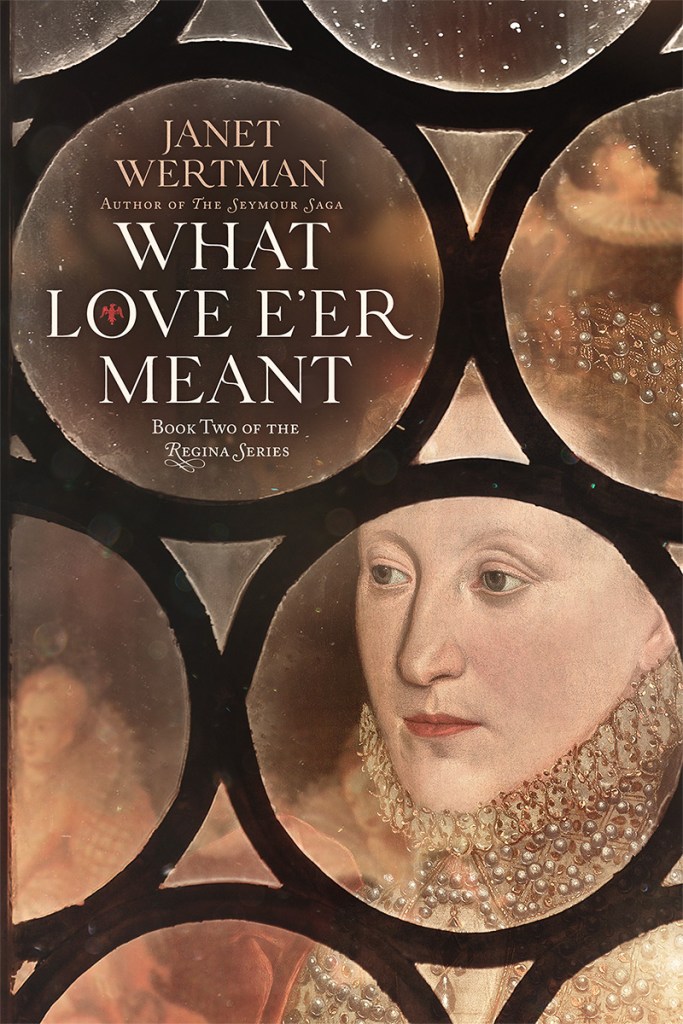
What Love E’er Meant is available via the following Buy Links
Amazon & Apple Ebook
Kobo
Barnes & Noble
Janet Wertman

Janet Wertman’s critically acclaimed, character-driven historical novels reflect a passion for the Tudor era she had harbored since she stayed up late at age eight to watch The Six Wives of Henry VIII and Elizabeth R.
Her Seymour Saga trilogy (Jane the Quene, The Path to Somerset, The Boy King) took her deep into one of the era’s central families – and now her follow-up Regina series (Nothing Proved and What Love E’er Meant out now, Forever Gloriana to come) explores Elizabeth’s journey from bastard to icon.
She shares interesting takes on the Tudors at www.janetwertman.com and her YouTube channel @TooMuchTudor.
For more information about Janet and her books click on the links below
Website • Facebook • Bluesky • Pinterest
Instagram – Janet Wertman • Instagram – Too Much Tudor
BookBub • TikTok • YouTube • Amazon Author Page • Goodreads
More information on the Coffee Pot Book Club and other works of quality historical fiction can be found on Twitter and Instagram.
Book Title: What Love E’er Meant
Series: Regina (Book 2)
Author Name: Janet Wertman
Publication Date: 7 September 2026
Publisher: Janet Wertman
Pages: 432
Genre: Historical Fiction, Biographical Fiction


Thanks so much for hosting Janet Wertman today, sharing en intriguing extract from her captivating new novel, What Love E’er Meant. We appreciate your support.
Take care,
Cathie xx
The Coffee Pot Book Club
LikeLike
My pleasure, Cathie. The book looks great.
LikeLike
Thank you so much for hosting me! I do so appreciate it
LikeLiked by 1 person
Delighted to be able to help, Janet.
LikeLiked by 1 person