The O’Connor children, like the children of any farmer, were well aware of the weather and the effect it had upon the family farm at Valencia Creek. In their letters to the ‘Young Folks’ page of the Weekly Times, they wrote of rain and dry spells, floods and fires. The two most prolific letter writers were Margaret (b.1894) and Hannah (b.1898).

early 20th century
Margaret wrote in 1910 of a dry spell and the benefits brought by the arrival of rain.
The weather was very hot a while back, and it caused a lot of damage through fires breaking out and the grass being long and dry. The harvesting is nearly all over now. The crops of hay this year have been very good. Some people have from three to five stacks of hay. The paddocks looked very dry looking a while back from the heat. The temperature was up to 104 in the shade, but it is quite different now, because these last few days have been continually misty rain. The rain will do the root crops a lot of good, also the grass paddocks.
Weekly Times Sat 5 Feb 1910 p.37
Just over a month later, Hannah describes their crops after a decent rain.
Everything looks nice and green about Valencia Creek since the rain. Our potatoes have been very good, this year. Father has them all dug out now, except the late ones, which are coming on splendidly. We have a lot of maize in this year. Some of the maize has from one to two cobs on them. The harvesting about here this year has been very good. Father had a very good crop. … Our vegetable garden looks lovely since the rain. We have a good few cabbages. The grapes are just starting to get ripe. Our flower garden is looking beautiful. There are a lot of seeds just coming up.
Later in the same letter, Hannah describes some of the problems that come when the Valencia Creek, which ran near to their homestead, flooded.
When Valencia Creek is in flood it is nice to watch the water going swiftly down with logs jumping up as they pass along. The water gets quite muddy. When the flood is up it cleans the river out. The flood sometimes does damage, such taking the banks away, and washing races down. Floods also turn rocks over, when they are very heavy. The last big flood shifted a big stone into where we cross. After the flood was down, it had to be removed out of the crossings, so as to let people pass with their carts or buggies. There is a gully running past our place. The water gets very high sometimes, and it lasts about a week before it goes down.
Weekly Times Sat 19 Mar 1910 p.42
Early the following year, Margaret, now aged nearly 17, wrote about the problems and dangers that come from unseasonal rain and flooding.
The weather has been awfully wet lately, and has caused great floods and a lot of damage has been done. The banks have been washed away in some places, large stones have been shifted, and some of the crossings in the river are made very deep through stones being shifted that were at the bottom of the water. Valencia Creek began to swell rapidly. From the time it started to rise properly it did not take very long to rise, to a monstrous flood, logs, sticks, etc., were floating down. It made a terrible roaring noise. When the creek flows about six miles down from our place it is joined by the Avon River. Then they both pass over the Avon bridge and flow downwards. The Avon bridge is not a very high bridge and it does not take very much for the water to go over it. The water lasted over the bridge for two days before it went down. Next day it could be crossed again, but rain came again and swelled the river for the second time. Great damage has been done to some crops. Some good crops have been completely ruined, while others have been severely damaged through so much rain. The rain will make the water in the creeks very clear, and it has also freshened up the grass. Our maize crop looks splendid. I think the rain has not spoilt it in the least … The Boxing Day picnic was very nice. There are such lovely trees to sit under. The Freestone runs past just below the ground. Other years the creek is generally nearly dry, but this year it was running, and the water was so nice and clear. The blackberries are beginning to ripen very quickly. There are a good few bushes down about the Avon bridge.
Weekly Times Sat 18 Feb 1911 p.39

Photographer: J A Waugh
Courtesy State Library of Victoria
In a letter published in early 1912, she mentions one result of heavy rain and flooding that might not have been seen as a disadvantage by some of those affected.
In winter it is very awkward for children that attend school from a distance of two or three miles, on account of wet weather and of the flood water rising. Flood water only prevents the children that are on the opposite side of the river. There is a low level bridge between Valencia Creek and Wadelock, and when there is rain for a couple of days the water goes over the bridge, and when the water is first starting to rise the chains are removed off till the flood has gone down. This bridge has often prevented children from attending school.
Weekly Times Sat 20 Jan 1912 p.38
Hannah wrote about the effects of heat and dry weather in summer.
The days are terribly hot, and dangerous fires rage about in the bush, and sometimes come down on the plains and do a great deal of damage, especially when a strong wind is blowing. Some days are very hot and the thermometer goes high. The grass gets gradually dry, and some of the water-holes dry up, and the creeks sometimes get very shallow. The days are longer, and the nights shorter. The nights are sultry, snakes crawl about the rivers or near scrubby places, or even out on the clear ground, also amongst high grass. I am very frightened of them … The flower gardens do not look so nice; The heat makes them very dull. They need plenty of water in the evenings.
Weekly Times Sat 31 Dec 1910 p.40
In the Friday 19 January 1912 issue of the Stratford Sentinel and Briagolong Express (p.2), there was a report on the heat the previous Sunday, describing it as a ‘a regular brick-fielder’ and one of the hottest days for some time at Stratford with the temperature rising to 104oF (40oC) in the shade by 2p.m. This was followed by hot northerly winds. A number of fires broke out in the district, with the worst at Valencia Creek.
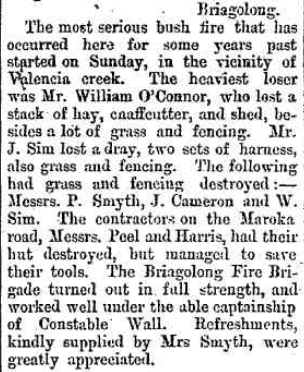
The Weekly Times also reported on this fire.
Thank goodness the weather has been cooler lately, and some nice rains have fallen, which it is hoped will extinguish the bush fires which have been causing considerable damage to grass and fencing. Mr. W. O’Connor is a heavy loser having lost all his grass, a hay stack and shed, and chaff-cutter, but with considerable difficulty he managed to save his crib of maize and dwelling.
Weekly Times 12 Feb 1912 p.3
The last, easily skipped over, word in that report is the most terrifying – the family home was under direct threat from the fires.
Following on from this Margaret wrote to the ‘Young Folks’ page.
Fires have been most prevalent about the districts this year. In nearly every district there has been a fire this year; and what a terrible lot of damage has been caused. What caused the fires to be more severe was the high, dry grass and the hot winds nearly every day, blowing at a fearful pace, and causing the fires to travel onward at a great rate, sweeping acres of grass as it travelled. What a lot of grass has been burnt this year, I suppose there has been many thousands of acres; not only grass, but houses and miles and miles of fence. In the newspapers there was plenty of news about fires. … In the hottest part of summer the fires are at their worst. Everything growing has to be well watered in the cool of the morning and the cool of the evening. There have been fires close to our place, and in the evening the bright sparks could be seen from a distance. It is dangerous to go near a fire in the hot winds as they carry the sparks in all directions, causing fires to light up other places of thick grass or timber. Sometimes there are terrible fires in South Gippsland, caused by there being so much heavy timber. What a terrible lot of insects get burnt, and birds get suffocated with the hot air and heavy smoke that goes away like clouds when in heavily timbered country. About a month ago it was quite smoky everywhere around, and you could not see very far, as the smoke was so thick. There are still fires burning back in the hills. The glare can be seen for a considerable distance, and the smoke can be seen rising up through the mountains. In summer time it is not safe to let high grass grow about a house, because if a spark of fire got into it, it would take some very hard work to save the house and outer buildings. Wax matches are very dangerous in summer. After the fires the water that was lying about was nearly all dried up from the heat. We have a creek rushing through our property (Valencia Creek), and we find it very useful. In summer all the watering places are dry except this creek, and it is always flowing past our place, even in the middle of summer.
Weekly Times 20 April 1912 p.39
Two years on, when Hannah wrote to the paper on the topic of summer time, the memory of the fire was still alive and her description carries something of the panic and the fear of that day.
Some summers are cool, while others are very hot. Some summers are very dry, causing stock to travel for a refreshing drink. All creeks and rivers get very low, and sometimes fish can be seen swimming about in the water. They can be easily caught. There are many fires about in summer, and I am very frightened of them, especially when they are close.
There was a big fire about two years ago, and we had a terrible time to save our house. Our hay was burnt and our fences and grass. It was a very windy day, and brought the fire down very quickly, and the day after the fire it was very smoky. Fires can be seen a long distance off. The smoke curls up into the air, and at night the glare of the fire can be easily seen, especially if it is a very big fire. Last year we heard of one fire seven miles in width. You cannot see clearly when there are heavy fires raging through the hills, as the smoke seems to hang round so thickly. What causes the fires to be more severe at times is that the heavy winds blowing make them travel at a fair pace. Last year there was plenty of smoke about but no fires got too near us.
There was a big fire about 14 years ago, and it came up the creek, as well as going to other places. A number of people were burnt out. Around the place got quite dark, but it did not come as far as our place.
In summer the grass is very dry and short, and the cows go off their milk. Some of the days in summer are very hot, and in the afternoon it becomes very sultry. About 3 or 4 o’clock in the afternoon you can notice some very black clouds coming up, and then the thunder begins. Then the rain, comes down, and you can notice the lightning flashing about. Sometimes it strikes trees. On dark nights there is sheet lightning, and it lights the place up all round.
Weekly Times Sat 11 Jul 1914 p.39

William O’Connor died in 1922 and his eldest son John Joseph (b.1891) took over the running of the farm, facing the same good times and difficult that his father had.
The issue of 31 December1938 of The Argus reported that bushfires had been raging at the upper end of the Valencia Creek and that sheds, fences, and grass on the O’Connor property had been destroyed. Less than two weeks later, the 1939 Black Friday bushfires broke out. Sarah Ann O’Connor, then aged 77 and walking with the aid of two walking sticks, was home alone with four children under fourteen for a good part of the day. And although the O’Connor property was undamaged my grandmother, Sarah Ann’s daughter Catherine, put her death seven weeks later down to the fear and shock of the approaching bushfires, no doubt combined with memories of the bushfire that threatened her home one day short of twenty-seven years earlier.
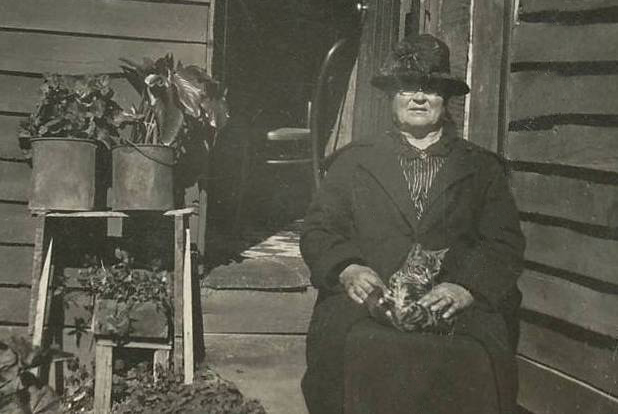
My mother, Catherine Mary McGrath, was thirteen and living in Maffra and her memories of Black Friday remained vivid throughout her life. On the 50th anniversary of the fires she wrote down her memories of that day which can be read via this link.
And despite all our technological advances, farmers today face the same elemental challenges and dangers that they always have.
~~~
Other posts on the O’Connor family’s life at Valencia Creek can be found here.
 Catherine Meyrick
Thank you for sharing this. A wonderful read and a good reminder for farmers. I come from a long line of farmers and educators so this is a real treat. I will be sure to share this post!
LikeLiked by 1 person
Thank you Stephanie. I’m pleased you enjoyed it. It was wonderful, a while back, to discover the letters send by my grandmother’s siblings to the Weekly Times newspaper in the early 1900s. She wasn’t a really a story teller and these letters helped give me some understanding of her life on a reasonably remote farm. The challenges of farming life haven’t really changed but I think that city dwellers often forget just what is involved in getting the produce they take for granted to the supermarket.
LikeLiked by 1 person