
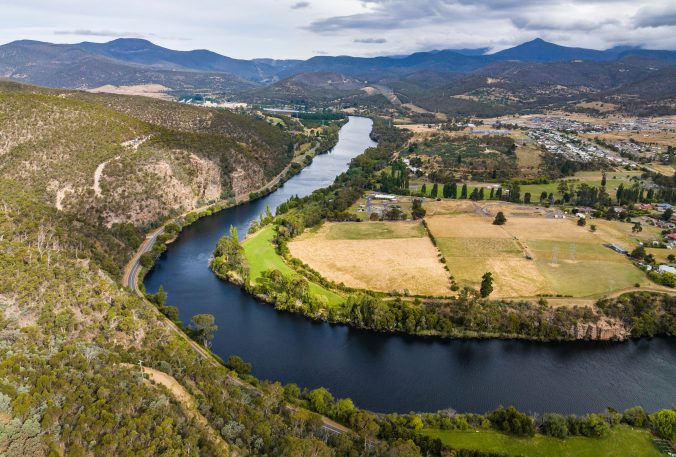
Albert Arthur Reader was born on 16 June 1888 at Plenty, a rural locality on the River Plenty, about five miles north-west of New Norfolk, Tasmania. His birth was registered by his mother, Hannah Woodhouse just over a month later. Hannah, born in Tasmania in July 1855, was the only child of two transported convicts, Thomas Woodhouse and Hannah Miles. She had grown up at Macquarie Plains where both her parents worked as servants, her father as a farm servant. She married William Reader at Holy Trinity Church, Hobart, on 16 April 1870, five months after her mother’s death of kidney disease in the General Hospital. Hannah was William’s second wife. He had five children from his previous marriage ranging in age from thirteen to twenty-one. I have not been able to determine how many, if any, lived with him.
Shutterstock
William was born at Staplehurst in Kent in October 1822, the son of an agricultural labourer. On 22 December 1842, aged twenty, he enlisted in the 96th Regiment of Foot at Chatham, Kent. Six months later William sailed from Gravesend on the Hyderabad, part of a detachment of 2 subalterns and 241 privates of the 96th Regiment under the command of Captain Snodgrass. They arrived at Launceston, Van Diemen’s Land, on 4 November 1843 to take up garrison duty there. On the night of 26 January 1845, William and another private of the 96th, William Morton, while under the influence, burst into the house of George Gough and demanded a light from him. They behaved in a threatening manner to Gough and his wife and stole a cap, three pairs of stockings and some quilling net.1 As they left the property, they wrenched off the garden gate and broke it to pieces. Both Williams were tried at the Launceston Quarter Sessions on 28 February 1845 and were sentenced to be transported beyond the seas for the term of seven years. As they were already in a place of transportation beyond the seas, this meant that they entered the convict system of Van Diemen’s Land. By the 1860s, William was a free man and had settled in the New Norfolk district. Located in the beautiful Derwent Valley, New Norfolk is Tasmania’s hop growing area and, for a man from Kent, must have brought some sense of home.
Childhood
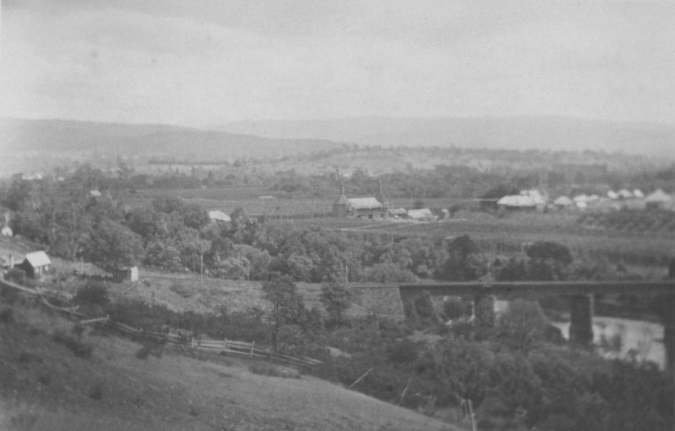
Following Hannah and William’s marriage, they lived at Glenora but by 1875 were living in a house with three acres of land at Macquarie Plains on the Askrigg estate, rented from the trustees of late Edward Terry who had been a substantial landholder in the district. I would assume, with that amount of land, William grew vegetables and perhaps fruit to feed his family. He may even have grown hop vines for his own use. Around 1887, the family moved to Plenty. They returned to Askrigg in 1892; however, William now only rented a house with less than an acre of land. By this time Hannah and William had six living children, two had died in infancy. Their last child, Leonard Lawrence was born in 1893 at Askrigg.
Little is known about Albert’s childhood. He attended the Macquarie Plains State School and would most likely have had tasks required of him around the home such as chopping wood and watering the garden. He might have worked on the hop harvest as many children did at the time. Hopefully he had time to run about with his mates, perhaps even fish in the river.
Photographer: E W Kerrison
Courtesy Libraries Tasmania – NS2218/1/164
On 22 September 1897, Hannah Reader died at the Hobart General Hospital of an intestinal obstruction. A year later, Albert and his thirteen-year-old sister Emma Bertha, known as Bertha,2 were caught begging. They were committed by the New Norfolk Court to the care of the Department for Neglected Children as Wards of the State on 26 August 1898. They would remain under the guardianship of the Department until they were twenty. William Reader was now aged nearly seventy-six and had claimed that he could not control them; however, I would imagine the begging was an indication that William was unable or incapable of caring for his children properly—he died four years later. Albert and Bertha had older siblings, two brothers and two sisters, but they could either not be located or were considered unable to take care of them. Their younger brother, Leonard3, aged five, was being cared for by a Mrs Hackett, wife of Samuel Hackett, a stonemason at Macquarie Plains.
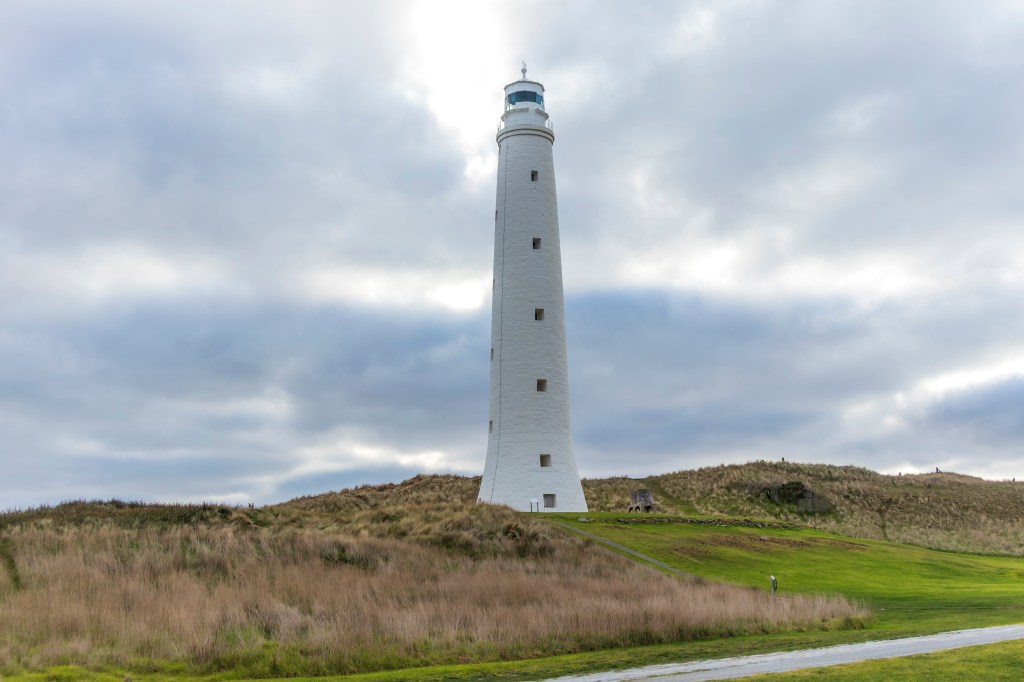
The Department attempted to place siblings in foster homes or service employment near to each other so family bonds were not broken. Bertha initially was placed in the female section of the New Town Invalid Depot for just over a week and then, because she was old enough, was sent into service with a Mrs Elizabeth McKenzie, a shopkeeper in Pedder Street, New Town, for a short period and next with a Mrs Hurst, also in New Town. Bertha was suspected of pilfering from her employer, so in the hope of keeping her ‘away from temptation until she is of mature age’4, her next position, far from all she knew, was on King Island in Bass Strait to the north-west of the island of Tasmania.
Shutterstock
Albert was sent to the Boys Training School. The School had been transferred in 1896 from the Cascades to a new building at New Town with property attached for farm training. As well as learning various labouring skills, Albert would have received a basic education. Once he was old enough to work, he would have been placed with an employer who would be responsible for seeing that he continued to develop those skills that would be useful in gaining adult employment. In late 1900 Albert’s oldest sister Louisa Clifford5 and older brother Charles6 were living at Glenorchy, about two and a half miles from the Boys Training School, close enough for them to visit; I do hope they did.
Albert’s file with the Department for Neglected Children consists of a single page7 relating to a visit in 1905 by Special Constable Hardinge to check on the conditions of Albert’s employment with a William Street at Gordon. These visits were usually conducted annually. By this stage, Albert was sixteen and may have been with William Street for some time. I have not been able to conclusively identify William Street but I suspect he was Edward William Street, a farmer at Long Bay (now Middleton) near Gordon. He would have provided Albert with board and lodging, in return Albert would have worked on the farm. Special Constable Hardinge reported that Albert was clean and healthy, well clothed and well behaved. The accommodation provided was satisfactory and Albert managed to attend church once a month. Mr Street was also paying money into the bank regularly for the work Albert did. Albert said he was treated kindly and had no complaints about Mr Street.8
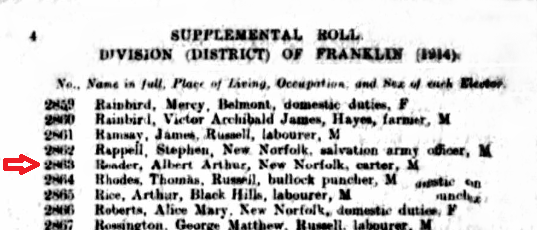
Albert next appears in the records as an adult in the 1914 Supplemental Electoral Roll for the Division of Franklin. That he was in the Supplemental Roll may indicate that he had not long moved back to New Norfolk. He occupation is given as a carter. His older brother Charles was living at Macquarie Plains with his wife and seven children. Albert might even have been living with him, as he gave Macquarie Plains as his address when he enlisted.
War
War was declared on 4 August 1914 and the Brighton Military Camp was established at Pontville by the middle of the month. Launceston’s Daily Telegraph reported on Friday 14 Aug 1914 (p.6)
The medical examination will commence to-day throughout Tasmania, and will be conducted by the area medical officers. All volunteers, whether they register or not, will be examined … All those men who are passed as fit will be given a warrant to proceed to Brighton Junction, and will report at the camp on Monday to undergo a period of training.
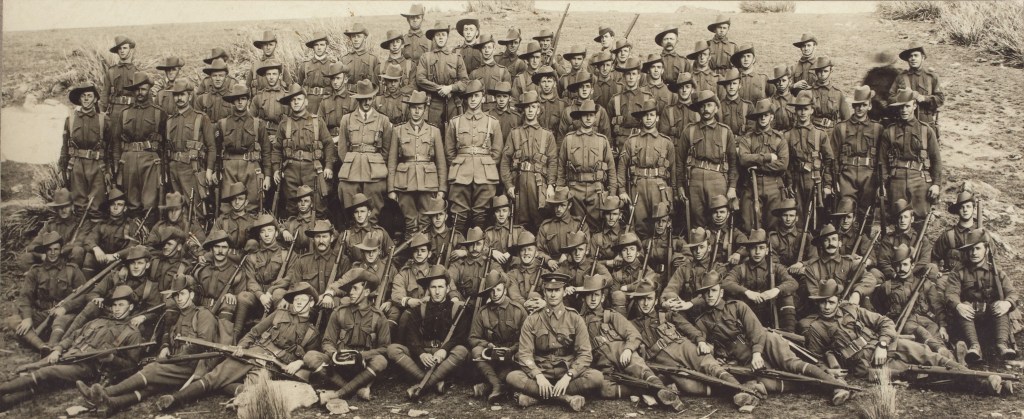
Photographer:J. W. Beattie
Courtesy Libraries Tasmania – NS669/9/1/12
Albert enlisted on 19 August 19149 and was appointed to ‘A’ Company of the 12th Battalion. ‘A’ company was recruited from Hobart and the south of the island. On his Attestation Paper, he stated that he was an axeman and had previously served in the Derwent Infantry, a militia battalion, but had left after a year as he had left the district. This seems to imply that after leaving the employ of Willam Street, Albert moved around following work as so many people did.
We don’t know why he chose to enlist. Men enlisted for many and varied reasons from a sense of duty to family, to country and to Empire; friends joined up, so they did too; the pay was better than they were currently getting; the chance to see something of the world; to take part in what seemed, at that stage, to be a great adventure. One of the few things that has been handed down through the family is the knowledge that William Reader had arrived in Tasmania as a soldier with the 96th Regiment. William might have spoken with pride of that period in his life and the glamour of it rubbed off onto his children. Perhaps this, too, had something to do with Albert’s enlistment.
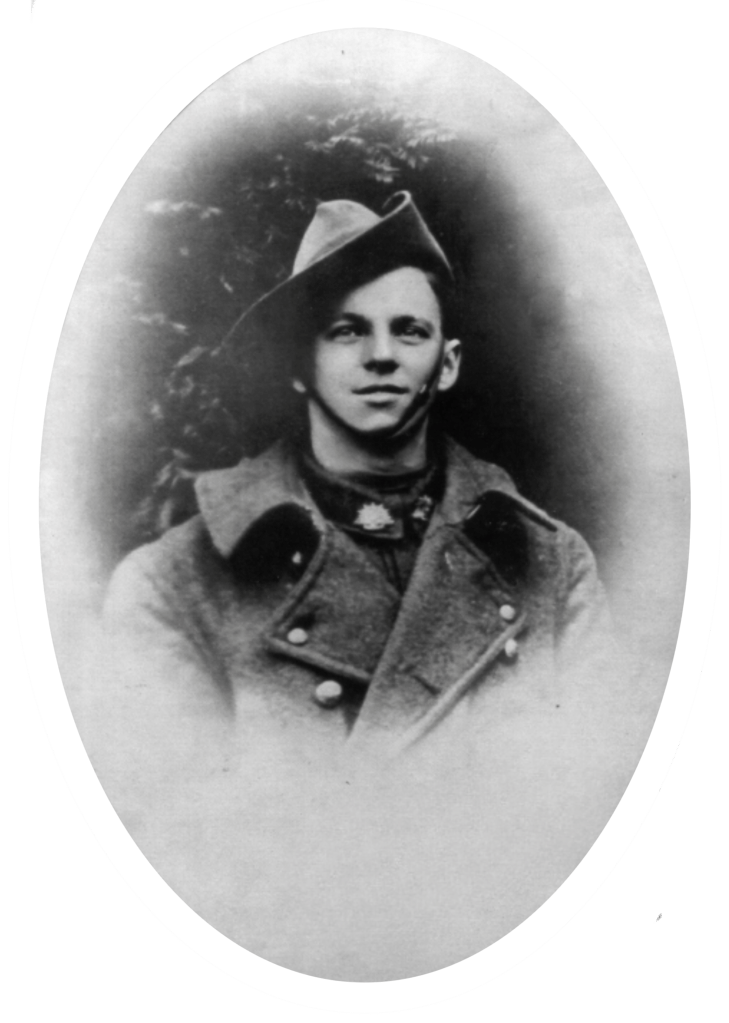
At the time of his enlistment, Albert was 5’ 6” (1.68 metres), the minimum height for a member of the Australian Imperial Force at that stage10, and 10 stone 10lb (68kg). His complexion was fair and he had grey eyes and auburn hair. Although he was baptised as an Anglican, he gave his religion as Wesleyan. Albert named his brother Charles as next of kin. He also made an allotment of two shillings per day to his eldest sister Louisa Clifford. Louisa was now living at Glenora, twelve miles from New Norfolk. She was married with four children but was not in good health.
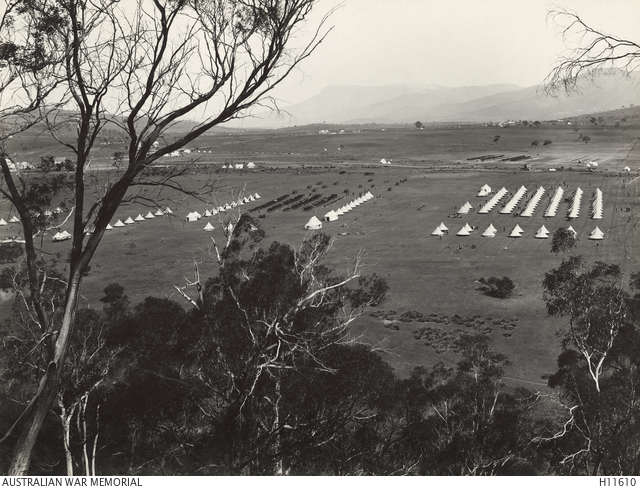
Photographer J. W. Beattie
Courtesy Australian War Memorial
Training started immediately and included marching, drill, proficiency with a rifle and the use of the bayonet, as well as manoeuvres in the surrounding countryside. Towards the end of September, two companies arrived from South Australia to join the 12th.11 The final two companies of the Battalion, from Western Australia, joined at Mena Camp in Egypt. An official farewell march of over 1,500 troops, Albert among them, made its way through the streets of Hobart on Monday, 5 October, to the cheers of onlookers. Flags and bunting decorated the streets, particular in the heart of Hobart. Crowds were thickest in the centre of the city, packing the footpaths and filling balconies; some even stood on roofs to get a better view.
As the Light Horse passed the enthusiasm reached its height, while flags were everywhere waved. The approach of the artillery was the signal for a fresh demonstration, and all the other smaller units were in turn warmly acclaimed. Then, looking up the street, one could see the glitter of sun on bayonets, and hear a steady tramp, tramp of marching feet, and down the street swung the infantry to be greeted with the same enthusiasm as the other units … Ever and anon there was a shout of welcome, as someone in the crowd recognised a friend, and a wave of the hand, a smile, or a wink, acknowledged the greeting.
The Mercury Tue 6 Oct 1914 p.5
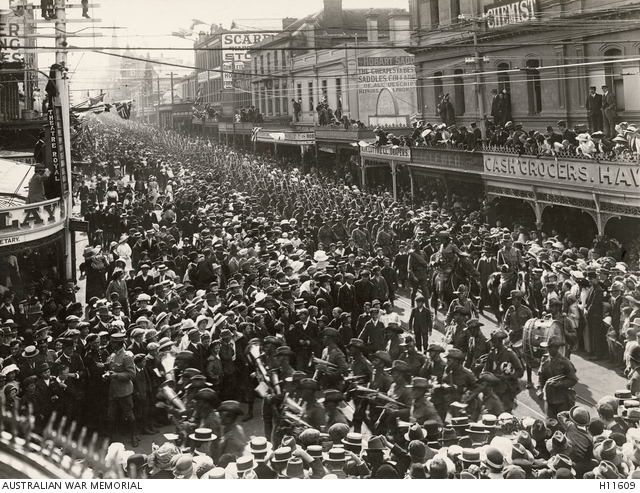
Photographer: J. W Beattie
Courtesy Australian War Memorial.
The public knew the departure of the troops was drawing closer, although the exact date was secret. When the First Tasmanian Contingent arrived at Ocean Pier by train from Brighton on Tuesday, 20 October to board the HMAT Geelong, word spread quickly so that it seemed that ‘almost the whole of Hobart’ was there.
At 4 p.m. the ropes were cast off and we drifted away amid cheers and wishes of ‘God speed.’ I watched the crowded pier recede and listened to the band playing ‘Rule Britannia’ and ‘The Girl I Left Behind Me,’ until the sounds were lost in the intervening distance.12
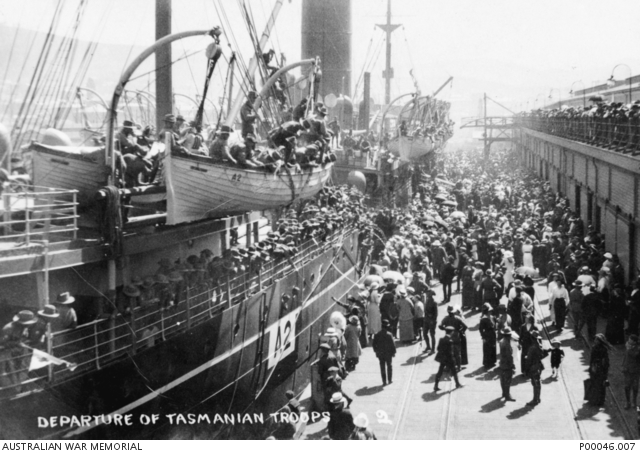
Courtesy Australian War Memorial
The Geelong sailed across the Great Australian Bight, arriving at Albany, Western Australia on 28 October where troopships from other parts of the country were assembling. The convoy departed on Sunday, 1 November, made up of 38 Australian and 10 New Zealand troopships, escorted by four battleships including a Japanese cruiser.
Egypt
The troops believed they were sailing to England and from there they would go to France but because of the overcrowding in the military camps in England, it was decided to send them to Egypt. The 12th Battalion disembarked at Alexandria on 10 December 1914 and travelled on by train to Mena Camp near Cairo. There the drill, manoeuvres, and route marches continued. Lieutenant L. M. Newton says, in his history of the 12th Battalion The Story of the Twelfth, that ‘the stretcher-bearers were left in camp frequently for duty with the Regimental Medical Officer who put them through their stretcher drill and gave them invaluable instruction in first aid.’ Albert was a battalion stretcher-bearer on the Western Front. He may well have been one at this stage but we have no records to confirm that. 13
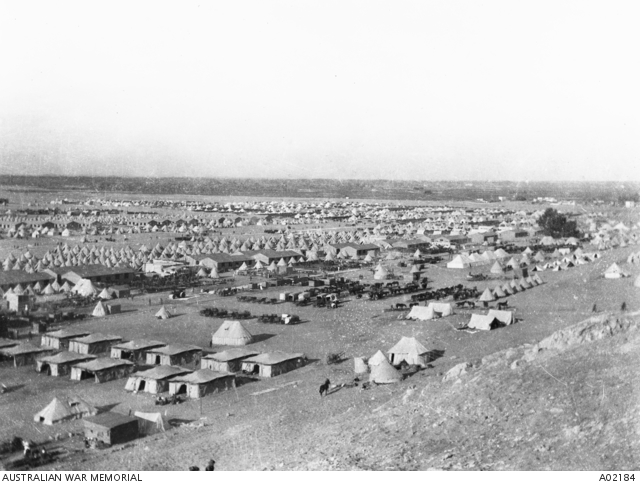
Courtesy Australian War Memorial – A02184
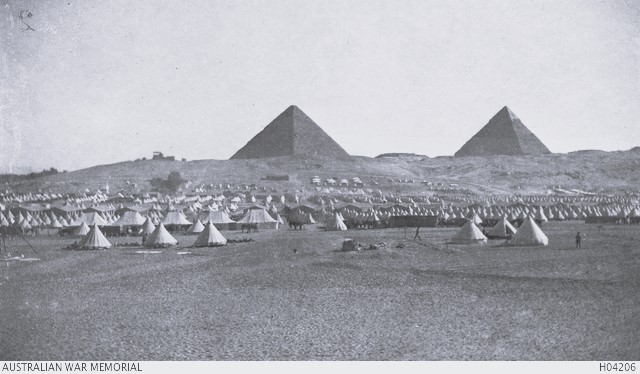
Courtesy Australian War Memorial – H04206
On the first occasion that they had free time, Newton says that ‘the Battalion went almost en masse to carry out a tour of inspection of the Pyramids and Sphinx.’14 Their first general leave was given on Sunday, 13 December, and the soldiers took themselves to Cairo to visit the gardens and the museum, to supplement the army’s culinary offerings at restaurants and cafes, to venture into establishments also offering music and dancing girls ‘flitting to and fro’, or to otherwise sample the city’s varied delights. I imagine, for Albert, at this point it was a great adventure and a chance to see the world that would not otherwise have come his way. He may have sent a postcard or two home, but nothing survives that I am aware of.
On 2 March 1915, the 12th Battalion left Egypt on the troopship Devanha for the Greek island of Lemnos where their training continued.
Adopting artillery formations, forming a firing line, calling up reinforcements, assaulting a crest of a hill, consolidating the line, reorganising after the attack, pursuing a fictitious enemy down the slopes of a hill, changing direction half-left to avoid a village, re-assembling for the mid-day meal, and in this manner day after day we gradually became as hard as nails and almost as fit, physically, as any body of troops within the knowledge of mankind.15
By the middle of March, the troops were aware that their destination was Gallipoli and by the first week in April other Divisions had begun to arrive on Lemnos. The Australian soldiers were issued with regimental colour patches on 13 April. They were given two small linen bags each carrying a day’s rations for when they landed – a tin of bully beef, a tea and sugar ration, a cube of oxo and some hard biscuits.16
A full rehearsal for the landing took place on the 22nd and, on 24 April at 2p.m., the transports of the 3rd Australian Infantry Brigade left Lemnos. The companies of the 12th Battalion were separated and attached to other battalions. ‘A’ Company, to which Albert belonged, and Battalion Headquarters remained on the Devanha.
Gallipoli
The convoy of troopships, battleships, cruisers and destroyers proceeded to the island of Imbros17 and anchored after dark. At 9 p.m. the men had their last meal before the landing. The men of ‘A’ Company then transferred to the destroyer HMS Ribble. The men settled themselves on the decks and chatted quietly; some tried to some sleep. The crew came around with hot cocoa about 2 a.m. In reading Newton’s description of this period before the landing, it possible to get a strong sense of the uneasy mixture of expectation and supressed fear many would have felt.
As part of the 3rd Brigade, along with the 9th, 10th and 11th Battalions, the 12th Battalion was among the first ashore. At 4.30 a.m. the Ribble took them within 100 yards of the shore. With the sound of a shot from the shore, followed by a volley of bullets, they understood that the Ottoman troops knew they were coming.
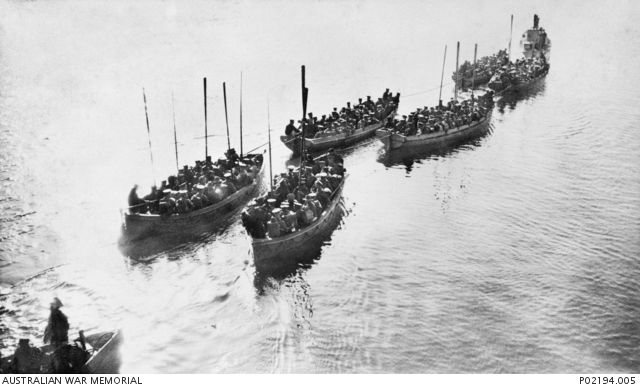
Courtesy Australian War Memorial
Boatloads of troops were now heading for the shore. The troops from the Ribble were towed by a steam pinnace, six boats at a time, to 50 yards from the shore . The men then rowed for the shore under heavy rifle and machine gun fire. When they were near enough, they jumped out of the boats, some men floundering in the water. Several officers were badly wounded as they landed.
The British aim had been to force their way through the Dardanelle Straights and capture Constantinople.18 They were unable to achieve this by naval attack so decided that ground troops were needed. British and French forces were to land at Cape Helles on the southern end of the Gallipoli Peninsula at the same time as the Australian and New Zealand Army Corps and artillery units from the British Indian Army landed on the western side. Once ashore they were to spread out and capture the higher ground held by the Ottoman troops.
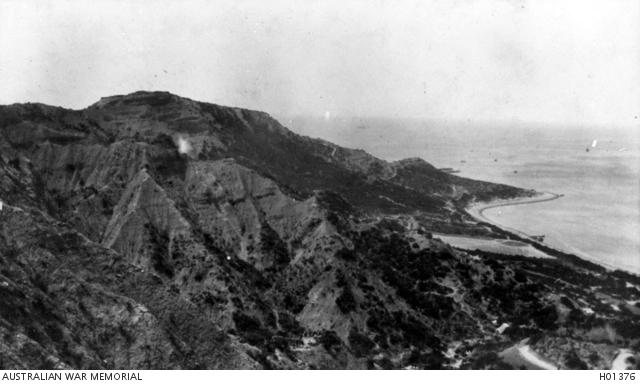
Because of the darkness of the night and the tides, they landed at Ari Burnu about a mile north of the intended landing place, a wide beach north of the Gaba Tepe promontory.19 At Ari Burnu the scrubby ground rose steeply from the beach to cliffs.20 The troops were meant to halt long enough for companies to form and make an organised attack against the first ridge. But in the unexpected terrain and under fire from the defending Ottoman troops, many officers and men barely waited, they threw off their packs and charged through the scrub and up the steep slopes, some making it to the summit and overpowering a trench of Ottoman soldiers. Some of the Turkish garrison escaped into the countryside. Reinforcements were rushed to the area, the Turkish commander, Mustafa Kemal, rallying to his troops, ‘I don’t order you to attack, I order you to die. In the time it takes us to die, other troops and commanders can come and take our places.’
Courtesy Australian War Memorial
The defending Ottoman troops regained much of the ground lost but the ANZACs held on to enough to set up a front line that stayed until the end of the campaign. Around 2,000 ANZAC soldiers were killed or wounded on that first day.
The War Diary of the 12th Battalion for April recorded that 28 officers and 873 men went ashore on the morning of the 25th. Roll call at the end of the day showed 8 officers and 472 men present. Of the officers, 4 had been killed and 17 wounded, 25 other ranks had been killed and 286 wounded. 90 men were missing, many of them would also have been killed. Among the dead was Lieutenant-Colonel L. F. Clarke, commander of the 12th Battalion, killed by a sniper.21
The troops of the Australian and New Zealand Army Corps were ordered to dig in. Failure to take the higher ground led to a stalemate. Each side was reinforced and their positions consolidated and the fighting continued. On 19 May the larger Ottoman force attempted to push the ANZAC troops into the sea but Ottoman casualties were so high that on 24 May a truce was called to allow both sides to bury their dead who were lying in No Man’s Land, some for several weeks. But by this time Albert was no longer on the Peninsula.
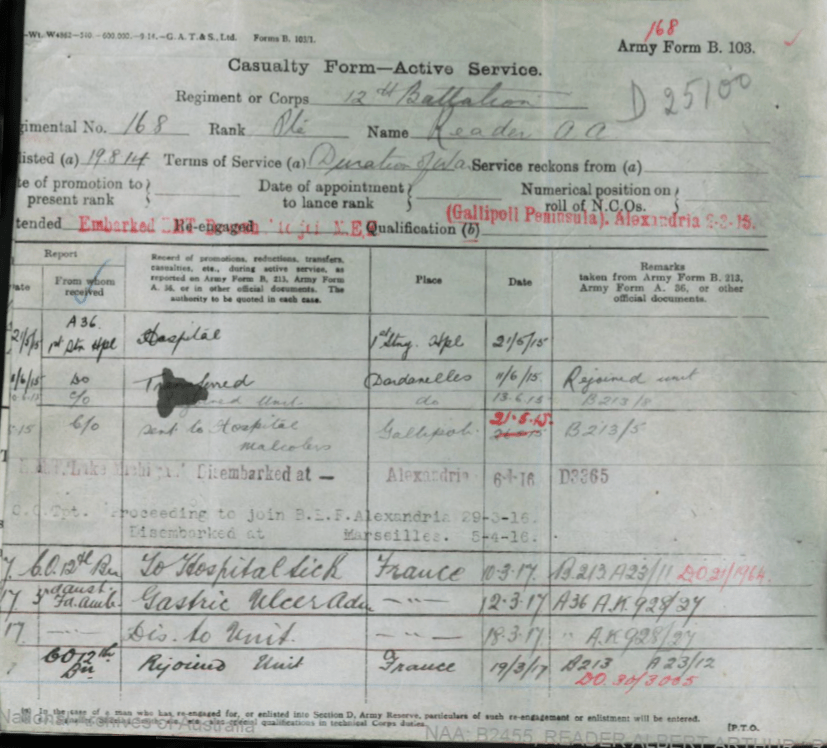
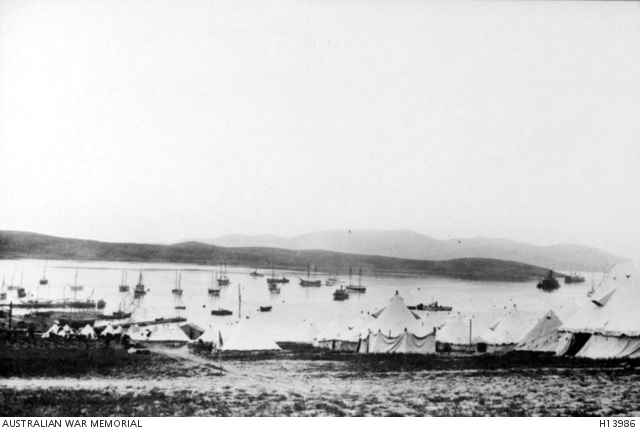
Albert was admitted to the 1st Stationary Hospital at Mudros on Lemnos on 21 May 1915. There is no indication that his next of kin were notified but at this stage it was taking weeks for the news of casualties to filter through to families in Australia – there were still families who had not been advised of the death of a loved one on 25 April. The word ‘Malcolers’ is written on Albert’s Casualty Form; I suspect it is a diagnosis but have been unable to identify it.22 Albert probably was one of the 271 patients who arrived without notice at the 1st Stationary Hospital at Mudros aboard the hospital ship Seang Choon. The patients included men with measles and scarlet fever. The Unit Diary for the hospital gives a sense of the stresses the hospital and its staff were working under. ‘Only half tents up and no time to trench same. Men [the arriving patients] had no rations or midday meal.’ The previous night there had been a hurricane and heavy rain.23
Courtesy Australian War Memorial
Albert rejoined his unit on 13 June 1915. Nothing else is known about Albert’s movements at Gallipoli or in France until July 1916. As we have so little information on Albert himself, I will draw selectively on L. M Newton’s The Story of the Twelfth to provide a general sense of what he and the rest of the 12th Battalion were experiencing. This post will in no way be a history of the war or even of the 12th Battalion. It is intended to give a glimpse of the conditions Albert and the men of his battalion faced and endured through the war.
Over the following months the fighting continued but they advanced no further.
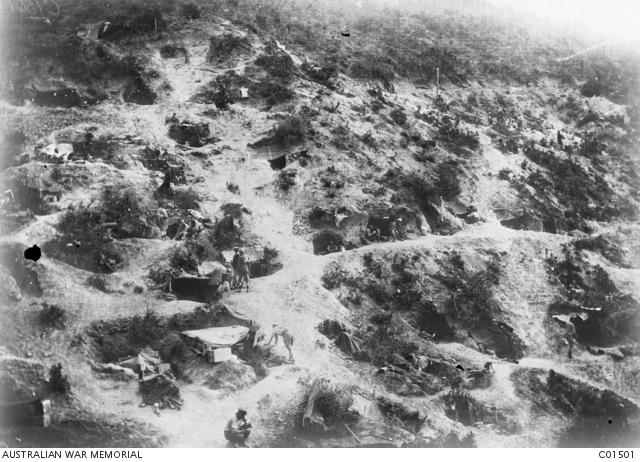
Matters settled down again to a continual ‘stand to arms’; dig,dig,dig; fatigue parties to carry water, which was now drawn from wells in Shrapnel Gully; and interludes when ‘Gallipoli stew’24 was cooked by enterprising individuals in their mess-tins. Fatigues were arranged with monotonous regularity. If one wasn’t digging, one was carrying water from Shrapnel Gully, or sandbags from the beach. It was arranged that each man should have a few hours in the day to himself, in which he could clean his rifle and attend to his own personal comfort and cleanliness.25
Courtesy Australian War Memorial.
The arrival of summer brought unpleasant heat and swarms of large shiny green flies that ‘… fought the soldier and each other for every scrap of food.’26 Water was in short supply and rationed to two quarts (2.25 litres) per day for each man. Men took the opportunity to bathe in the sea water in the evenings at ‘Brighton Beach’, south of Anzac Cove. It was a sheltered area used as a stores depot but not safe from from Turkish snipers and shells.
On 27 July the 12th Battalion was relived from duty in the trenches and went into bivouac further back. The Battalion War Diary for that date noted, ‘the rest from life in the trenches appreciated & necessary – 13 weeks without a spell: health of the B[attalio]n not good – diarrhoea and debility prevalent.’27
Lone Pine
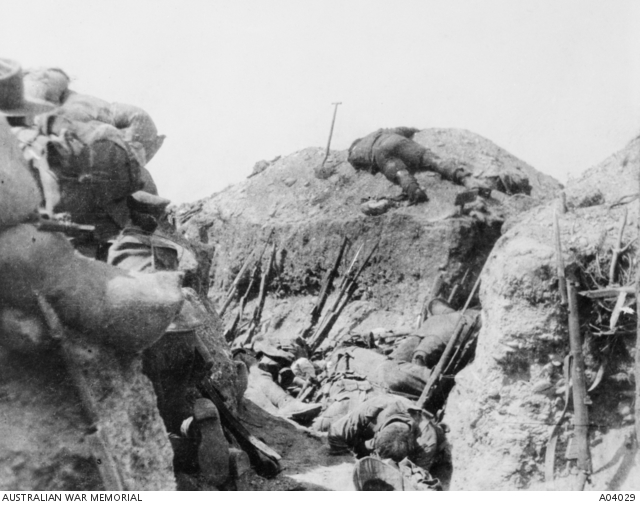
The Battle of Lone Pine took place between 6 and 10 August. The battle was part of diversionary tactics while the British, Indian, Australian and New Zealand troops made an assault on Sari Bair ridge controlled by the Ottoman army. The assault on Lone Pine was conducted by the Australian 1st Brigade reinforced by the 7th and the 12th Battalions.28 It began with heavy artillery bombardment of the Turkish trenches followed by a successful and brutal bayonet assault by three battalions of the 1st Brigade. In the evening of the first day, ‘A’ company of the 12th Battalion was sent in as reinforcements. They occupied part of the firing line the next day, resisting Turkish counter attacks. ‘D’ company spent the morning of the 7th clearing the dead who ‘carpeted’ the ground,and blocked some of the trenches.29 Lieutenant-Colonel Lane, who wrote much of the Gallipoli section of The Story of the Twelfth, described the appearance of the trenches.
Our own and Turkish dead lay anywhere and everywhere, and in some instances our own wounded were still lying at the bottom of the trench.30
Courtesy Australian War Memorial.
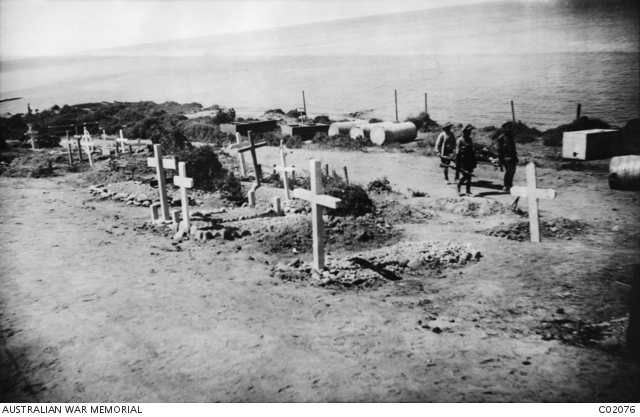
The Turks attempted to recapture the lost trenches but, by the morning of 8 August, were driven back. ‘A’ and ‘D’ companies were withdrawn and ‘B’ company sent in to replace them. ‘C’ company was used for stretcher bearing. Five days later, the 12th Battalion returned to their old position in the forward trenches. One officer and 16 other ranks had been killed in action, 2 officers and 145 other ranks were wounded, some would later die of wounds. And 4 men were missing, one of whom was an officer.
Lieutenant-Colonel Lane says
Back in the old familiar lines, the usual trench routine was adopted, but in a different spirit to their earlier occupation. The energy, good humour and chaff that marked that period were now lacking. The men were worn out and weary. Their health was so undermined that any prolonged exertion was impossible, and digging was not effected with the old rapidity or vim. However, watchfulness was in no wise relaxed, but it became necessary to shorten the period of duty for sentries.31
Courtesy Australian War Memorial.
In September rumours stirred of a possible period of rest for the 3rd Brigade at Mudros. The weather had cooled and men were issued with another blanket, their health was improving partly because of a new routine of having them out of the trenches every forty-eight hours. And all sorts of extras had arrived from the Comforts Fund. On 25 October they were all given an extra ration of rum to ‘celebrate’ six months on the Peninsula.32
A month later, on 25 November, they received word that they would leave for Mudros that night. They were forced to wait in cold winds for several hours until they could board the SS El Kaliera at 12.30 a.m. The El Kaliera then lay off Suvla Bay until daybreak when the men ‘for the last time saw the sun rise over Gallipoli’33 though at that time they expected to return six weeks later.
Return to Lemnos
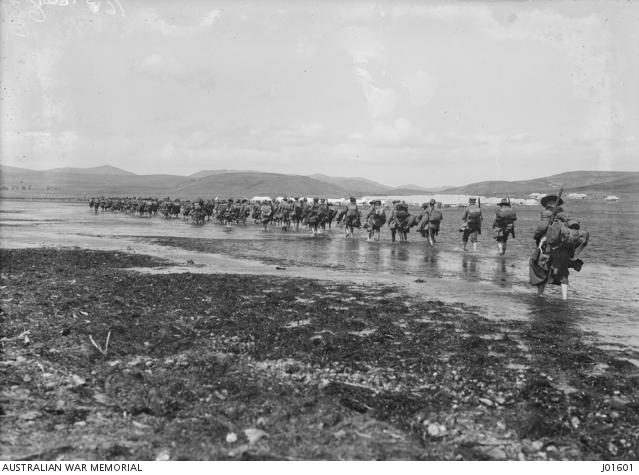
They arrived at Mudros Bay after midday and were taken to the pier by lighters. They then marched to Sarpi Camp about a mile away on the western shore of the bay. Newton says the looked a sight dressed in a motley collection of clothing: raggedy tunics; shorts; a variety of scarves, mittens and cardigans; even rabbit-skin jerkins.
Our marching and march discipline was anything but good. We had not been on a parade ground for more than seven months, we were cold, tired and hungry, and the majority almost as weak as kittens from the effects of dysentry and the conditions of life generally during the past few months.34
Australian War Memorial
A hot meal was provided not long after they arrived. That night they slept with ‘a sense of security that we had not experienced for a long time.’ The next day there was no reveille and the soldiers were allowed to sleep as long as they liked.35
The weather was cold and most men had severe dysentery. Reinforcements arrived and took all guard and fatigue duties while the rest of the battalion had an easy time resting and recuperating.
The wind dropped, the weather improved and physical training and drill began but in the afternoons football and cricket were played and some men visited nearby villages ‘purchasing coffee, cakes, chocolates, fruits and other luxuries, which had been unknown to us for some time.’36 They all received a new issue of clothing but, of course, some articles were still needed.
In the middle of the month Units from the 2nd Brigade began to arrive on Lemnos and the men of the 12th learnt of the proposed evacuation of all troops from Gallipoli.
We could not—we would not—believe it! After our landing, defending and occupying Anzac for all those months, after our hardships and sufferings there, it was hard to conceive that our almost sacred strip of land was to be given up voluntarily.37
Courtesy Australian War Memorial
Charles Bean in Volume 2 of his history tells of the way the news was received at Gallipoli.
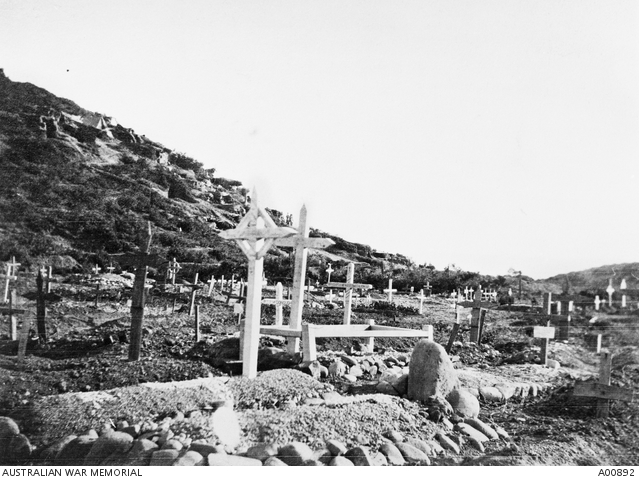
It came as a shock to the troops at Anzac, affecting every man deeply but each differently, according to his nature and his views concerning the campaign.38
The men hated to leave their dead mates at the mercy of the Turks. For days after the breaking of the news there were never absent from the cemeteries men by themselves, or in twos and threes, erecting new crosses or tenderly ‘tidying-up’ the grave of a friend. This was by far the deepest regret of the troops. ‘I hope,’ said one of them to Birdwood on the final day, pointing to a little cemetery, ‘I hope they won’t hear us marching down the deres.39
Christmas came with religious services, Christmas puddings, carol singing in the YMCA tent and, on Christmas Eve, the Christmas billies were handed out. Each one had been packed in Australia and filled with all sorts of goodies that the sender thought would be of use and bring some comfort to a soldier far from home. They contained a variety of items such as tobacco, cigarette papers, razor blades, socks, scarves and mittens, dried raisins, chocolate, butterscotch, biscuits, small tins of fruit or pressed ham, condensed milk, playing cards, shoelaces, and a cheerful Christmas card or note.
Egypt Again
On 1 Jan 1916 the 12th Battalion embarked the HMT Lake Michigan. They waited on board for a couple of days before leaving on 4 January. They disembarked at Alexandria and then went by train to Tel el Kebir, a training camp 68 miles (110 km) north-east of Cairo.
Training, reorganising and refitting again continued, and for the first time since our return from the Peninsula, we really began to look respectable … Leave to visit Cairo for a few days was given to all officers, N.C.O.s and men who had spent all, or a greater portion of the time, on Gallipoli, and as most of them had a good substantial credit balance in their pay books, due to their inability to spend money, they had a good time.40 No doubt Albert was among them.
On 25 January they left Tel el Kabir for Serapeum Camp, travelling in open railway trucks in bitterly cold weather. Serapeum Camp was on the eastern bank of the Suez Canal, about 7.5 miles (12 km) from Ismailia. Here rations left a lot to be desired – biscuits replaced bread and the meat ration was light. Fresh water was in short supply and the men were discouraged from using it for washing but they were permitted to bathe in the canal between noon and 2 p.m.41
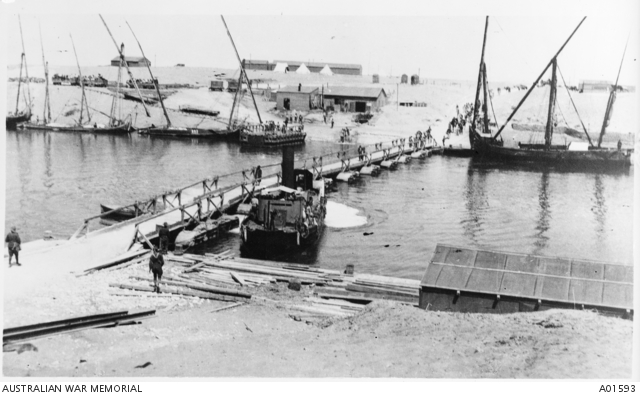
Courtesy Australian War Memorial.
Due to the great loss of men at Gallipoli, units were reorganised into two separate Corps: I ANZAC Corps, containing the Australian 1st and 2nd Divisions and the New Zealand Division, and II ANZAC Corps containing two new Australian Divisions, the 4th and the 5th. Battalions were divided with around half of the men joining newly created battalions and reinforcements bring up numbers to full strengths. This meant that all battalions would have a core of experienced troops alongside the untried men. In mid-February, the 12th Battalion was divided into two halves, one to remain as the 12th and the other, its ‘offspring,’ was the 52nd Battalion. Albert remained with the 12th.
On 28 March 1916, the 12th Battalion travelled by train to Alexandria, and boarded the HMT Corsican the following day, along with other battalions. On the 30 March they sailed from Alexandria en route for France.
Albert Reader’s experiences in France can be found here: We Will Remember Them: Albert Arthur Reader M.M. Part 2
©Catherine Anne Merrick.
Unauthorized use and/or duplication of this material without express and written permission from this blog’s author and/or owner is strictly prohibited. Excerpts and links may be used, provided that full and clear credit is given to Catherine Anne Merrick and https://catherinemeyrick.com/ with appropriate and specific direction and links to the original content.
- Net arranged in narrow, rounded folds or pleats and used to decorate collars, cuffs and hats. ↩︎
- Emma Bertha Reader (1885-1965). Married Stephen Gilding. ↩︎
- Leonard Lawrence Reader (1893-1962). Married Marion Louise Willcott. ↩︎
- Tasmanian Archives SWD 1/1/24 NCD134-5 Reader family-Albert & Bertha Emma – Image 23 ↩︎
- Hannah Louisa Reader (1874-1941). Known as Anna Lousia or simply Louisa. Married William Clifford. ↩︎
- Edward Charles Reader (1836-1936). Known as Charles. Married Elizabeth Woods. ↩︎
- By comparison Bertha’s file is huge (SWD-1-24, NCD 134-5). Bertha’s placement was with a William and Annie Lambert, the Under Lighthouse Keeper at Cape Wickham on King Island. It did not go well. In late March 1900, seven months after Bertha’s arrival, another woman on the island, Mrs Grave reported that Bertha was being ‘cruelly treated by those in charge of her’.(Image 13) When questioned later, Mrs Grave said Bertha was ‘starved and cruelly beaten’ and had run away to Mrs Graves the last time she was beaten. She described her as ‘in rags and covered with bruises’. Other neighbours also confirmed this. Mrs Lambert claimed that Bertha probably got the bruises from falling about on the rocks. H. M. Rivett Carnac, special constable on King Island, was requested to investigate and on 2 April 1900, Bertha was removed from the Lamberts. He was unable to find anyone to take her, so his wife employed her. In October 1900, Mrs Carnac, despite being happy with Bertha’s work, requested that she be placed elsewhere as her pilfering had continued and, consequently, she should not be around young children. The Carnacs regarded it as a ‘failing’, Mrs Carnac writing that ‘she takes things that are no earthly use to her or anybody else and buries them in the ground.’ (Image 43) By this stage, the Department had located Bertha’s sister, Louisa Clifford, who wanted Bertha to come to her. Bertha had lived with Louisa before and had only left because her father had taken her away, possibly when her mother died. Instead of going to her sister, Bertha was sent into service, on probation, with a Mrs O’Byrne at Hagley. Mrs O’Byrne and other prospective employers were warned by the Department that ‘Reader is not honest.’ (Image 51) In December 1901, Bertha was sent to a Mrs Murphy at Deloraine as Mrs O’Byrne no longer had any use for her services. The following June 1902, aged seventeen, Bertha was charged with two counts of larceny from guests staying at Mrs Murphy’s. She was sentenced to three months imprisonment but, as it was a first offence, the sentence was suspended as long as she was of good behaviour for twelve months. At this point, the Department for Neglected Children proposed to place Bertha in the Magdalen Home in Hobart. And there Bertha’s file ends. Not once in Bertha’s file is it mentioned that she was a grieving girl whose mother who had died suddenly, who had been sent to live and work for a range of strangers, who had no place of her own – her ‘bed’ in 1901 was ‘in the dining room on a sofa, very comfortable’.(Image 61)
By 1918, Bertha had moved to Victoria. She married Stephen Henry Gilding in October 1918 at Richmond, Victoria. ↩︎ - It is interesting to note that these two questions are asterisked on the form with a note printed at the bottom saying Please make these enquiries of the boy apart from the employer. ↩︎
- This is the date written on all of his Army records such as his Casualty Form; however, the date of joining on his Attestation paper is 17 August. This might be the difference between formally registering his desire to enlist at New Norfolk and actually arriving at the Brighton Camp. ↩︎
- The height dropped gradually as the war progressed and the number of recruits dwindled. By 1917 it was 5 foot. ↩︎
- The 12th Battalion drew half its recruits from Tasmania (‘A’ to ‘D’ companies), a quarter from South Australia (E and F companies) and a quarter from Western Australia (‘G’ and ‘H’). ↩︎
- Newton, L. M. The Story of the Twelfth. A Record of the 12th Battalion, A.I.F. during the Great War of 1914-1918. Hobart: 12th Battalion Association, 1925. p.12
Leslie Morriss Newton was a former Lieutenant and Adjutant of the 12th Battalion.
Chapters VI and VII of the book, covering the occupation of Anzac, are written by Lieutenant-Colonel. D. A. Lane as Lieutenant Newton was absent, recovering from wounds, for most of this period.
Chapter XII, Pozieres and Mouquet Farm, was written by Lieutenant-Colonel C. H. Elliott, the commander of the battalion, because Lieutenant Newton had not taken part. He and a number of others officers had gone to Divisional Headquarters at Albert, ‘to form the nucleus of a new battalion should the old one be too badly shattered in the operation before it.’ (p.217). ↩︎ - Newton p.33 ↩︎
- Newton p.26 ↩︎
- Newton, p.49 ↩︎
- Newton p.56 and Bean, C.E.W. Official History of Australia in the War of 1914–1918 Vol.I – The Story of ANZAC from the outbreak of war to the end of the first phase of the Gallipoli Campaign, May 4, 1915 p.245 ↩︎
- Part of Greece at this time. ↩︎
- The city was officially renamed Istanbul on 28 March 1930. ↩︎
- Many saw this as that hand of Providence as the Ottoman troops had laid hundreds of yards of barbed wire in the sea at Gaba Tepe. Newton described it as such in his history (p.65) as did Brigadier General H. E. ‘Pompey’ Elliott at the planting of the Memorial Avenue at Coburg on 20 August 1919. He said that ‘had they attempted to land there, not a man would have got ashore.’ The Brunswick and Coburg Leader Fri 5 Sep 1919 p.1 ↩︎
- This New Zealand site gives a good understanding of the terrain of the Gallipoli Peninsula and the landing places.
https://ngatapuwae.govt.nz/gallipoli/anzac-cove/# ↩︎ - Major C H Elliott then took command of the Battalion. ↩︎
- If anyone does know, please let me know. The information on the form is a transcription from a weekly Field Return (B213) used to report unit casualties, promotions, and transfers. It might even contain a transcription error. ↩︎
- No 1 Australian Stationary Hospital War Diary May 1915 Part 2 – AWM4 26/70/4 PART 2 p.4 ↩︎
- I haven’t been able to work out what this was. Canned meat, especially bully beef, hardtack biscuits and jam were the staples. Perhaps a heated up mixture of all three? ↩︎
- Newton p.109 ↩︎
- Newton pp.107-8 ↩︎
- 12th Battalion War Diary July 1915 – AWM4 23/29/5 – July 1915 p.9 ↩︎
- Chapter VII of Newton’s The Story of the Twelfth proves a detailed description of the role of the 12th Battalion in this, written by Lieutenant-Colonel D. A. Lane as Lieutenant Newton was absent, recovering from wounds, for most of this period. ↩︎
- Newton p.120 ↩︎
- Newton p.122 ↩︎
- Newton pp.123-4 ↩︎
- Newton p.131 ↩︎
- Newton p.137 ↩︎
- Newton p.139 ↩︎
- Newton p.139 ↩︎
- Newton p.142 ↩︎
- Newton p.143 ↩︎
- Charles Bean, C.E.W. Volume II – The Story of ANZAC from 4 May, 1915, to the evacuation of the Gallipoli Peninsula Sydney, 1924. p.881 ↩︎
- Deres – Turkish for Valley. Bean Vol. II p.882 ↩︎
- Newton p.147 ↩︎
- Newton p.153 ↩︎


Pingback: We Will Remember Them: Albert Arthur Reader M.M. Part 2 | Catherine Meyrick
Pingback: We Will Remember Them | Catherine Meyrick
Pingback: Hannah Miles ~ Life in Van Diemen’s Land | Catherine Meyrick