This post continues from We Will Remember Them: Albert Arthur Reader M.M. Part 1

France
The HMT Corsican arrived in Marseille on 5 Apr 1916. After a short march from the wharves, they boarded a train, the troops cheering as it left the station. They travelled through picturesque countryside with olive groves, vineyards and blossoming fruit trees. Children shouted greetings as the train passed, housewives waved handkerchiefs from their doorways and labourers stopped their work and waved.
Every six or nine hours the train would stop at some wayside station or shunt into a siding, when hot tea would be awaiting us … A line of sentries was invariably supplied by the duty Company at each stopping place and posted on either side of the train to prevent the Digger—as far as it was possible—from indulging in their favourite pastime of strolling off to purchase bread, cigarettes and a stray bottle of ‘vin rouge’.1
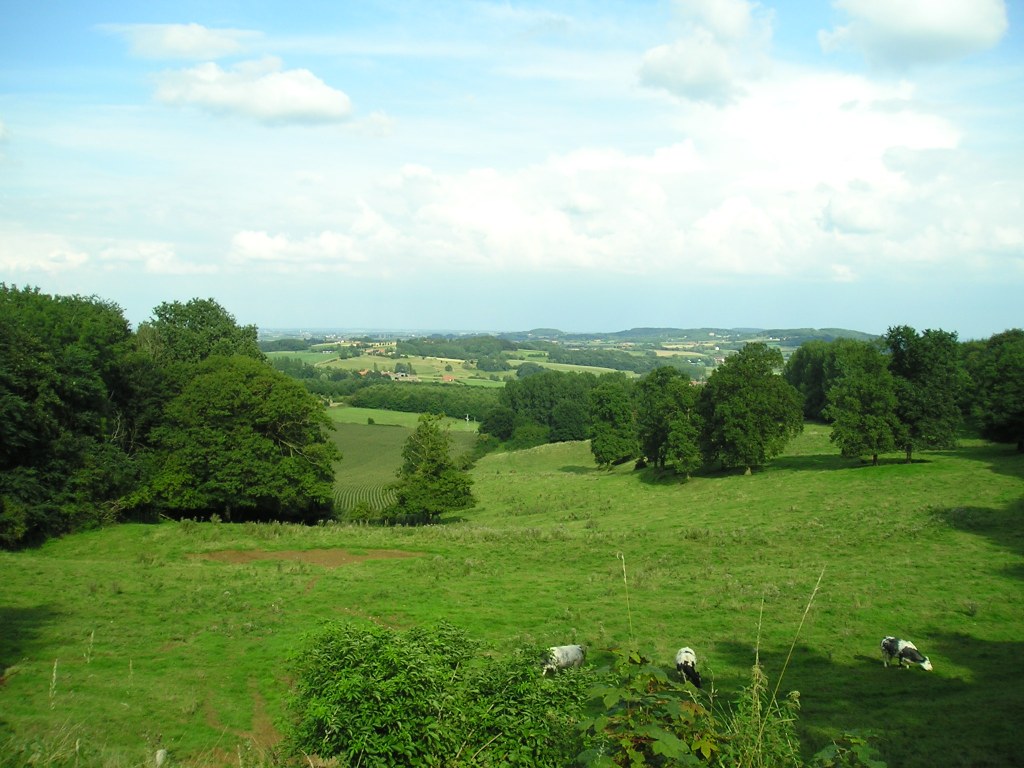
Photographer: André Leroux – Public Domain
On 8 April they arrived at Godewaersvelde in northern France, near the border with Belgium. It was in the ‘nursery sector’ which was quieter than further south and allowed the soldiers to become used to the different conditions of the war in France. It was still a place at war and dangerous.They were billeted north of the village of Strazeele on farms. The officers were lodged in the farmhouses but the ordinary soldiers had to make do with the farm buildings, often barns and stables. The response of one member of the 12th Battalion was ‘Do they think we’re a lot of blooming sheep?’2 From where they were located, they could hear the distant sound of artillery and see aeroplanes being fired upon by German anti-aircraft guns. On a positive note, they could go into the village and enjoy themselves ‘sampling “biere,” “vin rouge” and “cafe noir,” and making themselves generally popular with the “mademoiselles” in the various “estaminets” and shops.’3 So different from life at Gallipoli.
Training began with lectures on bayonet fighting, gas and the drill in the use of masks, as well as training in musketry. They then moved on to Sailly-sur-la-Lys, which was only three miles from the front line trenches, marching the eleven miles on a hard cobble road. Newton says that here
They made themselves known to the residents and became very popular, particularly with pretty Marie Louise, who served drinks at an estaminet in one of ‘A’ Company’s billets, as well as others matrons with their hard-working daughters, who catered for the soldiers by providing meals of fried eggs and chipped potatoes and omelettes.4
Training continued within individual platoons in the paddocks behind the company billets, much of the time under the cover of trees and hedges. They had to stop and remain still when enemy planes were heard overhead. The Battalion also supplied large working parties to dig trenches at night for Divisional Signallers to bury cables in.
They knew that they were soon to go into action when steel helmets were issued them on 18 May. They moved on to the Petillon Sector, in support of the 9th and 11th Battalions that were in the line. The weather was beautiful but the men had to remain in their billets during daylight hours because they were so close to the line that any movement could be seen by enemy observation balloons. Their work, done at night under direction of an engineer sapper, involved improving and repairing communication, support and front line trenches; constructing strong posts and laying duckboards; carrying mining timber, sandbags and other material from the trench tramway to the mine shaft for a tunnelling company.
On the night of 7 June, the 12th Battalion moved into the line to relieve the 11th. There were heavy bursts of artillery shelling and bombardment by both sides, nights when snipers were active, patrols by the enemy near to their line that were driven off by machine gun fire, aeroplane duels overhead. From the 23 June the 52nd Battalion relieved the 12th, a company at a time every second night because the 52nd had not been in the line before. Over the period in front line, 25 men were wounded. Earlier in the month, before they relieved the 11th, one man had been killed and five wounded as a result of heavy shelling on the ‘B’ Company billet. Nowhere was safe.
Courtesy Australian War Memorial
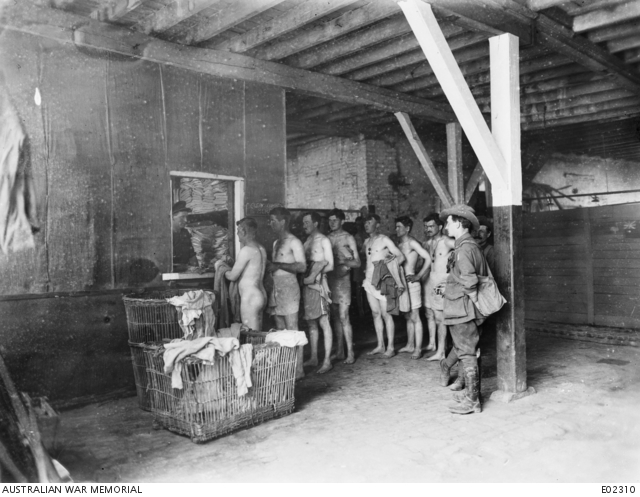
Back at Sailly-sur-la-Lys, the men had the opportunity to bathe.
Next morning we were allotted the baths at Bac St. Maur. They were situated in an old civilian laundry and were about the best baths we ever experienced in France, with almost an unlimited amount of hot water, and last, but by no means least, the men were also issued with a good clean set of underclothing.5
At 8 p.m. on 2 July they marched from Sailly-sur-la-Lys to Outtersteene, about ten miles away. They stayed about a week. The weather was ‘delightful’ and ‘parade hours were conveniently short and the work generally consisted of route marches of three to five miles.’ They moved southward bit by bit: Fontaine Houcke, Metren, Godewaersvelde, Doullens, Halloy les Pernois. They had not been told but they knew where they were headed because the ‘Big Push’ on the Somme had started at the beginning of the month. The following day they marched in the heat along dusty roads to Naours where they stayed for four days and
during that time carried out short route marches and company training in very inconvenient paddocks. We also received instruction in the new means of attacking by ‘waves,’ and the principles involved in village fighting (although there was nothing left of the villages when we did actually get there).6
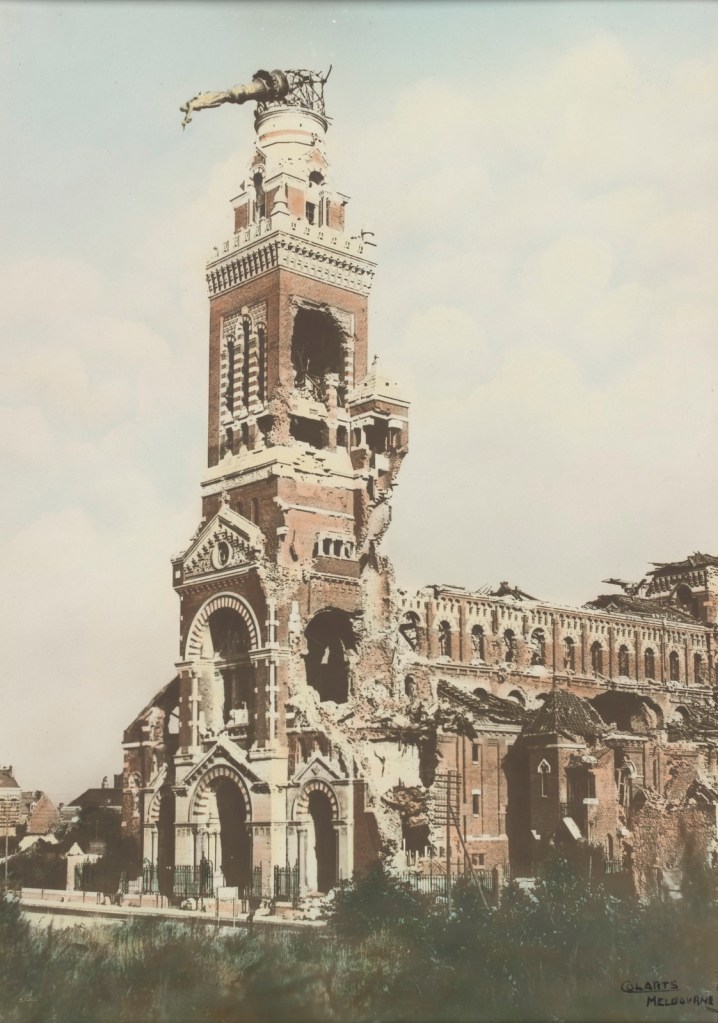
The golden statue is of the Blessed Virgin hold the child Jesus aloft.
Courtesy State Library Victoria
They left Naours and on 19 July reached Albert, a city that had been heavily shelled. As they marched through the city, they passed the damaged cathedral with its precariously leaning a statue of the Madonna and Child. It had been hit early in the war and leant precariously downwards from its base; however, the base had been secured in position by French Engineers.7
The Battalion was billeted in houses along the Bapaume road and was subject to shelling. Despite taking shelter in the cellars overnight, three men were hit by shellfire.8 The next day they left Albert for the reserve trenches; overnight two Lewis gunners had been injured in their billets.
On the 22nd, a ‘fine day’ weather-wise according to the War Diary, they received orders to attack Pozières.
Stretcher-bearer
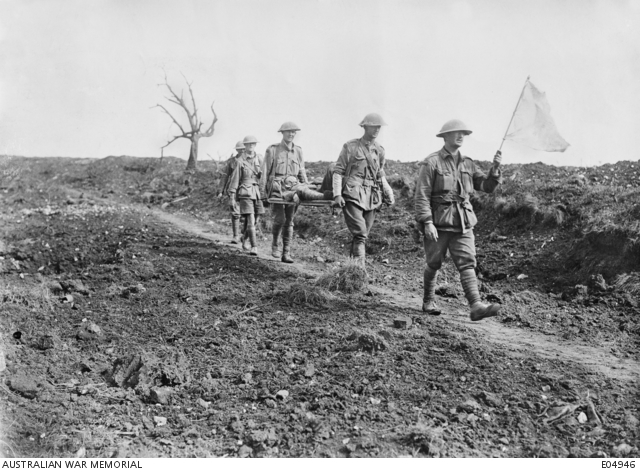
Albert Reader was a battalion stretcher-bearer at Pozières. These men were chosen from among the men of the battalion, usually sixteen for each battalion, and were trained by the Regimental Medical Officer. They wore a brassard with ‘SB’ on it, unlike the stretcher-bearers from the Field Ambulance who had a red cross on theirs. They treated the wounded where they fell providing initial first aid—dressing wounds, applying torniquets and splints, offering the most basic pain relief—and took them as quickly as possible to the Regimental Aid Post, usually located about 700 yards (640m) from the front. Once at the Regimental Aid post, treatment of the wounded was taken over by the Field Ambulance.
Photographer: Ernest Brooks
Courtesy Australian War Memorial
The journey back to the Regimental Aid Post was dangerous, as they worked unarmed. Some raised a white handkerchief or flag on a stick when carrying the wounded but when used, it was only effective against sniper fire, not artillery or shrapnel.9 The bravery of the stretcher bearers was commented on by a machine-gunner who survived Pozières.
‘The Stretcher-Bearers are I think the bravest crowd of the lot. I’ve seen men carrying wounded at a walking pace, through a heavy barrage of fire, through which one would think it would be impossible for any man to live, and return the same way and carry on again, as if it was part of an ordinary day’s work.’10
They went out under fire and returned under fire, repeatedly, working days without sleep. Their casualty rates were high.
Initially band members were trained as bearers but this had ceased by the middle of 1916, if not earlier, and men were chosen based on their mental and physical ability. They needed physical strength and endurance to carry heavy wounded men for long periods and distances over difficult ground. They also needed the ability to remain calm under fire amid the confronting sights, sounds and stench of battle and to bear with the agony of their patients. Many could keep their patients calm by use of their voice alone.11 Their actions made the difference between life and death. They offered hope in the depths of Hell.
Pozières
The village of Pozières, about four miles from Amiens, was on high open ground and strongly fortified by the Germans. Taking the village would open the way for further attacks intended to push the Germans back. The attack took place on 23 July. The plan was for the Australian 1st Division to attack in waves, preceded by an artillery barrage. The first line of infantry would creep as close as they could to German trenches before the attack, and once the trenches were taken the next wave would pass through them and take the second line of trenches, then a third would overtake the second and take the next.
The 12th Battalion took part in the attack on the village which was quickly gained but the Germans counter-attacked with concentrated artillery bombardment that reduced the village and its approaches to rubble. Lieutenant-Colonel Elliott, who wrote the Pozières section of The Story of the Twelfth, described the bombardment.
I do not remember any other so severe … The ground was very soft, and each shell sent a great cloud of dust into the air, often coloured red with brick dust. Whenever a shell burst in or near a trench, the latter would be obliterated for yards and the men of the Battalion had to work hard digging out unfortunate comrades who had been buried in the debris.12
It was ‘to the humble ‘Digger’ … the fact that his initiation to the horrors of heavy shell-fire was such a fierce and intense one (in my opinion the worst we ever suffered), as to sear the remembrance of it for ever on his mind.13
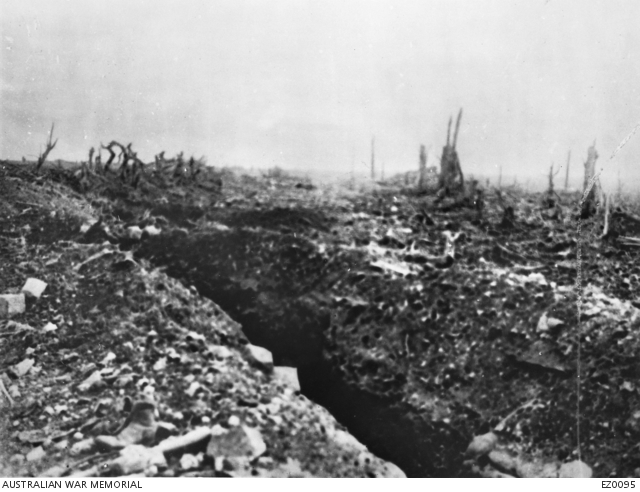
British Official Photographer
Courtesy Australian War Memorial.
The 12th battalion was relieved by the 19th on the night of 25 July and they and marched off to bivouac outside Albert. They had suffered 375 casualties: 3 officers killed, 4 wounded, 1 gassed and 2 were suffering from shellshock. 67 other ranks were killed in action, 235 wounded, and 35 were missing. 35 officers and men were recommended for honours and awards, including five stretcher-bearers.
The stretcher-bearers, as in any engagement of any size, had a tremendous task in evacuating the wounded, and no class of men carried out their duties more conscientiously and with less thought of self, and as the lines of communication were continuously shelled they had one of the most dangerous, as well as the most strenuous, of tasks.14
Privates John O’Neill, Edward Harding, Wilfred Stone, Albert Arthur Reader, Victor James Chilcott were Mentioned in Despatches
For conspicuous gallantry and devotion to duty during operations 23/25 July 1916 at POZIERES. They were stretcher bearers during the whole of this period with great courage and coolness carried many wounded men across shellswept areas to dressing station.15
After withdrawing to Albert, the 12th Battalion marched by stages west to Berteaucourt arriving on 28 July and undertook intense training with musketry, and route marches in hot dry weather. Reinforcements joined them there and the Battalion was generally reorganised. They marched eastward on the 9th to Bonneville where they had a demonstration of how to attack under cover of smoke, and also how to keep contact with aeroplanes. By 16 August they were back at Albert and bivouaced on the Brickfields.
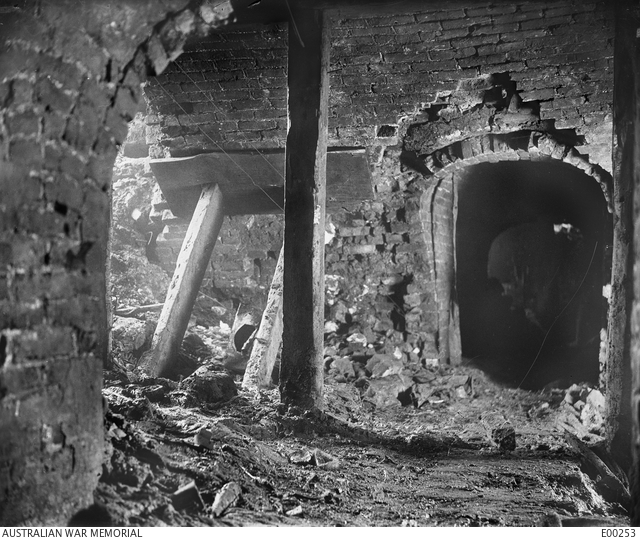
Photographer: Herbert Frederick Baldwin
Courtesy Australian War Memorial
In the four weeks the 12th had been away the heavy fighting had continued. Pozières and the high ground around held but the advance was halted at Mouquet Farm. On the 20 August the 12th Battalion moved up to the front line, overlooking Mouquet Farm. The next day they attacked the German trenches to increase their hold on the land in front of Mouquet Farm. The attack was made in daylight, following a barrage – the barrage moving forward as the 12th battalion troops advanced. ‘A’ & ‘D’ companies attacked in two waves and advanced to less than two hundred yards from the farm. More than twenty bombs were thrown into the cellars which the Germans still held. The next day was spent, under fire, consolidating their position and improving the new line and communication trenches.
The 12th was relieved by the 24th Battalion and went back to the Brickfields at Albert on the 23rd. Two officers had died of wounds and a further two were wounded; 45 men had been killed, 137 wounded and 41 were missing. All of the three AIF Divisions who had taken part went through two rotations during the seven weeks of the Pozières campaign. Their collective casualties totalled 23,000 with 6,800 of them killed or died of wounds – almost as many as the whole Gallipoli campaign.
To Ypres and Back
Eighty-four reinforcements were waiting the Brickfields and were taken on the strength. The 12th Battalion then went to Belgium where they were the Brigade reserve when the 3rd Brigade took over part of Ypres front line, opposite Hill 60.
The opposing trenches near the canal were much closer together than any we had hitherto experienced, so much so that orders had been given that no one was to speak above a whisper. On the left they widened out, and on our side ended in a morass where it was impossible to dig trenches, and a gap between us and the unit on our left had to be patrolled quarter-hourly every night. The front line trenches were very poorly constructed, and it was not felt that they could be held in the case of attack. In addition, the long, even slope made it ideal for an enemy gas attack (this being the locality where gas had first been used by the Huns), so that all ranks had to wear their masks ‘at the alert’ … In these circumstances, all ranks ‘had the wind up,’ well and truly … The whole tour of duty was very quiet as regards the artillery, though snipers were very active.16
They were relieved on 9 October and made their way from Ypres by train and route march ‘in delightful weather, and through very interesting country’ to Nordasques, 12 miles from Calais. At Nordasques, on 19 October, votes were cast for the 1916 conscription plebiscite. The AIF was a volunteer army and the numbers of new enlistments were falling. The Australian government only had the power to conscript men for service within Australia so, with public support, the Prime Minister hoped to push through Parliament the legislation necessary to force the ‘cold-footers’ to do their ‘duty’. According to Newton, the majority of men seemed to be opposed to the idea, mainly because they did not want younger brothers sent. Others did not want to fight alongside conscripts.17 The plebiscite failed by a narrow margin.
Winter
The winter of 1916/17 was abnormally cold with icy wind, snow and ice, and rain which turned the churned up ground of the Western Front to thick stinking mud. In November 1916, although winter was officially still a month away, the rain and the mud made it almost as good as the real thing.
The 12th battalion arrived at Fricourt, an open windswept area, about three miles west of Albert, on 24 October.
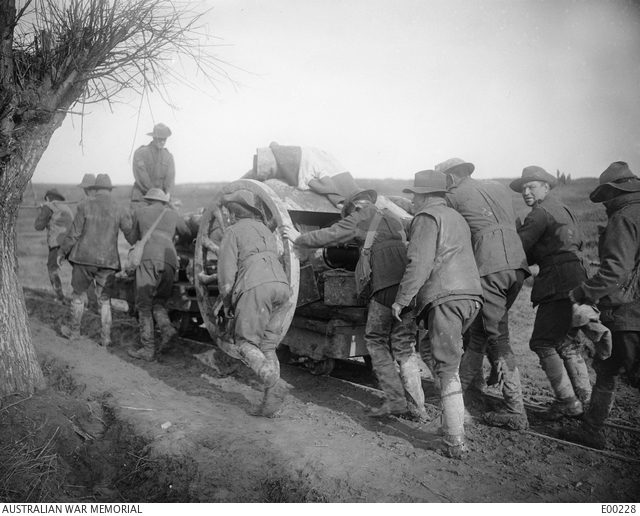
During the next few weeks rain fell repeatedly, rendering the conditions of living most deplorable, and effectually holding up the Allied offensive. The traffic on the roads was very heavy and congested, and the Battalion was employed chiefly on road repair work during the week’s stay at Fricourt. Large pits would be dug by the road-side, the earth being thrown well back, and then the mud and slush on the roads would be swept into the pits.18
Six days later, marching through congested military traffic, they arrived at Bernafay Wood, four miles away. Here it was worse than Fricourt. The area was a mess of half-obliterated trenches and water-filled shell holes. The men excavated possies and dug-outs in the slopes of the hill and covered them with their waterproof sheets. Rain made its way in down the sides of the sheets and the bottom of the dug-outs turned to slimy mud. Sometimes the dugouts fell in at night. As at Fricourt, many of the men were part of large working parties, out in the wet and cold all day, constructing and repairing roads. To make matters worse, they were not receiving regular consignments of socks from the Australian Comforts Funds so many men were wet-footed for up to ten days.
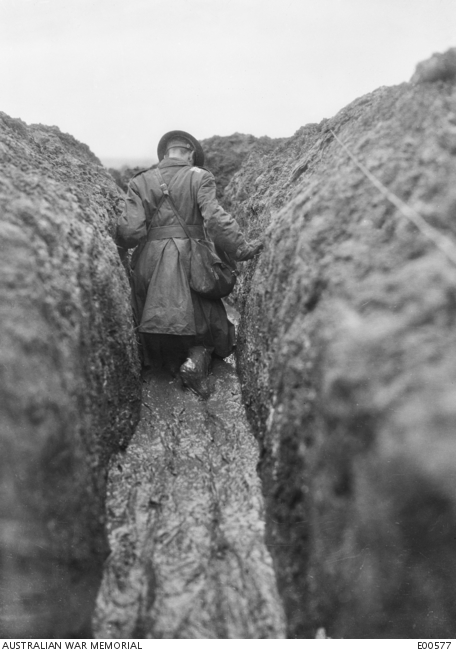
Courtesy Australian War Memorial.
Their trenches, in front of Gueudecourt, ‘were half full of a thick, viscous mud, which made traffic almost an impossibility. There was literally nowhere for the men to sit down, and many of them spent the whole twenty-four hours in a standing position with this wet, cold and clammy mud up to, and in some cases over, their knees.’19
When they were relieved, they tramped through Delville Wood to get back to their bivouac at Bernafay Wood.
Just as we were emerging from Delville Wood, we saw, on the left of the track, a newly erected shanty with ‘Australian Comforts Fund’ painted on a linen sheet. It was surrounded by Diggers who had removed their saturated equipment, while the fellows in charge were dispensing steaming hot cocoa in old jam tins, with the lids bent back as handles … This Comforts Fund stall remained in Delville Wood, under shell fire, during the whole of the winter, and supplied a hot drink to every man who passed through the Wood (either way) during the long nights; probably more than a thousand cups were provided nightly. The value of this stall to the Diggers throughout the 1916 winter cannot be over-estimated.20
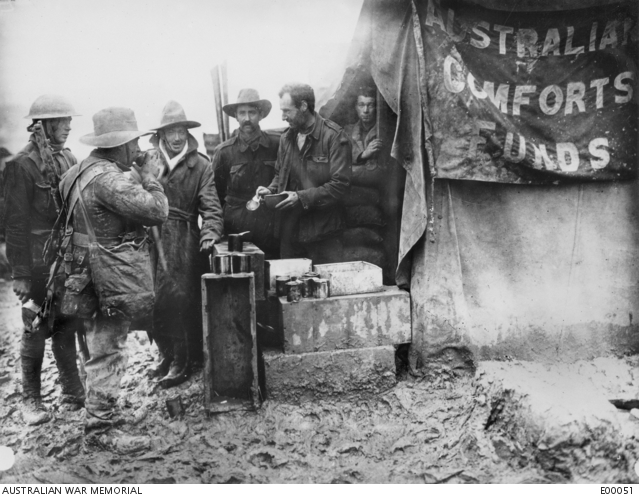
Courtesy Australian War Memorial.
In the middle of the month they moved to Rainneville, and the men were given leave to Amiens, a percentage each day. There they took the opportunity to have ‘a haircut, shave and bath, after which a search was made for a suitable restaurant in which to enjoy a meal of anything which varied the monotony of army rations.’21
By 5 December they were in the trenches near the village of Fleurs. The weather was very wet and in places the trenches were almost impassable with mud coming up to above the knees. This time, casualties were few, so the regimental medical officer attempted to keep the men as fit as possible. His dug-out developed into a small hospital, where men were kept for twenty hours or more off duty and given the few medical comforts at his disposal. He also made hot cocoa and milk for every man in the front line throughout the night. They were permitted to come in pairs for fifteen minutes each.
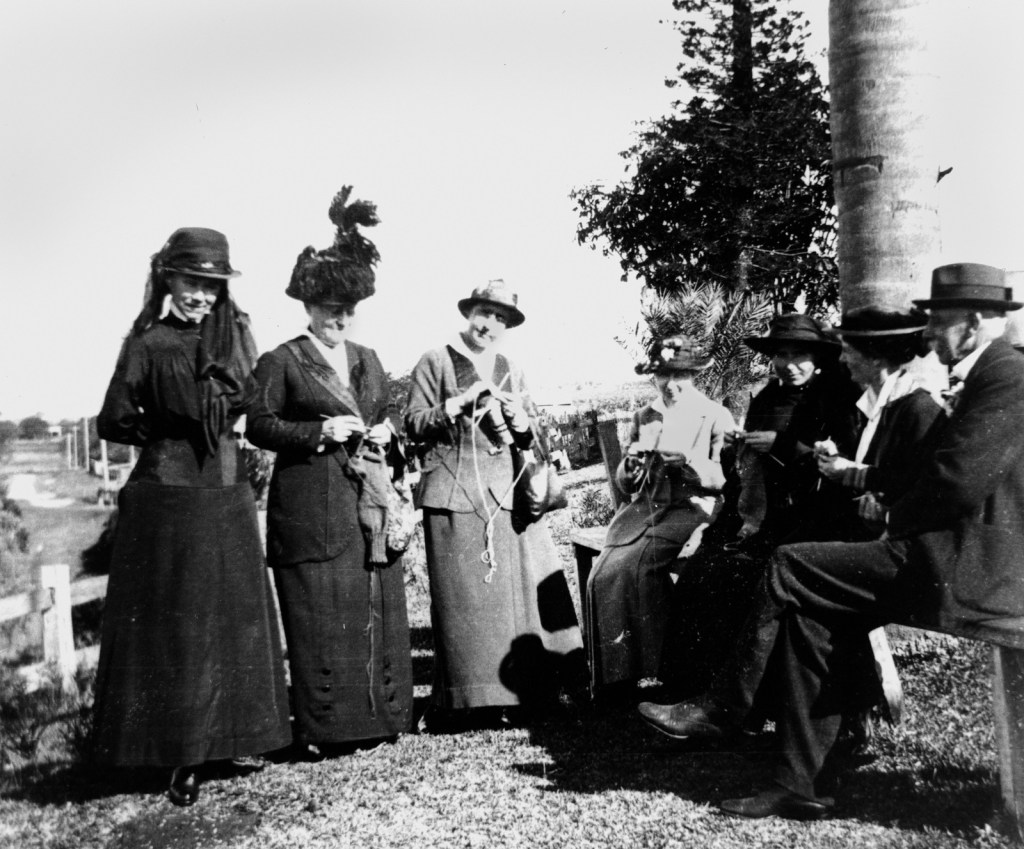
Women from the Campbell family knitting on an excursion to Redland Bay, 1916
Courtesy State Library of Queensland.
The stretcher-bearers also inspected the men in the front line daily, to see that no one was wearing puttees as they inhibited circulation and to check men’s feet for symptoms of trench foot. The men were to rub their own feet each day with a special white talcum powder instead of the usual whale oil.22 Trench foot was a serious problem caused by standing for days in the freezing wet, the the problem was due more to the wet than the cold. Tight boots and standing still contributed to the problem. The symptoms included painful swelling of the feet, blisters, sores and, at its worst, gangrene. Warm dry socks were essential and this is the reason why the 1.3 million socks knitted by the women, children, and even men, for the Australian troops overseas were so critical.
When they were relieved, between the 9 and 12 December,
The men were extremely tired and required a lot of urging to complete the long march, many of them wanting to sleep on the wet roadside, but those of the officers and N.C.O.’s who were not too heavily laden themselves carried the rifles and packs of the worst cases, and by coaxing some and ordering others, the remnants finally arrived at the camp just after midnight.23
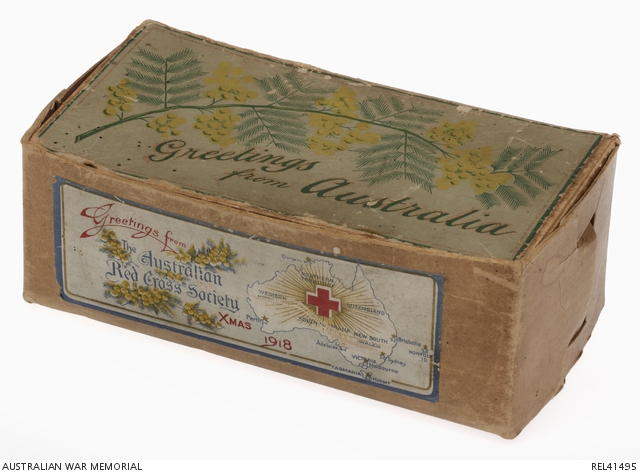
There was little to mark Christmas 1916, working parties went out the same. But Christmas pudding was added to their rations and regimental funds were used to buy tinned fruit and cake. And this year, although they were in the form of parcels, the Christmas ‘billies’ were greatly appreciated.24
Newton says that the Regimental Medical Officer was concerned not only about the physical health but the the melancholia the battalion seemed to be suffering: men were apathetic when carrying out their duties, they never sang or played the practical jokes they once did. Newton observed that
The Somme winter, with its mud, wet, and depressing atmosphere, had the Battalion in its grip … The morale of the 12th Battalion was never so low as during the month of December, 1916.25
1917
Through winter life carried on as before through periods of severe weather and heavy snow. There were large sick parades of men with minor ailments; constant movement from billet to billet; periods in and out of the trenches; digging, repairing and improving trenches and dugouts; fatigues and patrols. Training and instruction often took place in their huts because of the weather—musketry and bayonet fighting, bombing, skirmishing, signalling, passing messages, judging distances; and when they could, drills and route marches. There were periods of rest in rear areas; sport and concerts and even leave. As well, parties were detailed for road repair work.
On 11 Feb they relieved the 4th Battalion in the Eaucourt L’Abbaye sector and spent eight days in the line, a rapid thaw setting in halfway through. A week later, they relieved the 10th Battalion and were involved in a successful dawn attack on Ligny and Barque, about five miles north west of Pozières, on the 27th. They were relieved late that night. During the short period they had been in the line the Battalion, as well as capturing three villages, had advanced the line 2,000 yards, but at the cost of 8 officers wounded, 16 other ranks killed and 48 wounded.
Courtesy Australian War Memorial
They moved on to Dernancourt on March 1 where they stayed for three weeks and underwent more training and regular parades and the men got to have good baths and clean clothing. And, although the weather was still wet and cold, and the snow still fell, Lieutenant Newton says,
The recent release from trench warfare seemed to put new life into the men and all signs of the winter melancholia passed away, and they carried out their drill and training with a keenness which had not been seen for some months.26
On 10 March, Albert Reader reported sick and was sent to the 3rd Australia Field Ambulance hospital, diagnosed with a gastric ulcer. While we now know that gastric ulcer is caused by Helicobacter pylori, it’s possible that stress and diet may have aggravated the symptoms for some time. Albert may have had the symptoms for quite some time. Treatment at the time included bed rest, antacids and a bland diet taken in small frequent meals. Albert was a week at the hospital and rejoined his unit on 19 March.
The battalion marched to Baizieux on 23 March and training continued in musketry, bayonet fighting, bombing and use of the Lewis gun, in the countryside surrounding the village. The next day a practice attack was carried out by the whole Brigade. The 12th Battalion were ‘only used as supports and spent most of the time under cover of a high bank, enjoying the spring sun, which was shining all the morning.’
The Battalion held a sports meeting on the 31st and, as well as ‘the usual athletic events, for the first time we had competitions of a military nature, such as bomb throwing, bayonet fighting and Lewis gun drill.’27
Boursies
In February/March 1917, the Germans withdrew to the newly fortified Hindenburg Line to consolidate their position. The 1st Australian Infantry Brigade planned to make as surprise attack on the village of Hermies—held by the Germans and close to the Line—on 9 April. This would assist the Allies advance towards Bullecourt. As a diversion from the main attack, the 12th Battalion was to capture the village of Boursies. The attack was to be carried out without artillery support, but with assistance from the 10th Battalion to protect their left flank from machine-gun fire.
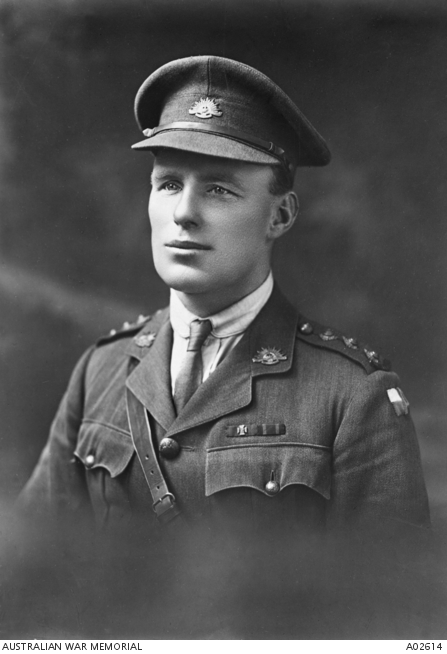
At 4 a.m. on 8 April ‘A’ Company led by Captain J. E. Newland advanced over the bank of the sunken road near Louverval and organised into two waves. A platoon from ‘B’ Company opened fire with Lewis guns to draw the enemy’s fire away and a bombing section from ‘A’ Company attempted to dislodging the enemy from a ruined mill, a short distance from the village. The first wave was able to cover a considerable distance before the Germans were alerted and opened fire with heavy rifle and machine-gun fire. The second wave followed and forced the Germans to retire. Posts were quickly established in Boursies although they had not advanced as far as intended because of intense enemy machine-gun fire. The front line was subjected to considerable shelling during the day but, after midday, it eased off until dusk. At 10 p.m, the Germans delivered a hurricane bombardment concentrating on the ruins of the old mill, followed by a counter-attack using bombs that drove back most of the battalion to the sunken road from where the attack had started.
AWM A02614
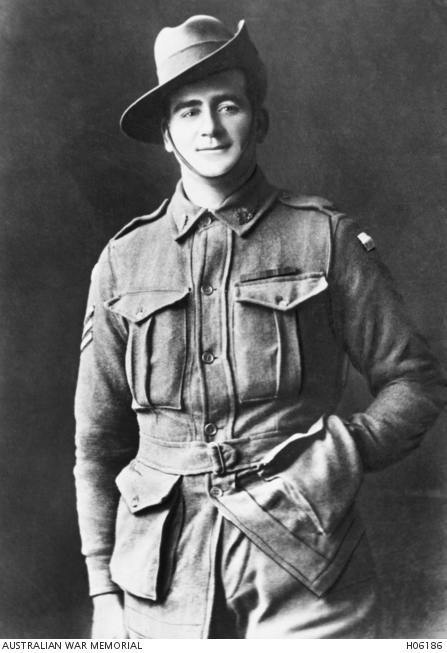
AWMH06186
Captain Newland sent for reinforcements and ‘appeared to be at every point of the line at almost the same moment, leading men here, urging men there, arranging for ammunition, directing reinforcements to weak spots in the line and, above all, instilling confidence into all ranks by his tenacity and utter disregard of his own personal safety.’ Sergeant Jack Whittle and reinforcements, charged the Germans and regained the lost ground. A platoon from ‘B’ Company broke the German attack with rapid fire and the Germans retired ‘in great haste and disorder.’ The platoon captured the German trench and a machine-gun. The rest of the battalion gained two German trenches and captured two machine-guns which were then used to fire on the retreating enemy. By dawn Boursies had been re-occupied by the Australians.
During all this the stretcher-bearers worked unceasingly under constant machine gun and shellfire, bringing the wounded to the regimental Aid Post in rear of Louverval Chateau which was also under continuous shellfire. On the night of 10 April, the Battalion was relieved by the 11th and the 1st battalions. Newton says that this engagement allowed them to ‘wrest the last village in the Somme Cantonment from the hands of the enemy.’28
Casualties for the four days of fighting were 2 officers killed and 5 wounded; 5 sergeants killed, 9 wounded and one missing; and 55 other ranks killed, 170 wounded and 9 missing. Nearly half the casualties were men from ‘A’ Company.
Lagnicourt
Now close to the Hindenberg Line, the British launched a major offensive around Arras leaving their line stretched and vulnerable elsewhere.
After a rest of four days, on the evening of 14 April, all four companies of the 12th Battalion moved into the front line at Lagnicourt to relieved the 9th Battalion. The night was particularly dark with little artillery and rifle fire, and no flares. At around 4 a.m. the enemy, outnumbering the front line ten to one, attacked swiftly and overwhelmed the front line, taking the village of Lagnicourt. ‘A’ Company under Captain Newland was attacked on three sides so he withdrew his line to the sunken road south of Lagnicourt. The men lined the bank, fighting back to back. The Germans then attempted to mount a gun in a position along the road, which would have allowed them to rake the entire company with gunfire. Before they could get the gun into action, Sergeant Whittle rushed out, alone, through extremely heavy fire and attacked them with bombs, killing the whole crew, and brought the gun back to the Australian lines.
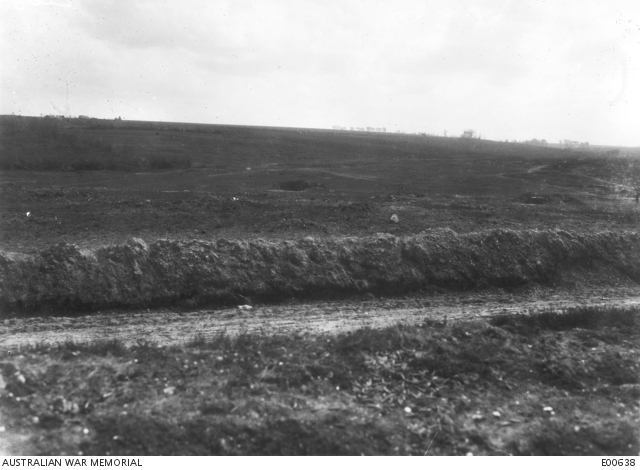
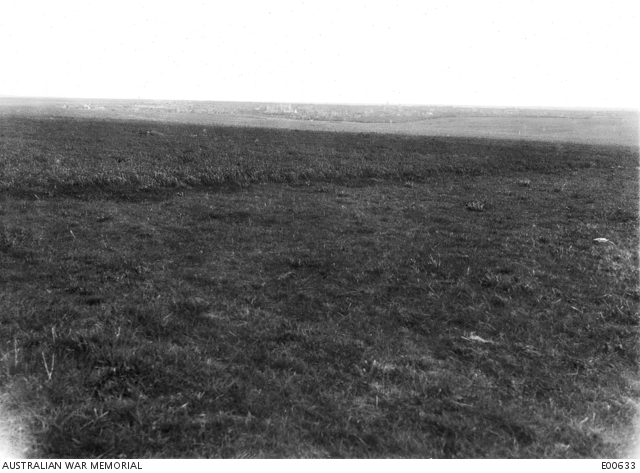
Views of Lagnicourt 1917
Meantime the whole of Battalion headquarters, grabbed their rifles and lined the high bank facing Lagnicourt. As dawn broke ‘in the half light a thick, black line of advancing Huns could be seen on the left of Lagnicourt and about halfway between us and the village.’29 Lieutenant-Colonel Elliott had sent urgent messages for the 9th Battalion to reinforce ‘A’ Company, and ordered Lieutenant Jack Webster to take ‘a handful of pioneers, stretcher-bearers and intelligence men, and occupy a position on the right of the road, to protect that flank if the enemy advance continued.’30 Webster misunderstood and advanced into Lagnicourt. The arrival of the 9th Battalion in an artillery formation stopped the Germans and a counterattack was launched from the sunken road by the 9th and 12th Battalion men. The Germans wavered and began to retreat, many of their men surrendering; others were shot as they retreated. The 12th Battalion once more occupied the whole of the line. The situation was reported as normal at 11 a.m. except for some shelling by the Germans. At 11.30 Lieutenant-Colonel Elliott was wounded in the head by a shell splinter.31
The Germans had intended to disable the twenty-one guns of the 2nd Australian Field Artillery in Lagnicourt but had only managed to wreck five. They had spent much of the two hours they held the village foraging for food and souvenirs.32
Aftermath
The 12th battalion was relieved by the 7th and 8th Battalions by 2.15 am on the 17th and returned to their billets at Fremicourt. Four officers had been wounded, and of the other ranks 29 had been killed, 55 wounded and 37 were missing. Captain Newland and Sergeant Whittle were awarded the Victoria Cross for their actions at Boursies and Lagnicourt.
On 20 April, 1917 Albert Reader was reported as wounded in action on 14 April. Four days later the 12th Battalion moved to Beugny-Ytres, about five miles south of Fremicourt.
At the end of the month Albert and two other stretcher-bearers were among the thirteen soldiers recommended for the Military Medal for their actions at Boursies. This was awarded on 8 May 1917.
Private Albert READER. Private Albert LONG. Private David McFARLANE.
At BOURSIES, during operations 8/10 April 1917, Privates READER, LONG and McFARLANE worked unceasingly for three days and nights in constant fire from M.G. [Machine Gun] and shell fire. They rescued several badly wounded cases from exposed positions swept by M.G. fire and the course to the R.A.P. was through a very bad barrage zone. R.M.O. remarked on the efficiency of their dressings under stressing circumstances.33
Notification was sent to Albert’s brother Charles on 3 May that he had been wounded. It was the standard pre-printed form with particulars typed in and no real information. Albert’s name appeared in the 297th Casualty List published on Tuesday, 15 May 1917.
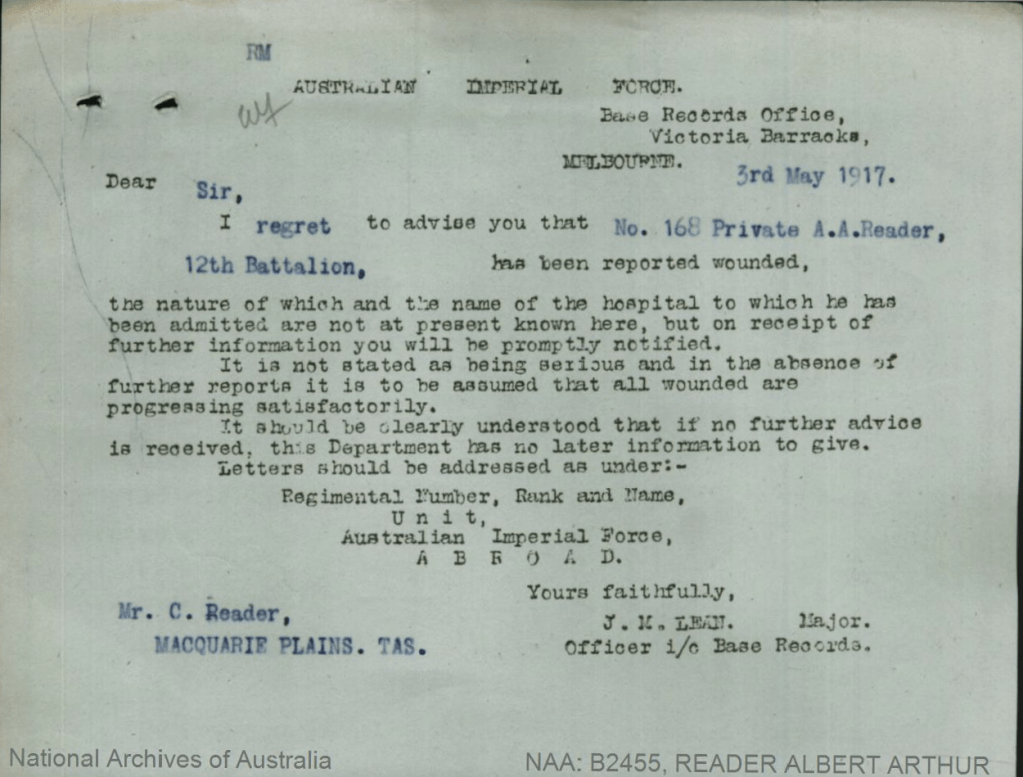
On 25 May it was determined that Albert had been killed in action on 15 Apr 1917 near Lagnicourt. Charles was sent notification of this on 9 June and Albert’s name appeared on 25 June in the 314th Casualty List.
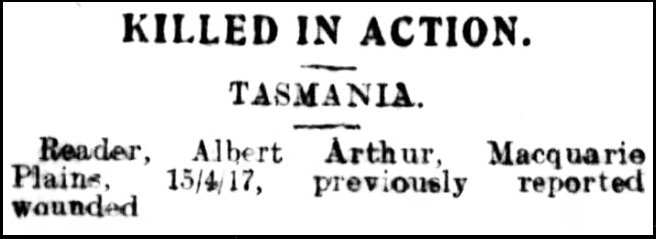
As Albert had been initially reported missing and there was some question about where he was buried, the Australian Red Cross Wounded and Missing Enquiry Bureau investigated. They checked whether he was a Prisoner of War in Germany, which he was not. They took two statements from soldiers in late November 1917. Private W Graham (6279) of the 12th Battalion, A Company, said,
Albert was his christian name. He was a S./B. [Stretcher-bearer]. I did not know him personally. Pte. James of A Co. (now undergoing a sentence of 12 months) told me he saw Reader shot in the stomach on Easter Sunday morning at Boursies, while stretcher bearing. They had to leave him. S/B McIntyre of A Co. (now with the battn.) would know more particulars. He was stretcher bearing with Reader at the same time.34
The information here is hearsay, and is not reliable. It has some discrepancies such the fact that Easter Sunday was 8 April that year and it implies that Albert was killed at Boursies.
Corporal Roy Bradshaw (195) of the 53rd Battalion stated
Reader was killed about that date [15 April 1917] at Bullecourt. I did not see it but was told by Pte Burrows of 12th now gone to Australia that he, Burrows, was wounded by the same shell. I heard nothing about his burial.
This is still hearsay so not conclusive.35
Finally, on 18 January 1918, they interviewed Corporal Frank Manser (163) of the 12th Battalion, A Company, at Etaples.
Reader and I came over from Australia together in 1914 and out to France together. He was a S/B in my platoon (A Co. II Pl.) He came from Tasmania. He was very short, dark complexion, ginger hair and moustache and we had been together in the Gallipoli campaign. We attacked the German line at Lagnicourt, near Bullecourt, at daybreak on Easter Monday, 15th April. On the way up, Reader, who was about 10 yards away from me, fell over. I went to him and found he was dead. He had been hit in the left side by a piece of shell and killed instantaneously. On reaching our objective a burying party was sent back and Reader was buried alongside a sunken road, near by. I do not know if a cross was put up as we had to carry on and I did not see his grave. Reader had been recommended for the M.M.36
This is a first-hand statement of a soldier who was present, although there is a minor discrepancy in naming the Monday as Easter Monday but coming so soon after Boursies, time could run memories together.
We Will Remember Them
iStock
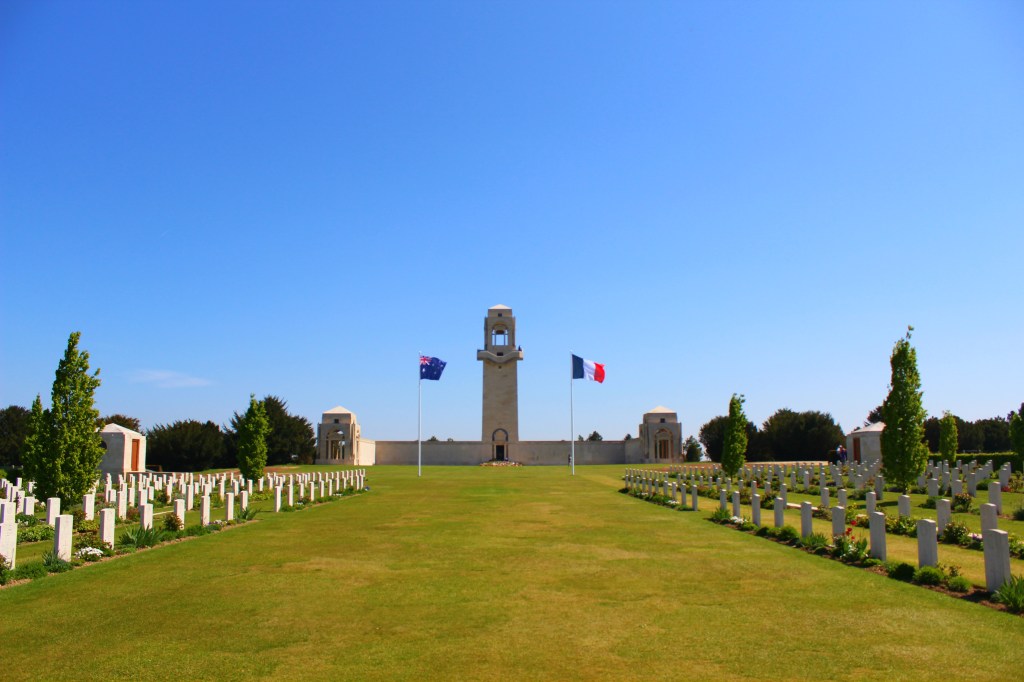
We do not know where Albert is buried but he is commemorated on the Australian National Memorial at Villers-Bretonneux. The memorial bears the names more than 10,000 Australians who died on the battlefields of the Somme and have no known grave. Also, his name is on Panel 67 of the Australian War Memorial’s Honour Roll.
In Hobart, in the Queens Domain, the Soldiers Walk is an avenue of 520 trees planted in 1918 and 1919 to commemorate soldiers, mainly from Hobart, who died during the Great War. The trees planted were Himalayan cedar, Atlas and Blue Atlas cedars but many of the trees have struggled or died over the years and have been replaced, since 2008 with Lebanese cedars.
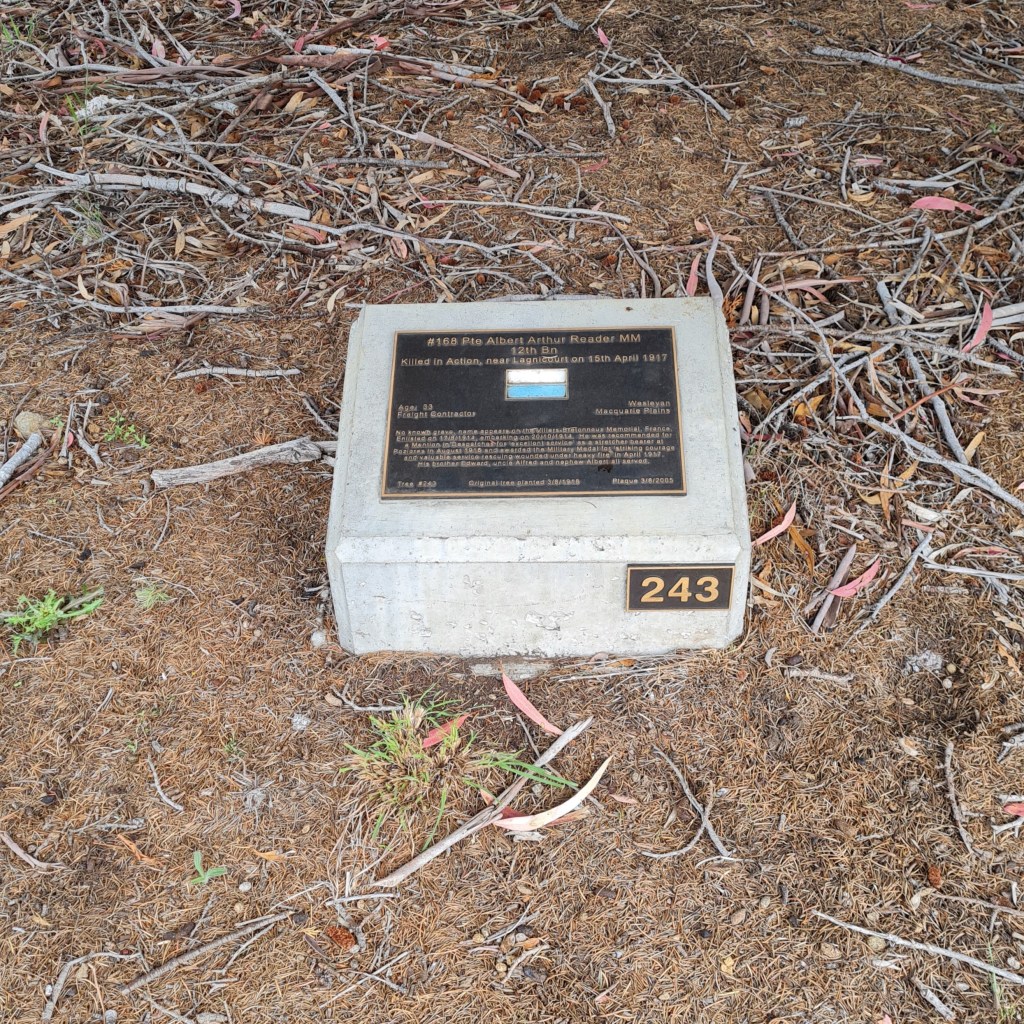
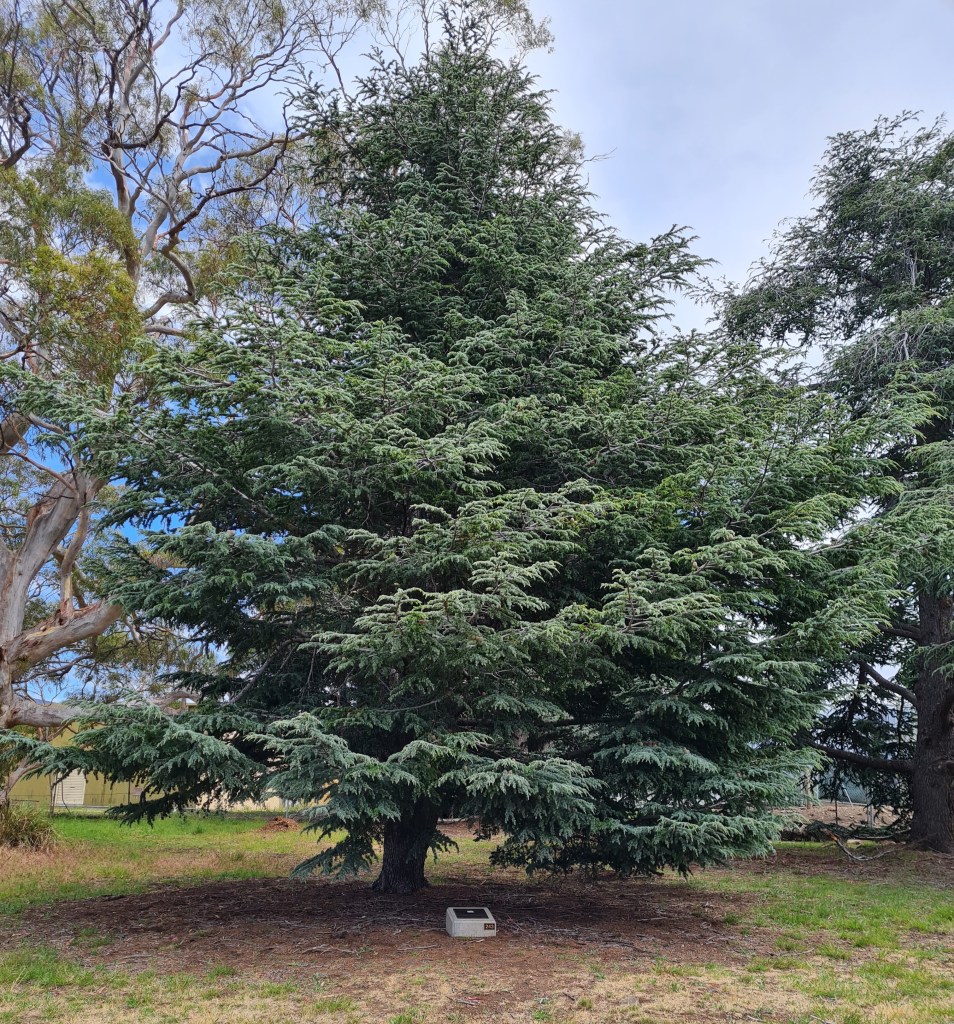
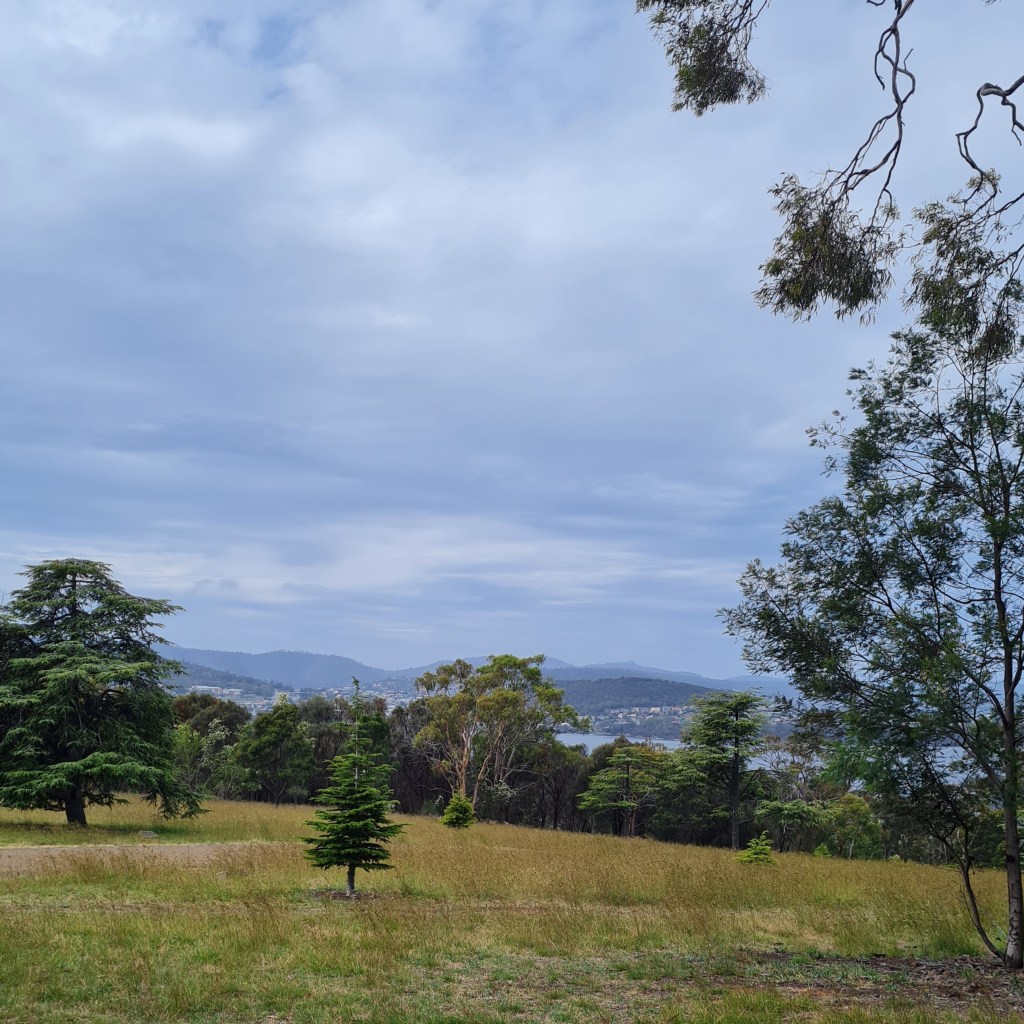
Albert’s tree is Number 243, well up the hill, towards the Powder Magazine. Standing in front of it you can glimpse the Derwent River which makes its way down from Lake St Clair and winds past Macquarie Plains and through New Norfolk and out past Hobart into the bay.
Albert Reader was an ordinary man who would have had the modest dreams of ordinary men of his time—a wife, a family, regular work that paid enough for them to live with a degree of comfort—dreams that were never realised. He, like most of his fellow soldiers, would have left in high spirits, with no understand of what he would face. Yet he faced the unimaginable, stood his ground and tirelessly served as a stretcher-bearer, bringing a glimmer of hope to those he went out, under fire, to bring to safety.
We must never forget these ordinary men and women who showed such extraordinary courage.
©Catherine Anne Merrick.
Unauthorized use and/or duplication of this material without express and written permission from this blog’s author and/or owner is strictly prohibited. Excerpts and links may be used, provided that full and clear credit is given to Catherine Anne Merrick and https://catherinemeyrick.com/ with appropriate and specific direction and links to the original content.
- Newton, L. M. The Story of the Twelfth. A Record of the 12th Battalion, A.I.F. during the Great War of 1914-1918. Hobart: 12th Battalion Association, 1925. p.166 ↩︎
- Newton p.170 ↩︎
- Newton p.171 ↩︎
- Newton p.173 ↩︎
- Newton p.204 ↩︎
- Newton p.209 ↩︎
- Many of the French believed that when the statue fell the war would end. It finally fell in March 1918—the Armistice was signed six months later ↩︎
- This number is from the Battalion War Diary. Newton says four men from ‘B’ Company. Where there are differences, I have used the numbers in the War Diary. ↩︎
- Johnston, Mark Stretcher bearer : saving Australians from Gallipoli to Kokoda CUP, 2015 p.89 ↩︎
- Johnston p.99 ↩︎
- Griffin, Kristina ‘Healer or Warrior: An Historical Account of the Role Duality of the Australian Army Medic in Warzones’
PhD Thesis. Charles Sturt University. 2021 pp.59-61 ↩︎ - Newton p.224 ↩︎
- Newton p.225 ↩︎
- Newton p.226 ↩︎
- Mention in Despatches AWM28 1/5 PART 3 – [Recommendation file for honours and awards, AIF, 1914-18 War] 1st Australian Division, 23 to 26.7.1916 Part 3]
John O’Neill (No.2267) – Enlisted 1 Jun 1916. Aged 26. Single. Labourer from Gippsland. Awarded Military Medal 24 Mar 1916. Died 25 Nov 1919 in England of Valvular Disease of the Heart.
Edward Harding (No.2845) – Enlisted 16 Aug 1915. Aged 38. Married. Storekeeper from Oatlands, Tas. 26 Jul 1916 admitted to hospital with Shellshock. Returned to Australia 9 Jun 1919. Died 1947.
Wilfred Stone (No.3089) – Enlisted 8 Jul 1915. Aged 23. Single. Miner from WA. Missing 6-10 Apr 1917. KIA 10 April 1917.
Victor Joshua Chilcott (No.2823)– Enlisted 10 Aug 1915. Aged 28. Single. Farmer from Ulverston, Tas. Died of Wounds 8 Oct 1917. ↩︎ - Newton p.241 ↩︎
- Newton p.243 ↩︎
- Newton p.244 ↩︎
- Newton p.251 ↩︎
- Newton p.255 ↩︎
- Newton p.257 ↩︎
- Newton pp.261-2 ↩︎
- Newton p.265 ↩︎
- Newton p.268 ↩︎
- Newton p.266-7 ↩︎
- Newton p.294 ↩︎
- Newton p.297 ↩︎
- Newton p.302 ↩︎
- Newton p.317 ↩︎
- Newton p.316 ↩︎
- Newton p.317. Lieutenant-Colonel Elliott was away from his battalion for over three weeks and spending time in the 14th General Hospital at Wimereux. His Casualty Form describes his injury as a Gun Shot Wound to the scalp. ↩︎
- Carlyon, Les The Great War MacMillan, 2006 p.366 ↩︎
- Military Medal AWM28 1/22 – [Recommendation file for honours and awards, AIF, 1914-18 War] 1st Australian Division, 8.4.1917 to 13.4.1917
Albert Long (2476) – Enlisted 4 July 1915. Aged 34. Single. Farmer from Evandale, Tas. September 1917. Returned to Australia 5 June 1919.
David McFarlane (2130) – Enlisted 8 March 1915. Aged 20. Single. Farmer from Melbourne. Killed in Action 1 May 1918. ↩︎ - Red Cross Wounded and Missing File 1DRL/0428 Courtesy Australian War Memorial p.4 ↩︎
- Red Cross File p.5 ↩︎
- Red Cross File -p.6 ↩︎


Great post and one that leaves you in awe. Day to day survival was sheer bravery.
LikeLiked by 1 person
It was. I still find it hard to comprehend. Absolutely nothing could have prepared them for what they faced.
And the nurses, too, were amazing women. The hospital in the town where I was born was run by two former World War 1 nurses. My mother credited them with saving her life after I was born, not the local doctors who had no idea.
LikeLike
That is an astonishing piece of work. So meticulously researched. It must have taken you ages – and I feel guilty for confessing that I have not read it all. I have visited the Western Front three times now – but not Gallipoli (yet). Ypres and the Somme are both humbling, but of course represent only a fraction of the war. It is certainly fitting to remember. The first vicar of the new church in our village in c1870 was Frederick Binyon, father of Laurence Binyon (1869 – 1943) who wrote ‘For the Fallen’. “We will remember them”
LikeLiked by 1 person
Thank you, Mike. The hardest part was trying to compress those massive battles into a few sentences – and to cut my first draft down from 50,000 words.
It is such an overwhelming topic and a war which changed all our countries. I’ve looked at so many photos of WW1 solders over the past few years and so many are young and fresh faced, so innocent looking, at the start they had no idea what they would be facing. We lost over 60,000 men in their prime out of a population of only 5 million, not to mention the wounded. And Britain lost whole villages of young men in the Pals Battalions. How did those at home ever come to terms with that?
Australians could not visit those cemeteries because of distance and cost but Mustafa Kemal’s statement in 1934 did something for those who lost men at Gallipoli. My father used to quote it.
‘Those heroes that shed their blood and lost their lives … You are now lying in the soil of a friendly country. Therefore rest in peace. There is no difference between the Johnnies and the Mehmets to us where they lie side by side here in this country of ours … You, the mothers who sent their sons from faraway countries, wipe away your tears; your sons are now lying in our bosom and are in peace. After having lost their lives on this land they have become our sons as well.’
LikeLiked by 1 person
In the ’80s I visited northern Cyprus. This was after the Turkish invasion. There were statues of Kemal Atatürk everywhere, UN troops in places and Turkish military camps that were no-go areas. One day, I got us lost and pulled into a army base by mistake. Within seconds, the car was surrounded by grim-faced armed soldiers. They didn’t speak English and I didn’t speak Turkish. A young officer arrived who could speak a bit of English and German; I could speak a little of the latter and we managed to communicate. Once he realised we were Brits, everyone became less threatening. The officer directed us back to the right road and we went on our way with smiles all round. I related this to a Turkish friend later and asked why the atmosphere had changed so much once they knew who we were. “It’s because of Gallipoli,” he explained. “Gallipoli?! But we invaded you?!” “Yes, but it was such a brave (he might have said ‘foolhardy’) thing to do. They respected that”.
LikeLiked by 1 person
That sounds very frightening.
By the end, I think both sides did have respect for each other. We have an Atatürk Memorial in Canberra, near the War Memorial. It recognizes both Turkish and Australian troops. It was unveiled in 1985 and I believe there is a similar one at Anzac Cove.
LikeLike
I don’t think we were in any real danger. In Nicosia, where the UN Green Line physically divides the Greek and Turkish Republics, friendly Turkish Troops encouraged us to visit what had been the ancient Cathedral of St Sophia, now a mosque.
LikeLiked by 1 person
A very poignant story and one that so many went through – you told it well. I was glad to have stumbled upon the Soldier’s Walk when we were in Hobart and read the snapshots of many who had perished in the war. It was a war that my many relatives who participated in, returned home at it’s end. They were lucky men.
LikeLiked by 1 person
Thank you, Graham. There are so many stories and I think it’s important we remember them.
Soldier’s Walk is a peaceful place but out of the way these days with that great road cutting it off. If you ever visit Tasmania again and are travelling around, the Gretna War Memorial is well worth a look. Gretna is about 50Km north of Hobart. The Memorial is a cross set on a hill overlooking the Derwent River – it is stunning.
There’s a picture here
https://www.abc.net.au/news/2015-04-22/11-unsung-war-memorials-to-see-in-tasmania-this-anzac-weekend/6401618
LikeLiked by 1 person
Thanks Catherine. Yes, the Gretna memorial has great presence, but the Legerwood memorials leave me astounded – maybe because I enjoy woodcarving myself.
These memorials in Tasmania seem to have a more human connection than the many we see in the UK. That was what struck us in Soldier’s Field in Hobart.
LikeLiked by 1 person